Tuesday, 26 July 2022

Peace of Heart According to St Benedict - Father Bernard Ducruet, OSB

Peace of Heart According to St Benedict
Father Bernard Ducruet, OSB
Giles Conacher, OSB (Translator)
ISBN 9781784697426
eISBN 9781784697037 
ASIN B09Z71MNN8
CTS Booklet PA66
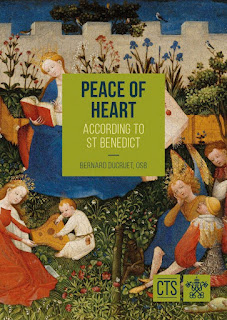

This is the second volume in this series to be released in translation by the Catholic Truth Society. The first to be released was Spiritual Combat: According to St Benedict, and it was an excellent read. At the end of that volume this one was announced. Unfortunately that was not the case this time. At the very end of both volumes to date we are informed that: 

“Fr Bernard Ducruet (1927-2020) entered the Benedictine Abbey of St-Benoît-sur-Loire as a monk in 1946. He was Abbot of the community and led it from 1971-1991, and died 4th April 2020. He was author of half a dozen other titles in this series.”

I am uncertain if all the books are being translated into English and released by the Catholic Truth Society, but based on these first two volumes I certainly hope so. But back to this book, it is an excellent volume. The booklet is listed at 48 pages and I highlighted 18 passages my first time through. The description of this book is:

“Learn to welcome peace beyond trials and to see it as a limitless gift from God, through teaching marked by the Spirit of St Benedict.

Trials quickly take Peace away from us. Does this mean peace of heart is impossible? No, for Jesus himself promised it to us. There is peace beyond our trials, but we do not receive it according to the way of the world. Fr Bernard Ducruet, through teaching marked by the Spirit of St Benedict, leads us to welcome the peace as a limitless gift of God and the fruit of struggle.”

The chapters in this volume are:

Peace of Heart: Translator’s Introduction
Introduction
Peace, Ahead of Trials
Peace, Beyond Trials
How to Live Through Trials
Conclusion

Some of the passages I highlighted during my reading of this volume were:

“But although peace is a gift of God, it is also a task for us. It is all very well to tell world leaders, warring parties, the grasping, envious, or discontented to embrace each other and embrace peace, but that doesn’t change much, unless they want to listen. “What’s wrong with the world?” asked G.K.Chesterton. He answered, “I am.” The only person I can really influence and convert is me.”

“So what we need to do is to establish unity in our hearts, peace; that is what this little book is about. Abbot Bernard lived into his late nineties, helping the monks of his community and very many others outside his community in their efforts to follow Christ, to make him the centre of their lives, so that nothing was dearer to them, so that he could calm their hearts as he calmed the wind and waves for his storm-tossed disciples.”

“But often you see the word “peace” at the centre of a Crown of Thorns – pax in spinis, peace among the thorns, for as Jesus says, his peace is not as the world gives it, where outwardly all is calm and harmony, but in the depths, struggle and division.”

“The preservation of charity and peace is a primary concern of St Benedict, and as Abbot Bernard will show, he is alert to every aspect of what needs attention in community life, from humble material matters, to the more complicated human relationships and, finally, to the mystical, directly involving God.”

“Peace is a battle. We are not to submit to the conditions of life in which we find ourselves, but to manage them, so that they become productive of peace. However, at the same time as we are active by trying to establish the conditions most favourable to peace around us, we must constantly accept that peace is a gift of God, which goes beyond all our efforts to bring it about.”

“From his Roman temperament and from his Sabine family background, from which came Rome’s best administrators, he drew this sense of order and organisation, of which peace is the first fruit. Echoing biblical wisdom, an ancient proverb says: ‘Peace is the tranquillity of order’ [St Augustine].”

“In the first part we will discover how peace is fostered by order established among the goods and activities of the community. Then we will see how peace also depends on order established in personal relationships, because charity itself must be ordered. Finally, at a deeper level, we will see how peace is the order established by each of us when we order our passions in our interior life.”

“Peace is the fruit of that order in which a hierarchy of values is established, everyone has their place, the passions are controlled and things themselves are respected. For a young person of our era, that risks looking like a pretty boring world, because people often prefer caprice to structure, spontaneity to order, a passionate life to calmness of soul… But for anyone who wishes to go forward into the adventure of man with God, it is necessary to affirm their nature, to pacify it and to set it in order.”

“In ancient monasteries they used to build store-rooms and libraries which looked like churches. St Benedict recommends that all objects be respected like the sacred vessels of the altar. For the truth is that every object has the same value – that of bringing the brethren into relationship with each other.”

“Things have to be run so as to render a service, to give to those who have greater need, to bring about communion between the brothers who manage and the brothers who use.”

“Thus the goal of the Rule is not the formation of an élite, pure and hard, or to encourage competition in virtue, but to give everyone what is needed for all to reach eternal life together.”

“A peaceful community is necessarily one progressing towards its goal, which is communion. SS John XXIII and Paul VI said that peace is the name for the development of the whole man and of the whole of mankind. Within our communities, progress in charity is the source of peace. But this progress meets difficulties caused by characters, personal failings, errors, sins… A peaceful community is not one in which holiness is obvious, already achieved, impeccable in its morality.”

“Forgiveness is the source of grace because it restores order. That is also why humble confession of sins to a priest and receiving absolution are likewise sources of grace.”

“The whole teaching of the Rule consists of leading us to discover the deep heart, and to become stable in it. That is where the hidden heart is, where delight, the “wish to love”, is found, the loving will that corresponds to grace.”

“So the whole Rule, in its various parts, is intended to teach us to pacify our heart and to dwell in its depths. The watchfulness of humility, obedience, attention to work, silence, the liturgy, all invite us to dwell in our hearts by going beyond the turbulences of feelings and senses. Having been given peace, we shall bring peace to others.”

“It is not possible to be faithful to the Gospel without being faced with this mystery of impossible peace. Wisdom and peace, then, are tried by the consequences of man’s sin. They have need of being redeemed by the Paschal mystery. Peace remains a battle which must face all the forces of evil.”

“Trials, whether of loneliness, absurdity or death, cause us to lose the peace of mind which we had so long sought and built up in our relationships with others, with things and in the pacification of our own hearts.”

“In our trials it is good for us to meditate on the Passion of the Lord. It is just when we offer him our crosses, by detaching ourselves from them, and when we take up his Cross, that we discover how much his Cross is carrying us, because it is life-giving and glorious, while ours crush us.”

This volume was a timely read for me. I am dealing with some trials in my family life, at work, and some unexpected trails because of long Covid. There was so much in this volume that was immediately applicable to the circumstances I find myself in. 

I hope those few samples quotes will inspire you to pick up this volume and give it a read. I know I will reread this book again and likely again many times over. I already plan to reread it before the next volume in the series releases. At least if they publish a third. Over the last few years I have read over 300 books and booklets from the Catholic Truth Society. With the reading of this booklet, 300 unique titles and over 400 reads. There have been many amazing biographies, prayer and devotional booklets, books on Catholic teachings and thought.  I have been so blessed by the books and booklets from the CTS and have recommended so many to others. This book is an amazing read in a new series and I strongly urge you to give it a read. So please pick up a physical copy or the eBook and give it a read, it will be life changing! I am certain it will. 

Note: This book is part of a series of reviews: 2022 Catholic Reading Plan! For other reviews of books from the Catholic Truth Society click here.

Books by Father Bernard Ducruet, OSB:


Monday, 25 July 2022

Way of the Cross at the National Shrine of the Divine Mercy - Marian Fathers of the Immaculate Conception

Way of the Cross at the National Shrine of the Divine Mercy
Fr. Kenneth Dos Santos, MIC (Introduction)
ISBN 9781596142688
eISBN 9781596142800
ASIN B00DSV01DE


This is a wonderful version of the Stations of the Cross. I absolutely love the sculptures by Timothy P. Schmalz, I have not seen these life sized stations in person but even the images in the book are very moving and powerful. I recognized his style from the cover of this volume immediately. His artwork is stunning; I even have a couple replicas on my desk. The description of this book is:

“This gem is the newly-revised, expanded Way of the Cross commemorating the Blessing of the life-size Stations of the Cross at the National Shrine of the Divine Mercy, home of Marian Press, in Stockbridge, Massachusetts. It contains St. Faustina's Way of the Cross (compiled from the Diary of St. Faustina and Scripture) and the Traditional Way of the Cross based on the version by St. Alphonsus Liguori. In addition, fourteen meditations - one for each Station written by Marian Priests and Seminarians, provide insightful reflections on Christ's Passion.”

Another description is:

“Containing St. Faustina's Way of the Cross and the Traditional Way of the Cross as well as fourteen meditations written by Marian Priests and Seminarians, this beautiful prayerbook is illustrated with images of the life-size Stations of the Cross at the National Shrine of The Divine Mercy!

This Way of the Cross booklet features the epic, life-size Stations of the Cross at the National Shrine of The Divine Mercy in Stockbridge, Mass. It contains "St. Faustina's Way of the Cross," compiled from the Diary of St. Faustina and Scripture, as well as the "Traditional Way of the Cross" based on text by St. Alphonsus Liguori. This special expanded edition also includes meditations on each Station written by Marian priests and seminarians, and a photo collage documenting the artistic process of world-renowned Christian sculptor Timothy P. Schmalz of Ontario, Canada, who made the Stations.”

The booklet was originally published in 2001, the eBook released in 2013 and now a new reprint is available as a physical volume. I have the eBook and love having them with me all the time. But no matter which edition you get this is a wonderful volume to have in your collection of prayer and devotional booklets. The book has the following elastically approvals. 

“Imprimi Potest:
Very Rev. Fr. Kazimierz Chwalek
Provincial Superior 
The Blessed Virgin Mary, Mother of Mercy Province
January 7, 2013
For text from the English Edition of Diary of St. Maria Faustina Kowalska:
Nihil Obstat:
George H. Pearce, SM
Former Archbishop of Suva, Fiji
Imprimatur:
Joseph F. Maguire
Bishop of Springfield, Mass.
April 9, 1984”

I love that this volume has the stations by both Saint Alphonsus Liguori, which is one of my favourites and also the way of Saint Faustina's Way. The final section is a series of reflections on the Stations. A sample of each station is:

THIRD STATION: 
Jesus Falls the First Time

C. We adore You, O Christ, and we bless You.
P. By Your holy Cross You have redeemed the world.

C. We had all gone astray like sheep, each following his own way; But the Lord laid upon Him the guilt of us all (Isaiah 53:6, 12).

Jesus: (C.) Involuntary offenses of souls do not hinder My love for them or prevent Me from uniting Myself with them. But voluntary offenses, even the smallest, obstruct My graces, and I cannot lavish My gifts on such souls (1641).

S. Faustina: (P.) My Jesus, despite Your graces, I see and feel all my misery. … O my Jesus, how prone I am to evil, and this forces me to be constantly vigilant. But I do not lose heart. I trust God’s grace, which abounds in the worst misery (606).

All: Merciful Lord, preserve me from every, even the tiniest but voluntary and conscious infidelity.

C. You, who suffered wounds for us,
P. Christ Jesus, have mercy on us.

Sung Verse: 
Is there one who would not weep,
Whelmed in miseries so deep
Christ’s dear Mother to behold?”

And

THIRD STATION:
Jesus Falls the First Time

Celebrant: We adore You, O Christ, and we bless You.
People: By Your holy Cross You have redeemed the world.

Meditation: Laboring under the weight of the Cross, Jesus slowly sets forth on the way to Calvary. His agony in the garden has exhausted His Body; He is sore with blows and wounds; His strength fails Him; He falls to the ground under the Cross.
Prayer: It was for my sins, my Jesus, that You bore the heavy burden of Your Cross and fell under its weight. Let my remembrance of these sufferings make me careful, lest I fall into mortal sin.

Celebrant: You, who suffered wounds for us,
People: Christ Jesus, have mercy on us.”

This is an excellent little volume, and one I will use time and time again. I highly recommend this booklet to you.

Note: This book is part of a series of reviews: 2022 Catholic Reading Plan

For all other reviews of Stations of the Cross click here.


Sunday, 24 July 2022

Ignatius Spencer - Father Ben Lodge CP - CTS Saints of the Isles

Ignatius Spencer
CTS Saints of the Isles
Father Ben Lodge C.P. 
Catholic Truth Society
ISBN 9781860823312
CTS Booklet B681


The CTS Saints of the Isles Series is one of my favourite series. I have tracked down what I believe to be all the books in the series, and this is my second last to read and review. Each of the books in the series is a biography. Most, like this one, are biographies of specific individuals.  Also most in the series are biographies of martyrs, but not this one. Over the last several years I have read over 300 books and booklets from the Catholic Truth Society. This was the fifteenth I have read in the Saints of the Isles Series since 2018, and several have been read more than once. I have also read many in the CTS Biographies and also Great Saints Series. There are many great stories about the lives of the saints. As mentioned, I believe I have a complete list of the volumes in this series. The description of the series is:

“The Saints of the Isles series brings together telling accounts of the extraordinary lives of men and women from the British Isles - lives of holiness, courage and true discipleship to Christ and the Gospel message.”

And the description of this specific book:

“An English aristocrat with a European view of the world, George Spencer left his Anglican rectory at Althorp, entered the Catholic Church, and then worked as parish priest in the Black Country.

His vocation let him to enter the Passionist Order taking the name Father Ignatius, and from there on spent his life working for the unity of all Christians.

Much of his work centred on Ireland where he argued that if the Irish prayed for their English oppressor, God would listen to their prayers.”

The chapters in this volume are:

Beginnings
     Early Life 
     Eton
Education
     University
     The Continental Tour
Anglican Orders
     Another Tour
     Parish Priest
     Questionings
Becoming a Catholic
     Conversion
     Student Life
     Parish Priest
Secular Priest
     Opposition
     First Irish Tour
     Becoming a Religious
A Passionist
Apostolic Life
     Health
     Sisters of the Holy Family
The Man
     Hallmarks of the Spirituality of Ignatius
     Conclusion

As someone who was raised Irish Catholic, I was taught in the family and school to hate the English and their oppression over hundreds of years. Reading this story and others in the series has opened my eyes to a vibrant, rich Catholic faith and tradition in England, and the Isles. This one specifically spoke to the bias I was raised with. It was a fascinating read from beginning to end. I highlighted many passages my first read through, and some of them are:

“The diary and letters weave a tapestry in which the life of an English nobleman can be seen struggling to find and follow the will of God. This struggle takes him from his comfortable living on the family estate at Althrop, through the towns and countries of Europe, encountering both the rich and the powerful, and the hopelessly poor. But it also presents a picture of an inner struggle between a man and his God, this struggle was to lead Spencer to risk losing his family as he gave up membership of the Anglican Church and became not just a papist, but a Roman priest.”

“The dominant one, as far as he was concerned was that he was given to periods of ‘melancholia’ or depression; this was especially true in his early years when he would try to avoid any form of social contact with others, but he in fact struggled with it all of his life.”

“He recognised that he was accepted by his classmates at the cost of giving up his devotions; he later admitted to his lack of courage in making a stand when they went out pilfering walnuts, turnips, ducks and chickens. He felt he had no friends to share with, and his faith in God had been sorely tried, and he claimed that for two years he did not pray.

To mark the end of his time at Cambridge, his parents decided to take George on the Continental Tour, and so in September 1819 they set off; this was to mark the beginning of his life-long passion for travel.”

“Despite journeying through Catholic countries like France, Italy, Sicily, and Austria George does not appear to have been influenced by any religious sights. He subsequently commented that he had not been brought up with any anti-Catholic feelings, ‘but though I knew nothing of what it was (i.e. Catholicism), I rested in the conviction that it was full of superstition and in fact, as good as no religion at all.’ His escape on Vesuvius certainly caused him to take stock of his life.”

“From the beginning, George’s pastoral commitment was evident to everyone. Day after day he went visiting through the villages and hamlets which made up his parish; he estimated he was responsible for 800 souls. He was constantly visiting the sick and the poor, and was seen to give away food, money and clothing- much to the alarm of his housekeeper.”

“In April 1827 George encountered his first Catholic priest Fr William Foley who was working around Northamptonshire. Foley proved to be a true friend and support, encouraging him to persevere with both his prayer and his studies. His Catholic contacts developed as he was introduced to Fr John Fletcher of Douai seminary who was chaplain to the Dowager Lady Throckmorton.”

“Towards the end of January 1830 George left Brington to stay for a week at Garendon park, with Ambrose Phillipps and several other Anglican and Catholic personalities. On January 28th, he had his last conference with Fr Caestryck at Holy Cross church is Leicester. By the following Sunday, George was received into the Catholic Church, and immediately wanted to go back to his flock in Brington and tell them of the errors of their ways!”

“The religious landscape in England was beginning to change. The Industrial Revolution had marked a huge population shift away from the land to the industrial centres and the navigation canals, which attracted many Irish Catholics. It was no longer legal to persecute Catholics, and in fact Anglican theologians in Oxford and Cambridge were beginning to turn a very critical eye on their own church, partly stimulated by the followers of John Wesley. This was to give rise to the Oxford Movement, which in its turn led to several celebrated conversion, not least of which was John Henry Newman.”

“As a Deacon, George preached his first sermon as a Catholic in January 1832. On 26th May, the feast of St Augustine of Canterbury, he was ordained in St Gregory’s church on the Coelian Hill by Cardinal Zurla, the Vicar General of Pope Gregory XVII.  It was from the same spot that St Gregory had sent St Augustine to work for the conversion of England. The following day, the feast of the Venerable Bede, George celebrated his first Mass. George was only too aware of the coincidences.”

“George spent a fortnight in Paris and was introduced by Lord Clifford to the Archbishop of Paris. George made the proposal for ‘A Crusade of Prayers for the Conversion of England.’ With a number of friends he launched the Crusade, the essence of which was to engage in prayer for the conversion of England; he believed that this was possible through prayer alone.”

“On his return journey he had audiences with Archduke Franz Karl, and the Emperor Franz Joseph I of Austria. Ignatius tried to visit as many convents as possible, convinced that these could enlist more convents to help.”

“In Ireland Ignatius used a rather neat argument to encourage the people to pray for England. He would explain that Jesus had said we should pray for our enemies, and if we did, then certainly our prayers would be heard.  He proposed that the Irish knew only too well that the English were their enemies because of the way they treated them, so if the Irish prayed for the English, God would listen, and the English would become Catholic, and so no longer be the enemy.”

“Ignatius continued preaching his little missions in Ireland through 1860, but at the Provincial Chapter (a meeting of the priests to decide policy etc., for the next four years), he brought under discussion the theme of “the sanctification and perfection of the Irish People.” The Chapter Fathers agreed with and supported Ignatius’ prayers and work. Ireland was also seen by Ignatius as a rich seed bed for new members of the Passionist Congregation.” 

“In a later letter to Mary Wykes he wrote: “Many wonders have been wrought by the receiving of the Lord in the Eurcharist.  Many by the intercessions of the Saints, but above all, of the Mother of God whom the Church teaches you to love and trust in, as your Mother likewise.  Pray to God to give you a tender devotion to her whom he loves above all creatures, and who all mere creatures is the most pure and amiable and exalted.””

“No person could have lived the life Ignatius did without having a strong inner life.  His life of prayer is solid and established in sound liturgy and doctrine. Writing to his Provincial on one occasion, he famously thanks God that he is not given to visions!”

“He goes on to argue that such a group of lay people, striving for perfection in their own lives, would be of enormous help in the active apostolate. Furthermore, he states that when other people would see this group living like the early Church, they could not fail to be influenced. Ignatius was convinced that if Protestants could see being lived out in practice, what they were being taught theoretically about primitive Christianity, then they could not help but return to the Catholic Faith.”

“The point is that Ignatius was a visionary in the true sense. He anticipated by a century and a half the Second Vatican Council’s call to the laity to be more fully engaged in the life and apostolate of the Church.”

This book was an eye opener. As I have read further and deeper in this series the more I have been impressed by the men and women who are Saints of the Isles. This volume was hard to put down. Saint Ignatius Spencer’s, life of service is inspiring. His passion for garnering prayer for England inspiring.  It is an excellent volume, well worth having tracking down. 

Not being about a martyr this biography was different from most in the Saints of the Isles Series from the Catholic Truth Society. It is, however, a very powerful story. A story of a great witness to faith, love and to service. Another excellent biography from the CTS it is a great read! 

Note: This book is part of a series of reviews: 2022 Catholic Reading Plan! For other reviews of books from the Catholic Truth Society click here.

Books in the Saints of the Isles Series:

Edmund Arrowsmith - John S. Hogan
Margaret Clitherow - Jean Olwen Maynard
Edmund Campion - Alexander Haydon
John Southworth Priest and Martyr - Michael Archer
Saint Thomas More - Alvaro de Silva
John Ogilvie - Eleanor McDowell
Frances Taylor - Eithne Leonard
Mary Potter - Elizabeth Gilroy
John Fisher - Richard L. Smith
Robert Southwell - Fiorella Sultana De Maria
Ignatius Spencer - Fr. Ben Lodge
Sr Elizabeth Prout - Dominic Savio Hamer
Forty Martyrs of England and Wales - James Walsh
Thomas Becket - J.B. Midgley

...


Saturday, 23 July 2022

Product Review - Mont Marte Premium Woodless Watercolour Pencils

Mont Marte Premium Woodless Watercolour Pencils
24pc, 7mm (0.28in) Core
ASIN B0894K65L8


My brother has an epic game collection (see photo at bottom). Every time we are at their place, or they are at ours several games get played each day. We use these, Mont Marte Premium Woodless Watercolour Pencils, for any of the Roll & Write games that are not dry erase. 

We absolutely love these Coloured Pencils. The description of these is:

High quality water soluble pigments
7mm (0.28in) core
Chip resistant leads with lacquer coating
Hold pencil on its side for excellent coverage
Use dry or add water to create beautiful watercolour effects

Ours are almost 2 years old. Not one has snapped. And most are down less than a half inch in length. They have been used for countless games, and for colouring. They are well made. They write and colour super smooth. They keep a sharp tip for a long time. The two clear trays that hold them in the transparent case have held up for two years, and in our house they have been used by 9-50 year olds. And including my mother-in-law up to 78, we gave her a set for her colouring books. 

This is one of our favourite accessories for playing board games. They are the best coloured pencils I have ever used. We like these so much we have picked up several sets to give away to friends, often with the game Second Chance. We highly recommend them.

Note: If you are local to Kitchener Waterloo or just looking for great Games and Puzzles check out J & J Super Store!


Friday, 22 July 2022

White Ops - Declan Finn - White Ops Book 1

White Ops
White Ops Book 1
Declan Finn
ISBN 9798763496963
eISBN 9798201303464
ASIN B09LJ2762Q
 
White Ops - Declan Finn - White Ops Book 1

This was the third novel I have read by Declan Finn; in nearly as many weeks. I have ready the first two in his Saint Tommy Series, Hell Spawn and Death Cult. I now understand why so many people rave about his works. Before reading book 1, I had also picked up this book, White Ops Book 1, but got going on the Saint Tommy Series first. I have also previously picked up several anthologies that Finn has contributed to, that I have not got around to reading. They as well will be bumped up in my to be read pile. 

The description of this story is:

“The Pharmakoi rampaged across dozens of star systems, taking on the toughest races in the Galaxy in their campaign of conquest. But they are only the beginning.

Sean Patrick Ryan sees that another race is behind the Pharmakoi expansion ; a race that wants to test our galaxy for weakness, and who needs to be eliminated from within. To fight the enemy in the shadows, Sean will put together a strike team to light up the darkness— with nukes if necessary.

They will get the job done at any cost.

They will be White Ops.”

The beginning of this story up to about half way felt like a fix-up story. Their seemed to be several story lines set in the same universe with overlap here and there. During that first half of the book it felt like a rewrite of J.F. Powers Morte d'Urban set in space. Which in and of itself would not have been a bad thing. But then as things started coming together, it felt more like a rewrite of Tom Clancy’s Clear and Present Danger with so many subplots that when they all started coming together the complexity of the story revealed a masterpiece. That is what I felt as reading the second half, a story masterfully written. Many different angles and pieces pulling together it was awesome. It definitely has a Babylon 5 feel about it, and like B5 has many throwbacks and callout to fans of science fiction and movies alike. A few that got a chuckle were:

“One hundred percent of his estate went to support the Andrew Greeley Chair of Catholic Studies at the University of Chicago... after an untimely explosion erased whatever objections Soron had in the matter.”

““They have yet to make a Bond film that can come close to the first fifty.””

And this passage:

“Ryan shook his head. “No. You see, the Renar could circumvent all of our scanners back then. They made a covert approach to who they thought was the leader of the planet Earth.”

Kami straightened a little. She furrowed her brow, and frowned thoughtfully. She tilted her head, staring off right behind Ryan. “No... I can’t even begin to imagine it. Who did they talk to?”

“Hint: It was a person who ruled near the center of the map, in a really large white palace, who had diplomatic contacts and relations with every single country and person on the planet, with representatives at every level, from government to the street level. He also wore white robes, which, as you may have noticed, the Renar viewed as something of a status symbol.”

Kami’s green eyes widened slightly, and she tilted her head. “You’re kidding. They thought the leader of the planet was the Pope?””

And who cannot but love the idea of the Holy Order of Saint Patrick. And what about this bit on our main character:

““Warriors are one thing. A soldier must play well with others. Between the Holy Order of Saint Patrick, and the SCA, I’ve gotten around. I’m creative. Sometimes, I just need to look at things long enough, and I can figure it out. For example, the war we all just went through.””

The action is excellent, the story entertaining. Reading this was like jumping back nearly 40 years to when I read Harry Harrison’s Stainless Steel Rat Series and Pier’s Anthony’s Bio Of a Space Tyrant series. But this series has a great message and underlying faith. It is like a classic science fiction space opera with a strong faith element! An excellent read in what looks like it will be an amazing series. An easy 5/5 stars!

Note: This book is part of a series of reviews: 2022 Catholic Reading Plan

Books by Declan Finn:
Love At First Bite Series:

The Last Survivors Series:

Convention Killings Series:

Pius Series:
A Pius Legacy
A Pius Stand
Pius History
Pius Tales (Anthology)
Pius Trilogy Short Stories:
...

St. Tommy Series:

Top Secret Service Series:

Dances with Werewolves Series:

White Ops Series:

Land&Sea Season 2:
...

Other books:
...

Anthologies contributed to:
Luna: Planetary Anhtology Series Book 2
Supernatural Streets
Starflight: Tales From The Starport Lounge
Mercury: Planetary Anthology Series Book 4
Venus: Planetary Anthology Series Book 5
Mars: Planetary Anthology Series Book 7
Places Beyond the Wild: A Z-Day Anthology
Shoot the Devil: Ten Tales of Humans Defeating the Demonic
Fantastic Schools, Volume 6


Thursday, 21 July 2022

Companion to Saint Paul - J.B. Midgley - CTS Companions Series

Companion to Saint Paul
CTS Companions Series
J.B. Midgley
Catholic Truth Society
ISBN 9781860822407
CTS Booklet Do718


A few of years ago I encountered the works of J.B. Midgley and was very impressed with his writing. I have worked at tracking all his books down. It took me a few years. I now have all of his books, or at least the ones I am aware of. This volume was the last I had left to read. I have read his works a total of 31 times so far; with a few having been read more than once. It has been worth tracking down all 28 books by J.B. Midgley. Twenty-six of those books were published by the Catholic Truth Society.  And 6 of those were from the CTS Great Saints Series. And 7 are from the CTS Companions Series. He also wrote books in the CTS Biographies and also Saints of the Isles Series. He even contributed to one of the CTS Devotions volumes. I have loved most of them. I first read a book by Midgley almost just over 4 years ago, almost to the day. This volume is a great book, by an excellent author in a wonderful series! It is much a little more academic than some of his other offerings. But how could you look at Paul and Pauline studies and not become academic to some extent.

The description on the back of the book is:

“This ‘Companion’ sketches a dramatic panorama of the amazing life, work and legacy of Saint Paul. The story of his life, with his major journeys, failures and successes, is told. Importantly, the author identifies the central themes of his many ‘Letters’, with helpful summaries and assessments of their significance. The feasts and devotions surrounding Saint Paul are also explained.”

The chapters in this volume are:

Introduction
Legacy of Saint Paul
Devotion to Saint Paul
The Life of Saint Paul
Those who worked with Paul
Themes of Saint Paul’s Letters
1 and 2 Thessalonians AD 50-51
1 and 2 Corinthians AD 57
Galatians, Romans AD 57-58
Philippians c.AD 59
Philemon, Colossians, Ephesians c. AD 61-63
1 Timothy, Titus, 2 Timothy c. AD 65-5
Hebrews C.AD 65
Acknowledgements

Some of the passages I highlighted my first time through this volume are:

“Paul’s enduring message is about the freedom which Christ brings to God’s people in whom He lives, and which He has achieved by His sacrifice on the Cross with the Holy Spirit and in charity. It is a freedom so unrestrained that the opportunities to serve him are limitless.”

“We find salvation when we use our lips to say that Jesus is Lord, and our hearts to believe that God has raised Him from the dead. WE have received the Spirit of adoption so that, as His children, we are able to call God Abba, Father and, as His heirs, we share Christ’s inheritance, participating in His sufferings and His glory.”

“Those who doubt their personal qualifications to carry the Gospel, may be comforted that, at first glance, Paul seems an unlikely addition to the ranks of the Apostles. This Pharisee, who was a legal adviser to the hostile Sanhedrin, a cruelly efficient persecutor of Christ’s followers, and a citizen of an occupying foreign power could be opinionated, short-tempered, censorious, and disruptive, but he became consumed with love for Christ and his Church whose members he referred to tenderly as his “little children”. Though he trembled at the thought of speaking in public, he did so with a certainty that the Lord would make good his deficiencies. He showed heroic courage in the face of danger and welcomed the severity of sufferings which united him with those of Christ whom he followed to the death, rejoicing in His Resurrection.”

He is the Patron Saint of Greece, Malta and the city of London. In England fort-three churches were dedicated to him and, with Saint Peter, another two hundred and eighty three, but perhaps it is his cathedral in London which best exemplifies the great Apostle’s enduring influence. 

““God our Father, you taught the Gospel to all the world through the preaching of Paul your Apostle. May we who celebrate his conversion to the faith follow him in bearing witness to your truth, and experience the power of his intercession.” (Opening Prayer, January 25th and Collect, June 30th adapted.)”

“Saul had always believed he was acting in good faith but now the grace of God began to work in him, enabling him to understand that in persecuting the members of His Body he was persecuting Jesus. The Pauline doctrine begins its life: Salvation through faith and the grace of God, and Jesus is one with His followers.”

“The New Testament lists Paul’s letters in an order of diminishing length which opens with Romans until concluding with Hebrews. The order in which they were written, however, shows the development of his theological thought as he articulates the depth and meaning of the Gospel.”

“Christ is the object of Paul’s constant love and heartfelt praise, and nothing is going to separate him from that love, not even hunger, nakedness, suffering and persecution. For him life is Christ and death a wonderful triumph. Because he has been crucified with Christ, he does not live his own life now, but the life of Christ who lives in him, and no one on earth can disturb him because he carries on his body the marks of Christ.”

“Paul condemns such teaching as more daemonic than divine, and foresees the dangers of an asceticism which enslaves rather than liberates, and an arrogant spirituality which is contemptuous of others.”

“Paul again sees the Church won by Christ through His atoning sacrifice as a Mystical Body subject to the Head who nourishes her. She is ONE body with one Head, and is one in faith, doctrine, government and worship. She is HOLY because her members are sanctified and saved by her Founder, the all holy God who commissions her to teach a holy doctrine and provide all the means to holiness.”

“Paul’s background, education, and intellect. Certainly, over the next thirty years of Pope St Clement, St. Polycarp, and St Justin never doubted that the letter was from Paul, and it was considered of such theological importance that the earliest canons placed it immediately after Romans.”

When I returned to university as a mature student the first course I did was Paul’s Life and Letters RS209 in the spring term of 1998, This was followed by an independent reading course on Paul and Pauline Theology RS398. I have had an interest in Paul since that first course. And try and read at least one book a year on Paul. This year I discovered that 2008 was the year of Saint Paul and the CTS published at least a few booklets for that year. This one predates that by three years and would have been an excellent resource that year, or for anyone interested in Paul and Pauline Studies. I would have loved to have had this booklet as a supplemental resource for both of the courses on Paul I did. And I plan to try and track down the specific booklets that are part of the ‘Year of Saint Paul’ to read. 

This book is excellent for the scholar or the casual reader. It lines up very closely with my own reading of Paul and the works he penned. It is a great primer. It is a volume well worth tracking down and reading.

This book is a great read in an excellent series. It is a different than the most of the others and more academic. That is not a criticism just an observation. I have been blessed by all of the books from Midgley’s pen, and Know that I will likely reread them all, but this one on Paul will hold a special place for me. I highly recommend this book, the series and many of the works from the Catholic Truth Society.

(Note I was able to use the Way Back Machine and look at the CTS website from 2008-2009 and compile a list of books that were part of the Year of St Paul, see below.)

Note: This book is part of a series of reviews: 2022 Catholic Reading Plan! For other reviews of books from the Catholic Truth Society click here.

For other books in the CTS Companions Series click here.

Books by J.B. Midgley:

Advent & Christmastide with the Saints
Antonio Rosmini
Benedict - Patron of Europe
Bernard of Clairvaux – CTS Great Saints
Charles Borromeo  - CTS Great Saints
Companion to St. Joseph
Companion to the Feasts of Mary
Companion to Saint Peter
Companion to Saint Paul
Companion to the Angels
Companion to the Feasts of Our Lord
Companion to the Passion of Our Lord
Dominic - CTS Great Saints
George: Patron of England - CTS Great Saints
Dewi Sant: St David Patron of Wales
Francis de Sales – CTS Great Saints
John Baptist de La Salle – CTS Great Saints
John Vianney – CTS Great Saints
Lent with the Saints
Nurturing the Young
Robert Bellarmine
Saint John the Baptist 
Stations of the Cross and Resurrection with the Saints
The Eucharist with the Saints
The Four Evangelists
Thomas Becket – CTS Saints of the Isles
Vincent de Paul – CTS Great Saints
Witchcraft, Sorcery and Magic


Contributed to:
First Fridays and First Saturdays The Devotions Explained 
...

Other books in the CTS Companions Series:
Companion to St. Joseph – J.B. Midgley
Companion to the Feasts of Mary – J.B. Midgley
Companion to Saint Peter – J.B. Midgley
Companion to Saint Paul – J.B. Midgley
Companion to the Angels – J.B. Midgley
Companion to the Feasts of Our Lord - J.B. Midgley
Companion to the Passion of Our Lord – J.B. Midgley
Companion to the Order of the Mass - Mgr Bruce Harbert
Companion to Reading the Old Testament – Adrian Graffy
Companion to Reading the New Testament – Adrian Graffy
Companion to Praying with the Bible – Z. Mattam
New Companion to Advent & Christmastide - CTS
New Companion to Prayer - Celia Wolf-Devine
New Companion to Lent - CTS
...

CTS Year of St Paul Series 2008-2009:
Acts of the Apostles - Henry Wansbrough OSB (Introduction) - CTS Scriptures
Letters of Paul - Henry Wansbrough OSB (Introduction) - CTS Scriptures
Paul of Tarsus - Pope Benedict XVI
Rome A Pilgrim's Companion - David Baldwin
St Paul the Apostle - Fr Jerome Murphy-O'Connor OP,
The Gospel of Paul - Ronald Knox
The Holy Land A Pilgrim's Companion - David Baldwin
Thoughts on St Paul - Pope Benedict XVI
...