Showing posts with label MessengerPublications. Show all posts

Thursday, 30 October 2025

Columbanus - Desmond Forristal

Columbanus
Bangor - Luxeuil – Bobbio
ISBN 9781872245294
ISBN 1872245293

Columbanus - Desmond Forristal

This is the second volume I have read by Desmond Forristal, but it will not be the last. I keep stumbling across other works he has written I want to track down and read. I do not recall how I stumbled across this volume. I have not been able to find a description of this volume, and the back cover of the edition I read does not have a description. Some online descriptions have the subtitle Bangor - Luxeuil – Bobbio.

The sections in this book are:

Preface
Columbanus
Leaving Home
The Life Of A Monk
A Greater Place Of Pilgrimage
Into The Unknown
Annegray
Director Of Souls
New Foundations
A Place Apart
Opposition
Journey Into Exile
The Rhine Voyage
Mission To The Pagans
The Parting Of Friends
Among The Lombards
The Last Monastery
Death Of Columbanus
Notes On Further Reading

I highlighted a number of passages while reading this volume, some of them are:

“The name and influence of Columbanus live on not only in the places he visited, but in other countries and continents as well. Endowed with the same pioneering spirit as their patron, the Columban Fathers and the Missionary Sisters of St Columban have helped spread the Gospel as far afield as China, New Zealand and South America.” 

“Columbanus was our first great European. He was the first Irishman to become known throughout the whole of the western world. He wielded immense influence through his travels, his preaching, his writing. Popes listened to his wise advice. Kings trembled before his eloquence. In an age of barbarism, the monasteries he founded became centres of learning and civilization. During his lifetime and for many centuries afterwards, Europe continued to feel the force of his towering personality.”

“Even during his lifetime, Patrick saw monasteries and convents being founded in Ireland. A hundred years later, the religious life was flourishing in every part of the country. This was the life to which young Colm now felt himself strongly drawn.”

“The day came that he had set for his departure. She still refused to accept his decision and begged him tearfully to stay. He refused. In a moment of high drama, she threw herself across the threshold of the door to prevent him leaving. He made what must have been the hardest decision of his life. He told her not to weep for him. Then he stepped over her prostrate body and firmly walked away from his home, never to return.”

“His first stopping-place was the monastery of Cleenish on Lough Erne in the north of Ireland. The monastery had been founded a few years earlier by St Sinell, a man renowned for his scholarship as well as his holiness. It was an ideal place for a young man to continue his education. Under Smell's guidance he deepened his knowledge of Scripture and mastered the Latin tongue. His very name was translated into Latin, and from now on he was to sign himself Columba or Columbanus, from the Latin word for dove.”

“Like the other great Irish monasteries of the time, Bangor was not only a place of prayer. It was a seminary, it was a university, it was a centre of arts and sciences, it was a town.”

“The rule prescribed the prayers that were recited each day in the monastery. The Divine Office, made up largely of psalms sung in Latin, was prayed in common by all the monks each day. There were three short periods of prayer during the daylight hours: morning, midday, and afternoon. These were interspersed with the daily work of the monks: manual work in the fields or workshops, copying manuscripts in the scriptorium, leaching and studying in the class-halls. There were three longer periods of prayer after work was done. Vespers was sung at dusk. Matins al midnight. Lauds al dawn.”

“This seamless web of prayer, work and penance structured every day of the monk's life. This was the rule of Bangor, which Columbanus grew to love and which he brought with him to the monasteries he founded abroad. It was clear and firm, a rock-like foundation on which to build the life of the spirit.”

“Soon after his arrival in Bangor, Columbanus was allowed to make his vows, and was admitted to full membership of the community. Some time later he was ordained to the priesthood, an honour which was granted only to a selected few. His qualities of mind and spirit were becoming recognised and he was taking an increasingly important part in the life of the monastery.”

“It took all of Columbanus’s powers of persuasion to make the old man change his mind. Eventually he yielded, acknowledging that the needs of the Church in Europe were greater than those of Ireland. More than that, he allowed Columbanus to choose twelve companions for his mission, twelve men who shared his vision, twelve of the monastery’s finest monks. Among them was a man named Gall, who was to become almost as famous as Columbanus in years to come. The twelve bade farewell to the abbot and the monastery, and made their way to the sea-shore, where they invoked God’s blessing on the venture they were about to undertake. Then they went aboard their little boat, cast off the moorings and left their homeland for ever. It was about the year 591.”

“His journey led him into Burgundy to the wild and desolate Vosges Mountains. It was an area of dramatic cliffs, of gorge-like valleys, of forests haunted by bears and wolves. Here in a place called Annegray he found what he was looking for. It was an old Roman castle, long since abandoned and falling into decay. But the Romans built to last, and the foundations were solid and on them he decided he could build the monastery of his dreams.”

“In the pages of Jonas’s book we see the qualities that made Columbanus great. We see his courage, his perseverance, his steadfastness, his passionate concern for the Church of God. We see him in relation to his fellow-monks, a man who exercised his authority and expected to be obeyed, and yet was prepared to undertake the hardest and most menial work alongside the youngest brother. We see the life of prayer and penance that he lived himself and expected his monks to live, while at the same time caring for each one of them with the tenderness of a father. And we see what is perhaps most unexpected of all: his love for the world of nature, and his friendship with every creature that God has pul upon the earth.

“Stories like these spread rapidly through the surrounding countryside. Other visitors found their way through the woods, asking Columbanus to pray for their intentions. Time after time his prayers were granted. The sick were healed, the troubled were consoled, the childless were blessed with children. The crowds grew steadily, and the tracks through the forest became well-beaten roads.”

“In the days of the Roman Empire, confession of sins was a public act, and was followed by public penance. In Ireland a different practice was followed. The penitent confessed to the priest in private, heard the priest’s advice in private, received absolution in private, and carried out the penance prescribed by the priest in private. Some of the penances laid down by Columbanus may now seem harsh, but it has to be remembered that it was a lawless and violent age, and that the law of the Church was often the only defence for the poor and the weak. Here is an example of Columbanus's prescriptions.”

“The Irish approach to the sacrament of reconciliation was eventually adopted by the whole Church. The sacrament became something more than an absolution from sin. It became an opportunity for penitents to discuss their problems with the priest and receive advice and guidance. It was one area in which the influence of Columbanus has lasted down to the present day.”

“Be that as it may, the central fact is crystal clear. Despite the king’s orders, Columbanus and his monks were not forced to return to Ireland. They were now free and could go wherever they wanted outside the kingdom of Burgundy.”

“Columbanus was mourned throughout Europe. From Rome to far-off Bangor, they grieved for his passing and gave thanks for his achievements. From an island on the edge of the world, he had brought new hope and life to a broken continent. There was a symbolism in the fact that so many of his monasteries had been founded on the ruins of Roman buildings. He was constructing a new Europe on the shattered remains of the old empire, a work which is still going on today.”

And the last page or back cover of the booklet has this quote from Saint Columbanus:

“The Church our common mother is indeed torn asunder and grieves for the strife and civil warfare of her sons and in sorrow bewails the discord of her dearest... Then quickly my dearest friends, agree and meet together and refuse to argue over ancient quarrels, but rather hold your peace and commit them to eternal silence and forgetting: and if any things are doubtful, reserve them for God's judgement; but the things that are clear, on which men can take decision, decide these justly without favouritism, and let there be peaceful judgement in your gates, and pardon one another, that there may be joy in heaven and on earth for your peace and concord.”

I hope those quotes give you a feel for this Saint. I have stumbled upon Saint Columbanus in a few collections of stories about Irish Saints. This longer volume dedicated to him was a fascinating read. As seen by the quotes above. He is also sometimes referred to by various Latinised or Irish versions of his name including: Colmán, Columbán, Columbanus, and Columba.I did not know much about Columbanus before reading this volume. But after reading this volume he has been added to my long list of favourite Irish saints.

This book was inspiring. The life this monk, priest and Saint lived is incredible. And the time in which he lived and did it, it boggles the mind. It was a fascinating read from beginning to end.

I have tracked down a few other volumes from Desmond and plan to read all I can lay my hands on. Unfortunately most are out of print and never had eBook editions. I hope they will be back in print soon and that digital editions will be made available.

A fascinating read I can easily recommend to any Catholic! 

Note: This book is part of a series of reviews: 2025 Catholic Reading Plan

Books by Desmond Forristal:
Black Man's Country
Colum Cille: The Fox and the Dove
Edel Quinn, 1907-1944
Maximilian of Auschwitz
Newman In Dalkey
Oliver Plunkett
Seventeen Martyrs
Superstar or Son of God?
The Bridge at Lo Wu: A Life of Sister Eamonn O'Sullivan
The Christian Heritage
The First Loreto Sister Mother Teresa Ball 1794-1861
The Mystery of God
The Second Burial of Bishop Shanahan
The Siena Story 1722-1997
The T. V. generation
True Story of the Horrid Popish Plot


Tuesday, 30 July 2024

Matt Talbot Hope for Addicts - Father Morgan Costelloe

The Mystery of Matt Talbot
Father Morgan Costelloe
Veritas
ISBN 9781853905483
2005
32p
 
Matt Talbot Hope for Addicts - Father Morgan Costelloe

This is one of two volumes written about Matt Talbot by Father Costelloe, who at the time of writing this volume was the Vice-Postulator for the cause of Venerable Matt Talbot, the other is titled The Mystery of Matt Talbot which was published in 1987, with reprints in 2001 and 2005 by the Irish Messenger Publications. This is one of several volumes I have read about Matt Talbot over the last year and a half, this is the tenth such volume, and I have at least that many I would still like to track down. This is one I finally found a copy of in my price range. 

The description of this volume states:

“Matt Talbot: Hope For Addicts presents Venerable Matt Talbot as a providential and timely light in the dark ness and despair that is drug addiction, one of the scourges of the twenty-first century.

After a horrific struggle, Matt Talbot, a chronic alcoholic, eventually found sobriety through devotion to the Eucharist, prayer, self-discipline and spiritual direction. The Matt Talbot Retreat Movement has discovered that on his way to sobriety he covered the 'Twelve Steps Programme' of Alcoholics Anonymous. although they were not created until long after his death.

Pope John Paul II has proposed Matt Talbot as a model for drug addicts; hundreds of favours though his intercessions have been reported for addicts and their families throL1ghout the world; and in the United States, the Matt Talbot Retreat Movement for recovering alcoholics claims over 25,000 members.

Matt Talbot: Hope For Addicts is the ideal introduction to the story and inspiration that is Matt Talbot. In the words of a recovering addict ·1 believe that what God did for Matt he can do for me'.”

About the author we are informed:

“Fr Morgan Costelloe was appointed Vice Postulator for the Cause of Venerable Matt Talbot in 1974. Since then he has lectured and preached about him in Ireland. Britain, the United States and Australia. In 1990 he delivered the keynote address, 'Matt Talbot: A Man of the Eucharist', at the Calix International Convention in Lincoln, Nebraska. His first booklet is entitled The Mystery of Matt Talbot. Fr Costelloe is the parish priest of Beechwood Avenue, Dublin.”

I highlighted a few passages while reading this volume some of them are:

“But Matt Talbot, known to his drinking friends as 'Barney', did not return to O'Meara's. At that time he was a chronic alcoholic. His life was totally unmanageable. He was part of the drug culture of his day and today he would probably be a junkie. After a horrendous struggle he overcame his addiction through the grace of God.”

“The habit of heavy drinking passed from father to sons, and many years later, when most of the sons were working, the family were living at 5 Love Lane, Ballybough. The name of the district spoke for itself Ballybough - in Irish, Baile na mBocht – meaning the 'town of the poor'. It was their worst slum dwelling.”

“Matt's Dublin of 1856 was an overcrowded city. Its population of a quarter of a million had been swollen by the famine refugees of the forties. These unfortunates had fled the countryside when the potato crop failed and sought work in vain in the cities. Many chose Dublin rather than New York, Boston or Liverpool. There were more than sixty thousand people in the Dublin hovels in laneways and side streets, so there was no room for the new arrivals.”

“Matt Talbot grew up against that background of poverty and hopelessness. He went to school for the first time when he was eleven years old. It was long before the introduction of compulsory education and he really only enrolled in order to make his first Holy Communion and to receive the sacrament of Confirmation.”

“Together with his capacity to drink, Matt showed a tremendous capacity for work. He was small. Tenacious and very strong and acquired the reputation of being a first-rate hodman. Unfortunately, the pattern of life that would plague him for the next twelve years was taking shape. He was progressively spending more money and time after hours in a local public house. 'Barney' Talbot was a regular patron of O'Meara's on the North Strand.”

“After a while Phil walked away, but Matt retired to a nearby bridge and thought deeply about the rejection. He appeared to grasp 'suddenly and clearly the state of his life: a young man who had become a slave to drink, a person who had willingly endured great humiliation to satisfy his craving. The suddenness of his conversion has been compared with that of St Paul and St Augustine. The stubborn determination that characterised the rest of his life asserted itself: he would try to break the habit. He would take a pledge to abstain from alcohol for three months.”

“Matt went to Clonliffe College, the Dublin diocesan seminary, about a mile from his home. He asked to see a priest and went to Confession. He had been away from the sacrament for a number of years and while he never missed Sunday Mass - even though he regularly saw the priest and congregation through the haze of a hang-over - he had failed in other areas. It seems that his confessor gave him great encouragement. Matt took the pledge for three months. He left the College with a lighter step. The fight-back had begun”

“Even before he met Father Walshe, Matt had decided that he needed spiritual help to keep his pledge for three months. He resolved to attend Mass and receive Holy Communion every morning at 5.00 a.m. before going to work. It was a revolutionary idea in 1884, when pious laymen went to Mass only on Sunday and received the Eucharist just twice a year. But Matt concluded that he needed all the help he could muster to overcome the pressure and temptation to return to the drink. How right
he was!”

“As a result of that experience, he made a resolution that he kept for the rest of his life. He never carried money on his person. His reasoning was very simple: no money, no drink.”

“When Matt was drunk he lost his reason, but he never lost his faith. He did not desert God in his addiction and God did not desert him in his crisis. The Holy Spirit was prompting him. Matt found his 'Higher Power' quickly. Within a few hours of his conversion, he was on his way to Clonliffe College.”

“A good Confession means turning away from sin and turning one's will back to God. From the moment Matt Talbot went to Confession that Saturday he stood unflinchingly by that decision. He had a fierce struggle ahead but God would see him through. He turned to daily mass and reception of the Eucharist. He would survive from one encounter with Christ to another - an early form of 'one day at a time'. He dropped into a church in the evening to renew his strength by prayer and thank the Lord for another day without a drink. These were the early days of his conversion. Later he expanded his spiritual programme to imitate the rule of the early Irish monks.”

“Father James Walshe, whom Malt chose as his spiritual director, would help with these. But certain failings in justice would stand out in his mind that Saturday - unpaid debts and sins against justice, against his mother and the blind fiddle player. His confessor would have reminded him that these required restitution whenever Matt was in a position to make it.”

“Receiving that sacrament was not just a forgiveness or a cleansing for Matt. There was that aspect to it: ‘Though your sins are like scarlet they shall be as white as snow' (Is 1:18). But the Sacrament of Reconciliation was also the source of divine power that enabled him to reform his life.”

“He chose the rule of the early Irish monks. It was summarised by St Columbanus: 'Pray daily, fast daily, work daily, study daily'.”

“Many addicts have a low self- image. Sadly, they do not realise that every person is precious to God and has been redeemed by the blood of Christ. Pain, loss, or rejection is often behind an addiction and this brings us to the mystery of suffering. Acceptance can come by realising that all suffering acquires value when united with Christ's Passion. The Paschal Mystery - the suffering, death and resurrection of Jesus - tells us that pain, loss and rejection can bring us closer to God.”

“The credit for discovering that Matt Talbot practised almost all the 'Twelve Steps' within his recovery programme goes to the Matt Talbot Retreat Movement of the United States. It was founded in May 1942 as a non-profit corporation by a small number of recovering alcoholics. They were all members of Alcoholics Anonymous and were making a retreat at a Jesuit Retreat House in New Jersey. They had
retired for a few days to work on the spiritual steps of their programme.”

“The story of Matt Talbot has been an inspiration to its members for almost fifty years. They can identify with him easily. He understands their problems. For he was not just an alcoholic whose illness brought suffering to himself and his family, but he later saw one of his brothers die from the effects of excessive drinking. Matt's recovery shows that the conversion demanded by the 'Twelve Steps' programme
Is possible, even to the stage where the recovered addict becomes a candidate for canonisation.”

“This booklet is not intended to be a biography of Matt Talbot. It sets out to show that he was born into a subculture where drinking alcohol was almost inevitable. But. having become an addict, he fought his addiction primarily with a spiritual programme and recovered.”

“The fact that he practised almost all of the 'Twelve Steps' of the Alcoholics Anonymous programme fifty years before they were conceived makes Matt Talbot .a prophetic figure. His successful recovery gives hope to addicts while highlighting the need for a spiritual dimension in their rehabilitation.”

This was a fascinating read. It was very different than any of the other volumes about Matt I have read. And being written by the then postulator it was intriguing to see what he focused on compared to other works of this saintly man that I have read.  

This book is an excellent resource. It is an amazing read, and I can easily recommend it. Matt is a man whose witness we need today even more than in his time. My own brother overdosed at the beginning of the pandemic in the spring of 2020. I wish I had discovered Matt and his story years ago to share with my brother. The number of people addicted to alcohol, weed, opioids and other drugs are constantly on the rise. I wish this volume was back in print and available as an eBook, there are dozens of people I would recommend it to. It is well worth tracking down and giving a read. I can easily recommend this for anyone struggling with addictions of for those with friends or family who struggle.

Note: This book is part of a series of reviews: 2024 Catholic Reading Plan

For all reviews of books about Matt Talbot Click here.

Books about Matt Talbot:
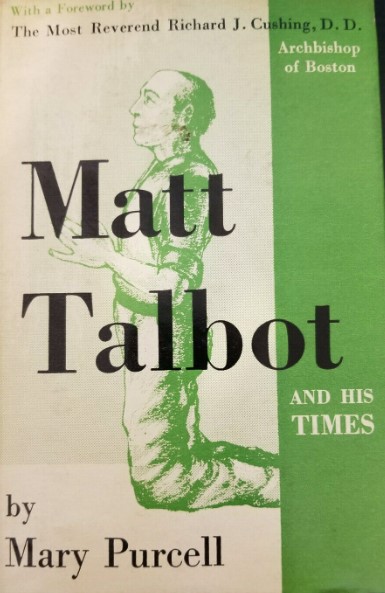
Matt Talbot and His Times - Mary Purcell
Matt Talbot: His Struggle, His Victory over Alcoholism - Susan Helen Wallace 
Matt Talbot - Xavier Carty 
Spotlight on Matt Talbot  - Edward O'Connor, S.J.
Matt Talbot - Simon O'Brynne 
The quest for Matt Talbot - Philip Rooney 
We knew Matt Talbot - Albert H Dolan
Matt Talbot - James F. Cassidy. 
An address to Pope John Paul II from the Parish of Matt Talbot, The Worker. 
Matt Talbot : the Irish worker's glory - James Francis Cassidy 
Matt Talbot - Albon White 
The Story of Matt Talbot - Malachy Gerard Carroll

The Mystery of Matt Talbot - Father Morgan Costelloe

The Mystery of Matt Talbot - Father Morgan Costelloe

The Mystery of Matt Talbot - Father Morgan Costelloe


Wednesday, 30 August 2023

The Mystery of Matt Talbot - Father Morgan Costelloe

The Mystery of Matt Talbot
Father Morgan Costelloe
1981
32p
 
The Mystery of Matt Talbot - Father Morgan Costelloe

This is one of two volumes written about Matt Talbot by Father Costelloe, who at the time of writing this volume was the Vice-Postulator for the cause of Venerable Matt Talbot, the other is titled Matt Talbot: Hope for Addicts which had 2 editions in 1989 one by Veritas and one by Hyperion Books. This is one of several volumes I have read about Matt Talbot this year, this is the eighth such volume, and I have at least that many I would still like to track down. This is one I received a scanned copy of from the National Library of Ireland, for they will scan out of print volumes for a price. A service I am very grateful for. This volume received the Nigil Obstat and Imprimi Potest. The copy I have does not have a back cover, so I have no description from the dust jacket. The inside front cover has 5 quotes of how others saw Matt, they are:

“He was a pleasant man and would laugh and talk with visitors. He sought to conceal his prayers and fasts.”
Mrs Mary Andrews, his sister.

“He was a pleasant, approachable and kindly man. He had a lovely smile. He seemed completely oblivious of what happened around him when he was praying.”
Sean T. O'Cea llaigh, altar server, later President of Ireland.

“At our first meeting I tried to ascertain whether the Servant of Cod was quite a normal man - free from eccentricities and with commonsense views on religious matters. He made a most favourable impression on me. Th ere was nothing nervy or over-wrought in his manner.”
Raphael O'Callaghan, Company Director and a close friend.

“He carefully avoided all ostentation, especially as regards his penances. He was a good, conscientious workman. I never met anybody like him. He was totally wrapped up in Cod.”
Daniel Manning, fellow worker in the timber yard.

"Before I was married, I used visit him frequently, and I always found him very gentle, good-humoured and ready to enjoy a joke."
Mrs Annie Johnson, his niece.

The sections in this booklet are:

Introduction
     Irish Monasticism
     Means Towards an End
     Well-tried Faith
     The ‘Hard’ Man
     Change of Life Style
     Hymns from the Top Flat
The Irish Way
     Praising God
     One Full Meal
     Monks at Work
     And So to School
     ‘Green’ Martyrdom
     Pilgrims for Christ
     Queen of Ireland
The Mystery of Matt Talbot
     ‘Old Reliable’
     Lost in Prayer
     The Word of God
     The Good Queen
     A Cluster of Books
     The Thought of Others
     Matt’s Menu
     Unskilled Labourer
     ‘No Time for Money’
     Mission to China
     The Folly of Christ
     ‘A Holy, Old Man.’
     Totus Tuus
     No Half-Measure
     The Irish Dimension

While reading this volume I highlighted numerous passages. Some of them are:

“As the Vice-Postulator of the Cause of Venerable Matt Talbot, I have heard similar remarks in Ireland and abroad. There is an aspect of his spirituality that appears forbidding and mysterious. Where did he get the idea for his fasts, his long night vigils and his awesome asceticism? The answer is that, under the guidance of a spiritual director, he imitated the life of the monks in the early Irish monasteries.”

“This booklet is not another biography of Matt Talbot. It presupposes that the reader has heard his life-story which is well told in Mary Purcell's Matt Talbot and his. Times and Father Edward O'Connor's Spotlight on the Venerable Matt Talbot. The purpose of this booklet is to explain the spiritual programme that led him to close union with God.”

“Many Irish persons today have lost a sense of history. They can name some of the great monasteries like Clonard, Glendalough and Clonmacnois, which became world famous through the visit of Pope John Paul 111979, but they know little about the life of the monks who lived there. They go on pilgrimage to Lough Derg. known as St Patrick's Purgatory, without realising that this penitential exercise has its roots in early Irish spirituality which has always emphasised the need for penance: ' Unless you repent you will all likewise perish' (Lk 13:3).”

“One of the extraordinary events in our history was the widespread interest in the monastic life which manifested itself within a hundred years of the death of St Patrick by the end of the sixth century there were thirty major monastic settlements scattered through the country and we are told of young men and women flocking to consecrate their lives to God. At first a hermit would set up his cell m a secluded spot to communicate with God in private; but the news would spread and others would gather around. him to seek his advice on prayer. Eventually small self-suff1c1ent communities were formed and the hermit's life, in the strict sense, was almost a thing of the past. The spiritual acorn became a mighty oak, some monasteries having as many as four thousand people including overseas students. Glendalough and Clonmacnois became university cities of their day, while remaining. like all the monasteries, places of prayer, solitude and study.”

“Life in the monasteries was summed up by St Columbanus as 'pray daily, fast daily, study daily, work daily' (Opera p.24). The great monks, who were proposed as models, were those who persevered in strict obedience to their Abbot, over forty or fifty years.”

“They held that if they could reduce its need for food, sleep and comfort to a minimum they would produce maximum response to God's inspiration for prayer and charity.”

“Asceticism was the order of the day in monastic I re land. It was so strict that scholars look to the Eastern Church to find anything like it Innumerable prostrations and genuflections during prayer were common.”

“This spiritual father was given the beautiful Irish title of 'anamchara', which translated into English, means ' soul-friend'. He was both confessor and advisor, who constantly reminded the monk that austerity was not an end in itself, only a means towards closer union with God. The need for an individual spiritual director was considered so important that novices were told that a monk without one was 'like a body without a head'.”

“There was nothing easy about life in these (Irish monastic) communities. Their ways of ascetic piety would be regarded by most men of the twentieth century as quite insane'. He goes on: 'All the monks submitted to a penitential regime, which seems astounding to our easy-going ways. The ideal of penance was what these men set out to find in cells lost in the midst of woods or in the most desolate countryside. The finest examples of a well-tried faith we reforged here' (Introduction to Ireland: Isle of Saints by G & B Cerebeland-Salagnance).”

“It was an unlikely beginning of a deep intimacy between him and his Saviour that would bridge the next forty years. To strengthen his resolution further, he decided to attend Mass and receive Holy Communion every day before work It was a revolutionary ideal In Ireland of the 1880's a good-living layman went to the altar just twice a year, at Easter and at Christmas. A nun or a Brother with religious vows went only on Sundays.”

“To fill in his time after hours and to satisfy his increasing interest in religious matters, he joined the Third Order of St Francis attached to the Franciscan Church, Merchant's Quay. He continued to go to Mass and Holy Communion every morning in the Jesuit church, Gardiner Street near his home and became a member of its Workingmen's Sociality dedicated 'to Our Lady Immaculate.”

“Although illiterate when he left school, he gradually learned to read and write. Matt became friendly with another priest, Dr. Michael Hickey, later Monsignor, of Holy Cross College, Clonliffe, who played a major role in his spiritual formation. An enlightened confessor and scholar, he became Matt's director, a true 'anamchara' guiding him in the way of Irish spirituality.”

“When we consider the principal elements in the life of the early Irish monk, it is easy to see how they were parallelled in the life of this Dublin workman. These were: prayer, fasts, mortifications, work, study, devotion to Our Lady and missionary drive. Let us consider each in turn.”

“The monk was a 'miles Christi', a soldier of Christ, who set out to conquer self in order to draw closer to God. It was a kind of martyrdom, as the monks acknowledged. Few Irish monks suffered red martyrdom -shedding their blood for the sake of the Gospel- although St Killian and his companions did when they travelled to Wurtzburg in Germany. But all the Irish monks were expected to achieve what was called 'white' martyrdom•- ·the renunciation of everything one loved, living in complete poverty of spirit. There was a higher stage on the way to perfection, however, for monks who performed additional penance by fasting and labour and sought the profoundest humility. The monks described this as 'green' martyrdom.”

“He continued to attend Mass and to receive Holy Communion at5 o'clock Mass every morning in Gardiner Street Church. But when the time of this first Mass was changed to 6.15 Matt discovered that he was unable to return home for his breakfast and get to work in time, so he changed his job.”

“Even during the Easter Rising of 1916 he made his way through military barricades to attend Mass. Sunday was D-day. He went to first Mass and
stayed in the church until the last Mass concluded with Benediction. Since he was obliged to fast from midnight in order to receive Holy communion, he did not have his breakfast until after 1.30 p.m. Occasionally he moved from one church to another on Sundays, depending on where his various Sodalities met He might slip away from the Jesuit Church, Gardiner Street to the Franciscan Church, Merchant's Quay or to the Dominican Church, Dominick Street.”

“He made himself as inconspicuous as possible, a small, poor man. He never used a prayer book but prayed with his eyes shut He knelt erect in the bench, hour after hour, with his hands joined in front of him. He did not allow them to rest on the seat in front of him and so remained upright without support He did not stand for the gospel, a habit he learned from a saint to retain recollection. To the members of the Franciscan Church choir, who saw him from the gallery huddled in deep prayer, he was affectionately known as the ' old reliable'.”

“His visits to a church were not limited to Mass time. He paid a visit to the Blessed Sacrament on his way to work, 'to see the Lord on the way down', as he said, and again after work 'to see the Lord on the way home'. Remembering that as a rule he returned to a church after his evening meal for a Sodality meeting. he saw a lot of the Lord.”

“His little room at 18 Upper Rutland Street had the bare necessities of a monastic cell. He had an iron bedstead, a chair, a table, a crucifix and a few holy pictures. His bed covering was a sheet and a half blanket, supplemented by an old sack during the cold winter nights.”

“He recited fifteen decades of the Rosary and the Little Office of the Blessed Virgin every day. He made Novenas for her feast days. He turned to her for guidance when a girl proposed marriage. There were five books about Our Lady found in his library and as we will see, it was through his devotion to her that his secret life of prayer, charity and penance was revealed to the world.”

“His spiritual books provided food for prayer, meditation and a deeper understanding of the Faith, but they provided a formidable challenge for a man, who could neither read nor write when he left school. He had painstakingly overcome these handicaps as an adult, but he explained that he read books very slowly, and prayed to the Holy Spirit {or enlightenment.”

“But there were not many ordinary days. Even in the early years of his conversion, be observed a ' black fast' during Lent and again during June in honour of the Sacred Heart. He had a ' black fast' during · Advent to prepare for Christmas and another after Easter in preparation for Pentecost Every Saturday he fasted on dry bread and black tea in honour of Our Lady.”

“He was agreeable and cheerful with the other workmen. He was more silent and recollected than they were but they liked him and respected him.”

“He lived his life of asceticism for almost forty years, largely unnoticed by his workmates and neighbours. On reflection, he struck them as the perfect example of self-abasement - poor, clean and shabbily dressed, but always alert to the needs of others. Towards the end of his life he seemed to live in the presence of God.”

“He concealed his life of asceticism and settled into the _routine of patients, receiving Holy Communion just once a week and eating the ordinary hospital meals. Sister Mary Dolores, who looked after him during that time, was amazed when she discovered, years later, that she had nursed the Servant of God.' Matt Talbot never showed by his conduct' she said later at the sworn inquiry of the Ordinary Process, 'that he was anything more than a sweet-natured, holy, old
man'.”

“In the sections 236 to 242 of the book St Louis Marie points out the difference between a child of Mary and a slave of Mary: a child has rights, a slave has surrendered all. It is summarised in the motto of Pope John Paul 11: Totus Tuus ‘Totally yours’. A Christian who considers himself a 'slave of Mary' will live very close to his mistress and therefore, very close to her Son.”

This was an absolutely fascinating read. It was as much a history of Irish monasticism, Irish spirituality, and history as the story of Matt. And being written by the then postulator it was intriguing to see what he focused on compared to other biographies of this saintly man that I have read.  

This book is an excellent resource and I believe a few different editions were published; I have seen at least three covers for this volume. It is an amazing read, and I can easily recommend it. Matt is a man whose witness we need today even more than in his time. My own brother overdosed at the beginning of the pandemic. I wish I had discovered Matt and his story years ago to share with my brother. The number of people addicted to alcohol, weed, opioids and other drugs are constantly on the rise. I wish this volume was back in print and available as an eBook, there are dozens of people I would recommend it to. It is well worth tracking down and giving a read. 

Note: This book is part of a series of reviews: 2023 Catholic Reading Plan

For all reviews of books about Matt Talbot Click here.

Books about Matt Talbot:
Matt Talbot and His Times - Mary Purcell
Matt Talbot: His Struggle, His Victory over Alcoholism - Susan Helen Wallace 
Matt Talbot - Xavier Carty 
Spotlight on Matt Talbot  - Edward O'Connor, S.J.
Matt Talbot - Simon O'Brynne 
The quest for Matt Talbot - Philip Rooney 
We knew Matt Talbot - Albert H Dolan
Matt Talbot - James F. Cassidy. 
An address to Pope John Paul II from the Parish of Matt Talbot, The Worker. 
Matt Talbot : the Irish worker's glory - James Francis Cassidy 
Matt Talbot - Albon White 
The Story of Matt Talbot - Malachy Gerard Carroll

The Mystery of Matt Talbot - Father Morgan Costelloe

The Mystery of Matt Talbot - Father Morgan Costelloe

The Mystery of Matt Talbot - Father Morgan Costelloe


Wednesday, 17 May 2023

Celebrating Holy Week - Vincent Sherlock

Celebrating Holy Week
ISBN 9781788120203
eISBN 9781788123761
ASIN B09BLHZ37F


This is the third volume I have read from the pen of Vincent Sherlock. I picked this volume up right after reading and praying through his volume, The Stations of the Cross. I really enjoyed this little volume. 

The description of this booklet is:

“In Celebrating Holy Week, Vincent Sherlock reflects on each day of the Easter Triduum. Opening up his own experience of the Triduum to the reader, Sherlock offers a detailed account of the significance and meaning of each day of the Triduum.He makes church and vestments speak, lingers on fonts that go empty and are then full again and turns the absence of song into a lyric of reflection. Urging us always to notice what is going on around us during this high point of the Christian year, Sherlock leaves no one out of the experience of the Triduum. In Celebrating Holy Week, Sherlock reminds us that we are all like the man with the pitcher of water who unknowingly guided the disciples to the place of the Last Supper, we are all a part of Easter too.”

The chapters in this volume are:

  Introduction  
  Palm Sunday  
  The Triduum  
  Holy Thursday  
  Good Friday  
  Holy Saturday  
  The Easter Vigil  
  An Easter Sunday Story  
  Conclusion  
  They Wondered

I absolutely loved the sections at the end of some of the chapters called “Signs and Symbols to Notice” from “The Easter Vigil” chapter they are:

 The darkness of the church. Without Christ we are in darkness.
 The Easter Fire … a flame to be blessed.
 The Paschal Candle.
 Alpha and Omega, beginning and end.
 Cross.
 The year.
 The grains of incense – five wounds.
 The call to recognise ‘The Light of Christ’.
 The faith to respond ‘Thanks be to God’.
 The spreading of light through the church as candle lights candle.
 Remember where the light came from-the Paschal Candle.
 Christ, the source of all light.
 Notice the lighting of church lights, candles on the altar.
 Darkness yielding to light.
 Night giving way to dawn.
 Flowers around the Altar. A sign of joy and celebration.
 Hear the bell rung during the Gloria that has been silent since the Mass of Holy Thursday.
 The blessing of Holy Water.
 Hear the ‘I Do’ when baptismal promises are renewed.
 Notice your own ‘I do’.
 When leaving the church notice again water in the Holy Water fonts.
 ‘He is risen’.

A sample chapter is:

HOLY THURSDAY
While The Triduum begins with the Mass of The Lord’s Supper on the evening of Holy Thursday there takes place, in many dioceses, a significant gathering earlier in the day. In some dioceses, for various reasons, this gathering might take place the previous evening or at another time near Easter. The gathering is for the Chrism Mass and sees the diocesan bishop gather with the priests and people of the diocese in the Cathedral to celebrate together the institution of the Priesthood and the blessing and consecration of the Sacred Oils of Catechumen, The Sick and Chrism to be used throughout the diocese in the coming year. At this Mass, the bishop speaks to the priests about their shared calling to be present to God’s people in the diocese and during the Mass, priests of the diocese and resident in the diocese renew their commitment to priestly service. It is noteworthy that this is the only Mass celebrated in a diocese on Holy Thursday morning.

Later that same day … 

 Did you ever think about the man carrying the pitcher of water in Mark 14:12–16? It would be a pity to overlook him on a day like today. We are not told much, indeed anything, about him as a person but he is a key figure. Jesus had told his disciples, ‘You will see a man carrying a pitcher of water’ and that they should follow him to the house where he was going. You would wonder about him. How many times he must have filled that pitcher, countless times in truth, and walked the street back to the house. That day was different though. His everyday task became a sign, a sacrament perhaps, and his role in this ever-unfolding drama took centre stage. He was noticed! There is something about noticing people, not least when they do not expect it, and it is linked with noticing the difference they make.

There is a story I like to tell, a moment I like to recall, when I waited for a friend outside Penn Station, New York. The place was busy, as you’d expect, with hundreds of people walking and talking. In the middle of Penn Plaza, I noticed pigeons pulling at a large piece of bread someone had dropped. Their work was continually interrupted by the passers-by and the pigeons flew to and from their find but were having very little success in taking any advantage of it.

I watched, maybe without even knowing I was watching, and then I noticed a man walking towards me. I would put him in his late twenties and a bit alternative perhaps! Black T-shirt, tattooed forehead, faded and torn jeans, a dangling earring and still a man who could blend into and get lost in the crowd. He walked through the pigeons and they scattered. Then it happened! He stopped and, as I watched, I saw him go back to the bread, go down on his knees and take the piece of bread in his hand and begin to break it into pieces. He rubbed the broken pieces on the ground and they became almost dust-like. As I watched, I thought his movements awkward and laboured but admired what he was doing. He got up, walked away and the birds flew back to the broken and scattered pieces. No longer were they congregated around one piece, now there was feeding to be done.

As he walked past me, I heard myself say ‘Well done!’ I don’t know where it came from and neither did he. He stopped, and looked at me and asked ‘What do you mean, “well done”?’ ‘That’s a good thing you just did’, I said. He smiled a little, looked at me and said, ‘If I didn’t do that, only the greedy ones would get it’. I was silent but filled with admiration and then I noticed, one of the arms of his T-shirt hung empty, he had one arm. I thought again about the awkwardness of his work and realised that, with one arm, he had done what I failed to do – notice, react, respond and make a difference. He walked away but his action and witness stayed with me.

‘If I didn’t do that, only the greedy ones would get it’. That is the line that stayed with me most I think. He was so right. It was, in truth, because bread was broken that it could be shared and shared generously with others. This takes us to the Upper Room where tonight’s Liturgy has its birth, but we must not forget the man carrying the pitcher of water, no more than I must not forget the man on bended knees, one-handed, breaking the bread.

Holy Thursday calls us to a place of awareness around Eucharist and Service. These two are centre stage in all that is happening today. We are asked to be aware of people around us, to notice people, not just for the sake of noticing but because otherwise they might all too easily go unnoticed. The man with the pitcher of water had no idea where his daily task would take him and, not just him, but all who have come to hear his story right up to this present day, right up to you reading these words and wondering about Holy Thursday. That man is carrying the pitcher of water for you and me today, leading us down a street, to an open door and to an Upper Room where our place at the table is assured and the bread will be broken, divided, shared so that all, not just the greedy ones, may be nourished and uplifted so that like the pigeons we can take to the skies – where we are intended to be.

Eucharist and Service then are key to all we look for on this day. In this evening’s Liturgy, there will be witness given to the Lord’s call to be servants of one another. This, we are told, he did in the washing of his disciples’ feet. They were reluctant to have this done, especially so Peter, who objected ‘“Never”, he said “never shall you wash my feet”’ (Jn 13:8). When Jesus pointed out that if he did not allow this to happen then Peter could have nothing to do with his ministry, he changed his mind saying; ‘“Then not only my feet but my head and my hands too”’ (Jn 13:9) – that response, that change of attitude is perhaps central to our approach to a moment like this. The willingness to be open to a new message and take on a role not imagined is, at once, challenging and exciting.

Where did Jesus get the water to wash the disciples’ feet? Certainly, it is possible that it is some of that same water carried by the man with the pitcher. That water too, finished up beside the wine on the table and may well have been mixed with it as we see time and time again when the bread and wine are offered at the altar. Noticing! That’s the best gift you can bring to this day. Noticing! Noticing people, noticing signs, noticing what is done around the altar and noticing the people involved and those, like the man who carried the water, who may well be behind the scenes. Noticing!

Feet washed, and altar approached, we will hear again those words and see again those gestures first seen and heard in the Upper Room. Try, if you can at all, to locate yourself there in a place where you can see and hear. Observe the movements, the taking of chalice and paten, their being lifted/offered to the Heavens, so they can be shared with all around. See the man, on his knees, outside Penn Station, taking the bread and breaking it so that all would have a chance to be nourished, not just the strong or the greedy.

Notice the ending of Mass tonight. There will be no final blessing, the priest will leave the altar in silence with no closing hymn. He may well carry the Eucharist to an ‘Altar of Repose’ where adoration might continue for a number of hours but there is no formal ending or dismissal. This is because the prayer is truly only begun and will continue through Good Friday, Holy Saturday and all the way, to the discovery of the empty tomb on Easter Sunday morning. It is great that you are here. It is where you need to be and where you are needed.

Notice! You may well be carrying a pitcher of water. Someone may need to follow you.

SIGNS AND SYMBOLS TO NOTICE
Church decorations such as bread and grapes, a white towel and basin. The tools of service.
Return of the Trocaire Lenten Campaign boxes. A call to share.
Ringing of the bell during the Gloria. It will not sound again until Easter.
The empty Holy Water fonts. Dryness of spirit. Emptiness.
Stripping of the altar after Holy Communion. No celebrations.
No final blessing at Mass. A silent procession from the altar.
A seamless prayer from Holy Thursday to the Easter Vigil/Sunday.
Continuous prayer.
A time for waiting and reflection.
Procession to the Altar of Repose.
Often a time for quiet prayer for a few hours into the night.
Akin maybe to ‘the wake’ – being with and in silence.
Silence! A time to reflect and anticipate the days to follow.”

I only highlighted a few passages my first time through this booklet. They are:

“‘If I didn’t do that, only the greedy ones would get it’. That is the line that stayed with me most I think. He was so right. It was, in truth, because bread was broken that it could be shared and shared generously with others. This takes us to the Upper Room where tonight’s Liturgy has its birth, but we must not forget the man carrying the pitcher of water, no more than I must not forget the man on bended knees, one-handed, breaking the bread.

The man with the pitcher of water had no idea where his daily task would take him and, not just him, but all who have come to hear his story right up to this present day, right up to you reading these words and wondering about Holy Thursday. That man is carrying the pitcher of water for you and me today, leading us down a street, to an open door and to an Upper Room where our place at the table is assured and the bread will be broken, divided, shared so that all, not just the greedy ones, may be nourished and uplifted so that like the pigeons we can take to the skies – where we are intended to be.”

“That’s the best gift you can bring to this day. Noticing! Noticing people, noticing signs, noticing what is done around the altar and noticing the people involved and those, like the man who carried the water, who may well be behind the scenes. Noticing!”

“Notice the ending of Mass tonight. There will be no final blessing, the priest will leave the altar in silence with no closing hymn. He may well carry the Eucharist to an ‘Altar of Repose’ where adoration might continue for a number of hours but there is no formal ending or dismissal. This is because the prayer is truly only begun and will continue through Good Friday, Holy Saturday and all the way, to the discovery of the empty tomb on Easter Sunday morning. It is great that you are here. It is where you need to be and where you are needed.”

This is a wonderful little volume. I picked up the eBook edition and I read it before church on each of the specific days. There are a couple of personal stories one about the authors father and another by a bishop. Both really add to the volume. The book is easily accessible. Anyone with a secondary education could engage with this booklet. It would be great for personal, family, or even youth group reading together. It is an excellent resource for ending Lent and transitioning into Easter It is a volume I can easily recommend.

Note: This book is part of a series of reviews: 2023 Catholic Reading Plan! For all review of Messenger Publications books and booklets click here

Books by Vincent Sherlock:
Let Advent be Advent
The Enchanted Way: Reflections on the Way of the Cross