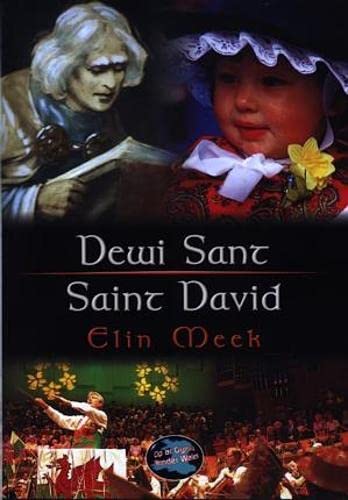
This is one of a number of books I have read about Saint David of Wales, or Dewi Sant. Most of the books I was able to find were for young readers. This is one of three written for adults I have tracked down, the other I have read was the first book I ever read about Saint David of Wales, read
Dewi Sant: St David Patron of Wales, by J.B. Midgley. This is also the second volume that I have read that was a parallel edition of Welsh and English on facing pages. There is another volume by Bowan I am trying to track down called
In Pursuit of Saint David.
My my son found out this past fall that the patron saint of his school,
Saint David’s in Waterloo, Ontario Is Saint David of Wales. This one was harder to track down and as such is the seventh volume about David I have read, six of them this year to.
Description on the back of the book:
“A new assessment of Dewi Sant— the sixth-century Celtic Saint and Patron Saint of Wales. Drawing on recent advances in Celtic scholarship and other studies involving disciplines as varied as folklore and archaeology, history and historical-geography, Professor E. G. Bowen here skilfully separates fact from fiction, myth and legend. He describes Dewi's battles against paganism and confrontations with Irish settlers, and traces his emergence as a great national leader in Church and ‘State’ alike, both in his own lifetime and throughout subsequent centuries.”
The chapters in this volume are:
Preface
I Homeland
II Pastures New
III The Synod of Brefi
IV Gloria Postuma
V Patron Saint
This was by far the most academic of the works I have read about Saint David to date. But it was also a work of faith. I was particularly drawn to the different pilgrimage routes. I highlighted numerous passages while reading this volume. Some of them are:
“There have been many books and articles about Dewi Sant, especially in modern times, and we know today very much more about his life and times than our parents did. This is due to the fact that there has been a considerable increase in our Knowledge of many subjects that throw light particularly on the period of history which the older historians called the Dark Ages — the period in which St. David lived.”
“It is therefore appropriate that this booklet in the St. David's Day series initiated by the University of Wales Press should now present the story of our National Saint from a modern point of view, making the fullest use of interdisciplinary studies.”
“This book is about Dewi Sant (St. David), a famous Celtic Saint and the Patron Saint of Wales who lived in the sixth century. We feel, however, that in spite of his eminence and the wealth of tradition concerning him which is grounded in a rich antiquity, it is difficult to write a satisfactory biographical account of him as has been done for so many other distinguished Welshmen throughout the ages in this series. This is particularly unfortunate as Dewi Sant is in many ways the patron of this series of booklets published in his honour every St. David’s Day.”
“There are other early (pre-Rhigyfarch) references to Dewi in both England and Wales. In England, the cult of Dewi appears in Wessex as early, at least, as the eleventh century and possibly before this. His name is recorded in the English Calendars of this region at this time, usually in the Welsh form of his name — Dewi.”
“All early references to the Saint are important in showing that he was, indeed, a very real person before Rhigyfarch wrote, but they are now eclipsed in importance by what is almost certainly an important contemporary reference.”
“This is fully two hundred years or more earlier than the date now assigned to the Catalogue of the Saints of Ireland which was previously thought to contain the earliest reference to St. David, and it cannot be more than a few decades later than the death of the Saint himself, or possibly, even contemporary with his old age. The fact that we have his name inscribed in this way on a near contemporary stone memorial at Llanddewibrefi is, indeed, of the greatest significance.”
“The first of them points clearly to the fact that David's homeland and early education are associated with mid-Ceredigion. His father Sant is said to have been King of Ceredigion, son of Cedig, son of Ceredig, son of Cunedda. Divine power sent Sant to Non (a nun) who became the mother of the Saint. Afterwards, the father seems to have withdrawn from his Kingdom to take up the eremetical life. The most important point in the pedigree in its later stages shows that David would be a great-great grandson of Cunedda, the famous Celtic hero. David was educated at Vetus Rubus, the Welsh Henfynyw — the Old Mynyw, the name given to his monastery in later times to distinguish it from the New Mynyw, Menevia, which is St. David's. The little Celtic Monastery at Henfynyw had an excellent reputation as a place of sound education and learning under the care of a distinguished Bishop named Guistilianus. It seemed that David was sent from Henfynyw for a further period of preparation, or retreat, to St. Paulinus in a monastery located in what was later known as northern Carmarthenshire.”
“It was the coming of new ideas by sea from the homelands of Christianity in the Eastern Mediterranean and their fusion with what remained of Christianity from Roman times in these far western margins of the Empire that, ultimately, brought into being the Celtic Christianity which surrounded St. David in his day. It is now thought that the sequence of events was as follows. Monastic life as developed at Henfynyw was certainly not a feature of the earliest Christianity in Britain, found during the period of the Roman occupation. However, during recent decades a new generation of historians and archaeologists has been attracted to the study of Early Christianity in Britain and it is safe to say that we know twice as much about this subject as we did before the Second World War. The conclusions of these workers (particularly those of Professor Charles Thomas) have given us a clearer understanding of the sequence of events relative to Early Christianity in the Celtic lands and to Celtic monasticism in particular.”
“All our evidence, therefore, points to the fact that there was organised Christianity in western Britain during the Roman occupation.”
“While Christianity was in difficulties in south-eastern Britain after the Roman withdrawal, we find evidence today that Church organisation was by the late fifth and early sixth centuries a regular feature of the west, inheriting from the Continental Church, and the British Church in Roman times, its ritual, liturgy and diocesan organisation. It was into this situation in the north and west that organised monasticism entered, to which David was so deeply committed, and whose origins must now be examined.”
“If this pottery could travel to the monasteries around the shores of south-western Britain (where many pieces have been recorded) so, too, could pilgrims, books, and ideas; so that there can be no longer any doubt that it was along these western sea-routes that full monastic life arrived on our western shores. The pattern spread rapidly from our Western Approaches to such sites as Llanilltud Fawr, Nantcarfan, Llandaf, Caldey, Glastonbury, Tintagel, St. David's, Llanbadarn Fawr, Tywyn, and other places in West Wales between AD 470 and 670 and it is to this movement that even small monastic cells like Henfynyw belong. In the heart of this movement we find St. David.”
“The all-important matter is that St. David and his colleagues were ‘campaigning’ here in south-western Dyfed. The word ‘campaigning’ is used advisedly in this context, for the Saints from Henfynyw were not only fighting a battle for Christianity against the paganism in their midst, but were campaigning also against a real physical enemy — the Irish settlers who had taken possession of the land. Archaeologists and historians have clearly established the fact that an extensive area in south-western Dyfed reaching from south of Aberaeron, on the coast, inland to include the lower Teifi valley and western Carmarthenshire, and most of north Pembrokeshire, was settled by Irish invaders in the fifth and sixth centuries.”
“It is not only the place-name evidence that indicates the Irish immigration into south-west Wales: in the same area archaeologists have recorded a large number of Early Christian inscribed stones, usually with bilingual inscriptions in Latin and in ogham characters. The ogham indicates the use of the Old Irish language on these tombstones.”
“It is clear, therefore, that in the days of St. David the lands around the southern Irish Sea Basin formed a Celtic Christian thalasocracy whose centre was unquestionably at St. David's. This accounts for its outstanding importance and that of its founder. We recall that after describing David's triumph over Baia and his wife, Rhigyfarch proceeds to depict the party establishing a large monastery on the new site.”
“Emphasis is placed on hard manual labour and on the austerities of the monastic life. The latter have distinct Egyptian undertones following from an adaptation to western conditions. David himself, together with his monks, practised severe privations, entering the river even in the depth of winter and standing there for long periods in the cold water. There was austerity also regarding food and drink. The monastery at St. David's supported itself— all sharing a simple fare with meals of bread, herbs and water varied only a little for those of advanced age or in poor health, when fish or other light food would be provided.”
“The description of day-to-day life makes little mention of book knowledge and book learning and nothing at all of lettering or artistic work, which characterised the great Irish monasteries across the water and his own father's monastery at Llanbadarn as well. All we are told is that “when outside labour was finished the monks returned to their cells and spent their time in reading or writing or praying'. Such was the concentration on work and worship that, at all times, no conversation beyond what was absolutely necessary was permitted. The lack of emphasis on book knowledge at St. David's in David's time stands out in marked contrast to the great learning of the Scriptures and the Classics associated with St. Illtud or St. Cadoc at their monasteries in south-eastern Wales at this time.”
“Above all else, David seems to be in contact with people outside the monastery. The monks of St. David's certainly did not forget the Christian virtues of helping the poor, the needy and the bereft. We are told that it was one of their daily functions to feed the orphans, widows, the weak and the needy, ‘and all pilgrims on their travels’. All such gathered daily beneath the monastic walls. Apart from the picture of St. David on a preaching crusade at home or overseas, these Celtic Christians also strongly believed that the good name of their leader Dewi Sant should be heard abroad, so that, in addition to the lowly and the dispossessed, ‘the Kings and Princes of this world would be encouraged to abandon their kingdoms for the monastic life as did Constantine, King of the Cornishmen’.”
“This became known as Semi- Pelagianism. This development is important as southern France was a springboard for the spread of Christian ideas first through Gaul and then on to Britain. This happened to Semi-Pelagianism and it took deep root here — so deep, in fact, that St. Germanus of Auxerre had occasion to visit Britain on two occasions (AD 429 and 447) to attempt, at the request of the Pope, to exterminate these heretical views. These visits are said to have been entirely successful, as mentioned by Rhigyfarch in this chapter.”
“The relics of Celtic Saints, in particular, proved to be objects of the greatest veneration, and it was fervently believed that the Saint, even after death, could work miracles from his tomb or the shrine where his bones were said to rest. In this way it is clear that a Saint's cult is centred at his tomb. It is for this reason that St. David's became a great centre of pilgrimage in medieval times.”
“With St. David's own background in mind we must not forget that with all these little landing places and small harbours, the St. David's peninsula jutting out westward was, above all, on the high road to Ireland, which was only some 47 miles away. Irish seamen and merchants as well as pilgrims were often to be found in the neighbourhood. St. David himself, as we have already seen, had very close associations with south-eastern Ireland, while on the other hand we hear of many Irish Saints who came over to St. David's and stayed under his tuition for long periods. One important Irish Saint — St. Finnian of Clonard — is said to have spent three years with David.”
“On the basis of circumstantial evidence and small sections of roads and trackways traditionally known as ‘pilgrim ways’ we can attempt a general reconstruction. It would appear that there were three major approach roads used by pilgrims to St. David’s from South and Mid-Wales. There was, first of all, the West Wales coast road and, secondly, a road that followed the edge of the South Wales Coastal Plain, and lastly a number of old roads and trackways lying between them.”
“The South Wales coastal route is even more clearly defined, following for much of its course older Roman roadways.”
“In the early twelfth century his supporters in high places succeeded in obtaining official recognition of his cult in Rome, and he was canonised during the pontificate of Pope Calixtus II between the years 1119-24. David was the only Celtic Saint ever to be honoured in this way, and at the same time the Pope ordained that two pilgrimages to St. David's would equal one to Rome and that three visits would be equivalent to one to Jerusalem itself. This great distinction increased the prestige and status of St. David still further and pilgrimages to his shrine increased in number and importance accordingly.”
“In this context Dewi emerges as a typical figure of the British Heroic Age, like King Arthur, fighting the Anglo-Saxons and assuring his men of the ultimate victory of their arms. It was this image of Dewi that did much in later years to ensure his emergence as Patron Saint and national leader of both South and North Wales.”
I hope those samples from my highlights give you a feel for the value and worth of this volume. I am very thankful I was able to track down a copy of this volume. It was well worth the effort and it is an excellent read. Saint David of Wales is a fascinating character, and historical figure. There is much in his life worth emulating. And this volume will challenge readers with a deeper understanding of David, his place in history, and of a Celtic spirituality we could benefit from today. An excellent resource, one I can easily recommend.