Showing posts with label Catholic2022. Show all posts

Friday, 5 July 2024

Brother André of Montreal - Ann Nolan Clark and Harold Lang - Vision Books #71

Brother André of Montreal
Harold Lang (Illustrator)
Farrar, Straus & Company, Inc.
1967


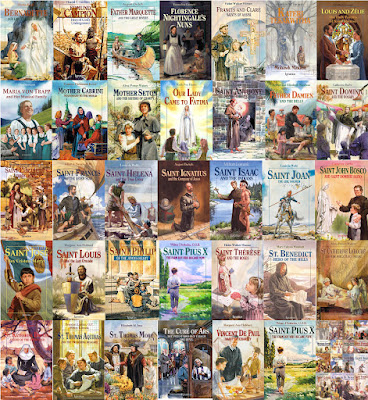
This is one of the original 72 Vision Books for Young Readers. The originals were published between 1955 and 1969 by Farrar, Straus & Cudahy, Inc. Reprints of about half are available from Ignatius Press. This is not one of them. I wrote a piece about the series as a whole, Vision Books for Young Readers, after reading a few and wanting to know more about the series. This one was one of the last in the series, to the best of my research only one volume was released after this one, but there were three others announced at the end of this as being in progress. The description of the book states:

“One of the best-known sights of Montreal is the white basilica, St. Joseph's Oratory, which towers above the city. Less known is the man whose determination and faith led to its construction. Brother Andre, who spent the forty prime years of his life answering the door at a boys' school across the road from the Oratory and who always wanted to help build a church in honor of St. Joseph. Orphaned, sickly, awkward at every manual job to which he turned, both in his native Canada and in the United States, Alfred Bessette found his place in life in 1874 when he became Brother Andre in the Congregation of Holy Cross. Soon after his death in 1937, first steps were taken which may lead to his canonization.”

About the author we are informed:

“Ann Nolan Clark is the author of Secret of the Andes (Newbery Medal, 1953), In My Mother’s House, World Song, Paco’s Miracle, and Medicine Man’s Daughter, among others. She lives in Santa Fe and for many years worked among the Indians of the Southwest as teacher, writer, and school supervisor. Her first Vision Book was Father Kino, Priest to the Pimas.”

She only wrote the two volumes in the series. 

While reading this volume I only highlighted a few passages, I just did not want to stop and take the time. They are:

“Getting to know the facts of his life was something else again. I could not find much about his childhood, and to me it is very important to know the child before I write about the man.”

“Leaning on his hay rake, he asked Saint Joseph where he was to die, and in his mind there arose a picture of a long stone building with many dormer windows, a spire, and a cross. Later he was to live for forty years in the building that he saw in his imagination in a hayfield near Farnham, although at the time he saw it the building had not yet been built.”

“On December 2 7, 1 870, in the chapel of Hotel Bellevue, Alfred Bessette was permitted to take the holy habit of a brother of the Congregation of Holy Cross, dedicated to Saint Joseph.”

“Little by little he began to dream of this place's becoming a shrine where tired and troubled people could come to ask the Carpenter of Nazareth to lay a prayer for them before the throne of God.”

“His drive to build a shrine had perhaps been greatly strengthened by the death of his beloved Bishop Bourget, who had helped him in his darkest hour and had made it possible for him to become a working brother of the Congregation of Holy Cross. After the bishop's death, it became known that his greatest ambition had never been fulfilled: to build a fitting church to honor the Guardian of the Queen of Heaven, who was also patron saint of Canada. This grieved Brother Andre and made him doubly determined to have a shrine in loving memory.”

“In 1909, on the eve of Saint Joseph's feast day in a cold, snowy March, a thousand people carrying lighted candles and chanting the Litany of Joseph and sacred hymns came winding up the icy road to pay homage in his honor at Brother Andre's oratory. That year the Confraternity of Saint Joseph was organized in Montreal.”

This book was a fascinating read from beginning to end. I could hardly put it down. I have been familiar with the basics of Brother Andre’s story. And I was even sent oil to use with our son before his spinal surgery. But reading this biography was deeply moving. All he overcame both physically and intellectually. The example of his deep faith that guided and led him though his whole life, and his devotion to Saint Joseph. 

This is an excellent volume and one I can easily recommend if you can lay your hands upon it. It is another from the original Vision Books Series I am surprised that Ignatius did not bring back into print. I encourage you to try and track down a copy and give it a read, it will inspire and challenge readers of all ages!

Note: This book is part of a series of reviews: 2024 Catholic Reading Plan!   

Books by Ann Nolan Clark:
A Santo for Pasqualita
Blue Canyon I!_ orse
In My Mother's House
Little Navajo Bluebird
Looking-for-Something
Magic Money
Medicine Man's Daughter
Paco's Miracle
Santiago
Secret of the Andes
The Desert People
Third Monkey
World Song

Books in the Vision Books Saints Biographies:
The Cure of Ars 
Edmund Campion 
Florence Nightingale's Nuns 
Fr. Marquette and the Great Rivers 
Francis and Clare, Saints of Assisi 
Kateri Tekakwitha 
Mother Cabrini, Missionary to the World 
Mother Seton and the Sisters of Charity 
Saint Anthony and the Christ Child 
Saint Catherine Laboure and the Miraculous Medal 
Saint Dominic and the Rosary 
Saint Elizabeth's Three Crowns 
Saint Francis of the Seven Seas 
Saint Helena and the True Cross 
Saint Ignatius and the Company of Jesus 
Saint Isaac and the Indians 
Saint Katherine Drexel 
Saint Louis and the Last Crusade 
Saint Philip of the Joyous Heart 
Saint Therese and the Roses 
Saint Thomas Aquinas and the Preaching Beggars 
Saint Thomas More of London 
Vincent De Paul: Saint of Charity 

Out of Print books in the Series:
Catholic Campuses, Stories of American Catholic Colleges 
Champions in Sports and Spirit 
Children Welcome: Villages for Boys and Girls 
Christmas and the Saints 
Columbus and the New World 
Dear Philippine: Mission of Mother Duchesne 
Edel Quinn: Beneath the Southern Cross 
Frances Warde and the First Sisters of Mercy 
Good Pope John b
Governor Al Smith 
In American Vineyards, Religious Orders in the United States 
John Carroll Bishop and Patriot
John Neumann, The Children's Bishop 
Kit Carson of the Old West 
Lydia Longley, the First American Nun 
Marguerite Bourgeoys, Pioneer Teacher 
Martin de Porres, Saint of the New World 
Modern Crusaders 
More Champions in Sports and Spirit 
Mother Barat's Vineyard 
My Eskimos: A Priest in the Artic 
Peter and Paul: The Rock and the Sword 
Peter Claver, Saint Among Slaves
Pope Pius XII, the World's Shepherd 
Rose Hawthorne: The Pilgramage of Nathaniel's Daughter 
Saints of the Byzantine World 
Sarah Peter: The Dream and the Harvest 
St. Augustine and His Search for Faith 
St. Francis de Sales 
St. Gregory the Great, Consul of God 
St. Jerome and the Bible 
St. Margaret Mary, Apostle of the Sacred Heart 
The Bible Story, The Promised Lord and His Coming 
The Cross in the West 
The Ursulines, Nuns of Adventure 
...


Tuesday, 4 June 2024

Father Kino Priest to the Pimas - Ann Nolan Clark and H. Lawrence Hoffman - Vision Books #59

Father Kino Priest to the Pimas
H. Lawrence Hoffman (Illustrator)
Farrar, Straus & Company, Inc.
1963

Father Kino Priest to the Pimas - Ann Nolan Clark and H. Lawrence Hoffman - Vision Books #59

St. Augustine Academy Press
9781640510852
2019

Father Kino Priest to the Pimas - Ann Nolan Clark and H. Lawrence Hoffman - St. Augustine Academy Press Edition

St. Augustine's HEP
9798861823067
2023

Father Kino Priest to the Pimas - Ann Nolan Clark and H. Lawrence Hoffman - St. Augustine's HEP Edition

This is one of the original 72 Vision Books for Young Readers. The originals were published between 1955 and 1969 by Farrar, Straus & Cudahy, Inc. Reprints of about half are available from Ignatius Press. This is not one of them. I wrote a piece about the series as a whole, Vision Books for Young Readers, after reading a few and wanting to know more about the series. This one had 2 editions currently in print but not from Ignatius. The description of the book states:

“Among the many brave Jesuit missionaries who explored the early American Southwest, one star shines Padre Eusebio Franciso Kino, a native of the Italian Tiröl. Though he dreamed of following St. Francis Xavier to China, obedience led him instead to Mexico, and his patience and kindness led him to be beloved by all. Here is his story, written by Ann Nolan Clark in 1963 for the Vision Series.”

A description of a different edition states:

“Father Kino, Italian priest from the Tyrol, had lived for the day when he would sail off to a foreign missionary assignment to China, he hoped. He was sent instead to Mexico where his great work was the mapping, exploration, and Christianization of the Pimeda Alta, that vast land in northern Mexico and southern Arizona. He became father and hero to the Pima nations, building 29 missions and baptizing 4,000 Native Americans. The people of Arizona have acknowledged their debt by choosing Father Kino to represent their state in the National Statuary Hall, Washington.”

About the author in a different vision book we are informed:

“Ann Nolan Clark is the author of Secret of the Andes (Newbery Medal, 1953), In My Mother’s House, World Song, Paco’s Miracle, and Medicine Man’s Daughter, among others. She lives in Santa Fe and for many years worked among the Indians of the Southwest as teacher, writer, and school supervisor. Her first Vision Book was Father Kino, Priest to the Pimas.”

I knew nothing about father Kino before beginning this volume. But I can easily state that this is an excellent volume. It gives a clear history of this man, his passion for the missions, and his determination against odds, and multiple failures. I can easily see why this volume is not currently in print. It goes against the current political narrative and political correctness. It is the story of a young man who studies across Europe, but whom felt a great need to follow God’s will and serve in the missions. And though his passion was for China, he followed orders and went first to Mexico, then stays in California, Arizona, and the regions thereabouts. He died just a few years before Saint Junípero Serra was born, who would ultimately see his passion for witnessing to the people of California to fruition. 

Father Kino was beloved by all he ministered to. He was a man of deep faith, but also a priest with a tireless work ethic. Father Eusebio Francisco Kino, SJ was a Jesuit missionary who had trained as geographer, cartographer, mathematician and astronomer. He was also a great explorer, often pushing further and further into unexplored territory. The canonization cause of Father Kino is underway with an indication on 11 July 2020, Pope Francis advanced the cause and declared him Venerable. There appears to be a movie about his life starring Richard Egan from 1976. 

This was a fascinating read. Once I started I could hardly put it down. It was amazing to read about this priest’s faith, his passion for ministry, his determination and his amazing work ethic. I can easily recommend this book, no matter which of the editions you track down.

Note: This book is part of a series of reviews: 2024 Catholic Reading Plan!   

Books by Ann Nolan Clark:
A Santo for Pasqualita
Blue Canyon I!_ orse
In My Mother's House
Little Navajo Bluebird
Looking-for-Something
Magic Money
Medicine Man's Daughter
Paco's Miracle
Santiago
Secret of the Andes
The Desert People
Third Monkey
World Song

Books in the Vision Books Saints Biographies:
The Cure of Ars 
Edmund Campion 
Florence Nightingale's Nuns 
Fr. Marquette and the Great Rivers 
Francis and Clare, Saints of Assisi 
Kateri Tekakwitha 
Mother Cabrini, Missionary to the World 
Mother Seton and the Sisters of Charity 
Saint Anthony and the Christ Child 
Saint Catherine Laboure and the Miraculous Medal 
Saint Dominic and the Rosary 
Saint Elizabeth's Three Crowns 
Saint Francis of the Seven Seas 
Saint Helena and the True Cross 
Saint Ignatius and the Company of Jesus 
Saint Isaac and the Indians 
Saint Katherine Drexel 
Saint Louis and the Last Crusade 
Saint Philip of the Joyous Heart 
Saint Therese and the Roses 
Saint Thomas Aquinas and the Preaching Beggars 
Saint Thomas More of London 
Vincent De Paul: Saint of Charity 

Out of Print books in the Series:
Catholic Campuses, Stories of American Catholic Colleges 
Champions in Sports and Spirit 
Children Welcome: Villages for Boys and Girls 
Christmas and the Saints 
Columbus and the New World 
Dear Philippine: Mission of Mother Duchesne 
Edel Quinn: Beneath the Southern Cross 
Frances Warde and the First Sisters of Mercy 
Good Pope John b
Governor Al Smith 
In American Vineyards, Religious Orders in the United States 
John Carroll Bishop and Patriot
John Neumann, The Children's Bishop 
Kit Carson of the Old West 
Lydia Longley, the First American Nun 
Marguerite Bourgeoys, Pioneer Teacher 
Martin de Porres, Saint of the New World 
Modern Crusaders 
More Champions in Sports and Spirit 
Mother Barat's Vineyard 
My Eskimos: A Priest in the Artic 
Peter and Paul: The Rock and the Sword 
Peter Claver, Saint Among Slaves
Pope Pius XII, the World's Shepherd 
Rose Hawthorne: The Pilgramage of Nathaniel's Daughter 
Saints of the Byzantine World 
Sarah Peter: The Dream and the Harvest 
St. Augustine and His Search for Faith 
St. Francis de Sales 
St. Gregory the Great, Consul of God 
St. Jerome and the Bible 
St. Margaret Mary, Apostle of the Sacred Heart 
The Bible Story, The Promised Lord and His Coming 
The Cross in the West 
The Ursulines, Nuns of Adventure 
...


Thursday, 3 August 2023

Islam, Britain and the Gospel - John Coonan, John Wijngaards, and William Burridge - CTS Onefifties

Islam, Britain & the Gospel
John Coonan
John Wijngaards
William Burridge
Catholic Truth Society
ISBN 9781784695378
eISBN 9781784695095
ASIN B075FN1S7F
CTS Booklet CL11


Over the last several years I have read over 300 volumes from the Catholic Truth Society. In 2018 during the 150 Anniversary of the CTS they released special editions of 25 of their most popular and influential booklets, they were released as a series called Onefifties. And were released between late 2016 and early 2018 I believe. I have been slowly working my way through them. I have picked up all of them in eBook format. We are told about the series that:

“CTS Publisher Fergal Martin said, “1868 to 2018 we feel is something to celebrate. We have delved into our archives of thousands of titles and uncovered countless gems that celebrate the huge range and diversity of CTS publishing across a century and a half. The CTS archive represents a unique and valuable resource chronicling the changing concerns of the Catholic population of the British Isles and beyond over the last 150 years. There is something original and special here for everybody. Our hope is that readers can dip into the past – and find the present.”

The description of this volume is:

“In the last half of the twentieth century, mass immigration brought Islam, amongst other things, to Britain for the first time. These are some contemporary religious responses.

Mgr Coonan’s text is really a primer on Muslim belief and practice; it clearly notes the main differences between Christian and Muslim teaching (on the divinity of Jesus Christ and the nature of God, for instance) but does not explain why one might prefer one to the other, nor about different branches and styles of Islam.

William Burridge’s Our Muslim Neighbours adapts some of Coonan’s material. He gives a notably sympathetic account of the social reality of Islam, and portrays (for example) the place of women in Islam in a wholly positive light. He briefly discusses differences within Islam.

Neither of these texts criticises Islam, nor makes any apologetic effort on behalf of Christianity.

Our third text is more constructive. John Wijngaards, a well-known Scripture scholar, addresses head-on the common Muslim allegation that the Gospels have been deliberately altered to conceal the true nature of Jesus. He gives a clear and patient argument for the authenticity of the Gospel text.”

The three original volumes contained in this booklet are:

Islam Comes To Britain - 1979
Our Muslim Neighbours - 1987
Can We Trust The Gospels? -1985

They are interesting selections for the best of the CTS over the preceding 150 years, especially in a post 9/11 World, with the grooming gangs in England over the last few decades. Reading this in 2023 during massive Islamic riots in France that includes burning down many buildings including churches, and defacing of the National Holocaust memorial, make it hard to read without conflicting feelings.. Doing some research I do not believe that Coonan has any other published books, and Burridge only has the original volume, on the other hand I found over 20 volumes attributed to Wijngaards. Looking at his other titles there is nothing that appeals to me and just from the titles a few are circumspect. So again I cannot help but wonder at the inclusion of these in this collection. Was it a mere act of political correctness, at attempt at appeasement, or really just a mistake? I have read hundreds of books from the CTS over the last several years, and this is only the second one that theologically and politically I have questioned. 

The chapters and sections in this volume are:

Islam Comes To Britain 
     Mosques in London – and Rome
     Mohammed
     The Teaching
          The Qur’an
          Tradition (Sunna)
          Muslim Law (Shar’iah)
          The Credo of Islam
          God
          Angels
     Sacred Books
     Prophets
     Resurrection and Last Judgment
     Predestination
     Concerning Christ
     Concerning Our Lady
     The Practising Muslim
     The Profession of Faith
     Ritual Prayers
     Fasting
     Pilgrimage
     Almsgiving
     The Community of Islam
     Christian Mission and Islamic ‘Calling’, Da’wah
     Islam shares with Christianity belief in:
     Islam differs from Christianity:
     Bibliography

Our Muslim Neighbours 
     Submission to God
     The Five Pillars of Islam
     Muhammad
     The Message 
     The Muslim family
     The rights of women
     Christians and Muslims
     Islam shares with Christianity belief in:
     Islam differs from Christianity:
     Divisions in Islam
     Some useful names and addresses
     Books and pamphlets

Can We Trust The Gospels? 
     The origin of a myth
     The text of the Gospels
     The nature of the evidence
     Guardians of Tradition
     A new beginning

The two contrasting lists of similarities and differences are identical in the first two pieces it is:

Islam shares with Christianity belief in: 
1. One God;
2. The Last Judgment and future life;
3. The Resurrection;
4. The value of prayer, fasting and almsdeeds;
5. The virginity of our Lady;
6. Angels;
7. The existence of evil – the devil.
8. It gives a special place to our Lord as a prophet.

 Islam differs from Christianity: 
1. It does not accept the doctrine of the Trinity.
2. It rejects the Divinity of Christ.
3. It rejects His death on the Cross.
4. It rejects the claims of the Catholic Church.
Both religions are expansionist: the Catholic Church through mission, Islam through Da’wah, or calling.”

The first two pieces seem to be written by authors who have drank the kool-aid and I found them both so blatantly out of touch even for when they were written that it is hard to believe. The final piece does have some great sections on defending the validity of the Gospels. But the vast majority of the volume is just not worth the time.

If I was not committed to reading and reviewing all the books in the CTS OneFifties Series, I would have added this to the ‘did not finish’ pile early on, within the first few pages of the first two pieces. The third piece has some great merit but not enough to outweigh the other two. This is only the second volume I have read from the Catholic Truth Society, of over 360 book and booklets read that I cannot recommend, that I gave 1/5 stars. 

There are many great books in this series and from the CTS, this is not one of them!

Note: This book is part of a series of reviews: 2023 Catholic Reading Plan! For other reviews of books from the Catholic Truth Society click here.

For all reviews of books in the CTS Onefifties Series click here.


Saturday, 15 July 2023

Charles De Foucauld Adventurer of the Desert - Emmeline Garnett and Leo Summers - Vision Books #56

Charles De Foucauld Adventurer of the Desert
Emmeline Garnett
Leo Summers (Illustrator)
Vision Books #56
1962

Charles De Foucauld Adventurer of the Desert - Emmeline Garnett and Leo Summers - Vision Books #56

This is one of the original 72 Vision Books for Young Readers. The originals were published between 1955 and 1969 by Farrar, Straus & Cudahy, Inc. Reprints of about half are available from Ignatius Press. This is not one of them. I wrote a piece about the series as a whole, Vision Books for Young Readers, after reading a few and wanting to know more about the series. This one took me a long time to find a copy of that was available at my price point. And it became even harder to track down after he was canonized in 2022. It was an excellent read. The copy I tracked down had a well preserved dustjacket. The description of the book states:

“The Viscount de Foucauld, French aristocrat and Army officer, was sent to Algeria during France's struggle to colonize North Africa. His deep attraction to Africa and the desert led him to undertake, in disguise, an adventure into Morocco to sketch and map that unknown country then forbidden to Europeans. Impressed by the strong seriousness of the Moslems for their religion, Char les was fervently re-convened to his own Catholic faith, became a Trappist brother, then a priest, and finally returned to the desert to live in charity and poverty among the Arabs until he was murdered by marauding tribesmen in 1916.”

About the author we are informed:

“Emmeline Garnett, a Londoner, holds an Oxford University degree in English. She has been a teacher and is now a lecturer in a British training school. She is the author of the Vision Book, Florence Nightingale's Nuns.”

About the series form the back dustjacket:

“Each new Vision Book adds another exciting life story co chis rich collection of biographies for Catholic youngsters. Written by well-known authors in sparkling, lively language, Vision Books are based upon careful research and historical face. Imprimatur.”

The volume does have the Nihil Obstat and the Imprimatur. The back of the volume has a note I have never seen before:

“His Holiness Pope John XXIII has graciously imparted to the authors and publishers of Vision Books His Apostolic Blessing.

"In view of His ardent zeal for the spiritual welfare of all His children, the Sovereign Pontiff ... cherishes the prayerful hope that these volumes may stimulate their readers to a greater desire for virtue and for that exemplary holiness of life which should characterize Catholic youth.

"As a mark of His paternal interest in this undertaking, the Holy Father cordially imparts ... to the authors and publishers of the Vision Books His paternal Apostolic
Blessing."

DOMENICO CARDINAL TARDINI
Secretary of State to His Holiness
July 4, 1959”

But back to this volume, the chapters in this book are:

Author's Note 
A Long Line of Soldiers 
Military Academy 
Soldier in Peacetime 
Active Service 
Moroccan Journey 
An Explorer Returns Home 
Brother of Silence 
Nazareth 
Desert Calling 
Breaking-in the Desert 
Tamanrasset 
Death in the Desert 

Even having read two other volumes about Charles De Foucauld I was absolutely fascinated and enthralled reading this biography. It is an excellent volume and one I wish Ignatius would bring back into print. I could hardly put it down. I highlighted numerous passages while reading this volume, some of them are:

“THE CHURCH HAS not yet made a saint of Charles de Foucauld. Perhaps she never will. But he certainly was what we call in ordinary speech "a saint." He was also, by any standards, one of the most extraordinary and romantic figures of his time. This is why I have not, except where I had authority from his own writings, pretended to know at any moment what he was thinking. The story is told almost entirely from the point of view of people who knew him.”

“There had been a de Foucauld at the Crusades with St. Louis the King. Another had stood beside the Dauphin in Rheims Cathedral when Joan of Arc crowned him under the echoing arches. During all the most exciting scenes of French history, it seemed, a de Foucauld had stood beside the King of France. Most had been soldiers; but one, a priest, had been killed during the Revolution for standing by the Church, which had been outlawed by the revolutionaries. Their family motto was "Never turn back."”

“General Henrion, after having seen so many round young puppyish faces that morning, could not but be struck by his twenty-fourth recruit. This boy was tall, thin, handsome, dignified in his way. His young face was grave, as though he looked into a tough future, determined to make something of it.”

“The General looked at him hard and liked what he saw. He had been a St. Cyrien himself forty years before, and liked a touch of spirit in a boy or a horse. After a brief conversation he dismissed Vallombrosa, and scribbled a note to the effect that this recruit had impressed him as "a mixture of youth, gracious strength, pride and sympathy."”

“Far into the night they talked, filling in the background of each other's life. Antoine fell more and more under the spell of his odd companion. Charles, whatever his faults, and they were many, had the fortunate trick of picking good friends. Before they finally slept, each felt that he had made a friend for life.”

“At the end of the nineteenth century exploration quickened. It was plain that unless the great powers agreed more definitely with one another, the day would soon come when their territories would clash. Thus, at various conferences, they more or less sat around a table and divided the continent among them.”

“Neither of these two young officers was in the least religious because the religion in which they had been brought up seemed to them a soft, feminine thing. At home m France there was hardly anyone to be seen in the churches except pious women. Charles respected his sister Mimi's religion, which was also that of his dear cousins and his dead mother. The little altar which his mother had made him when he was a child was still in his room at home, and he did not like to disturb it, for sentimental reasons. But to be really religious did not seem to him to be worth a man's trouble.”

“He discovered the joy of emptiness, loneliness, silence, when one travelled with a handful of dates in one's pocket, cut free from the nagging details of life in a civilized country.”

“In the desert, alone, man is cut down to his proper insignificant size, and then he finds that he needs something beyond himself to fill the gap.”

“It did not happen at once. It took three years, under Abbe Huvelin's careful teaching, first to sort out Charles's half-Moslem beliefs and then to find out exactly what he wanted to do with his life. He visited various monasteries and made a pilgrimage to the Holy Land. Then, in the cold January of 1890, he walked alone up from the railway station to the monastery of Our Lady of the Snows in Langucdoc.”

“The next morning, as a compliment to his guest, de Susbielle went to his Mass. After all, it was only polite. 

He was startled. Never in his life, in all the memories of his pious boyhood, had he heard a Mass like this. Sincerity and something-yes, there was only one word for it, goodness – seemed to flow in waves from the unremarkable, rather untidy figure at the altar to the men kneeling on the sand. Here was a man who really believed, so deeply and so much with his whole self that there was no need for the outward trappings of piety. He did not need to preach Christianity because he lived it.”

I hope those quotes give you a feel for this volume. It is an excellent read. And if you can lay your hands on it I can easily recommend it. I would love to see Ignatius republish this volume. Saint Charles is a great example and one we need in this time and age. This is another excellent read in a great series. I have loved all the volumes I have read in the Vision Books Series, both the original volumes and those in reprint from Ignatius.

This is a great read if you can lay your hands on a copy. I encourage you to try and track it down, or reach out to Ignatius to inquire about it.

Note: This book is part of a series of reviews: 2023 Catholic Reading Plan


Books in the Vision Books Saints Biographies:
The Cure of Ars 
Edmund Campion 
Florence Nightingale's Nuns 
Fr. Marquette and the Great Rivers 
Francis and Clare, Saints of Assisi 
Kateri Tekakwitha 
Mother Cabrini, Missionary to the World 
Mother Seton and the Sisters of Charity 
Saint Anthony and the Christ Child 
Saint Catherine Laboure and the Miraculous Medal 
Saint Dominic and the Rosary 
Saint Elizabeth's Three Crowns 
Saint Francis of the Seven Seas 
Saint Helena and the True Cross 
Saint Ignatius and the Company of Jesus 
Saint Isaac and the Indians 
Saint Katherine Drexel 
Saint Louis and the Last Crusade 
Saint Philip of the Joyous Heart 
Saint Therese and the Roses 
Saint Thomas Aquinas and the Preaching Beggars 
Saint Thomas More of London 
Vincent De Paul: Saint of Charity 

Out of Print books in the Series:
Catholic Campuses, Stories of American Catholic Colleges 
Champions in Sports and Spirit 
Children Welcome: Villages for Boys and Girls 
Christmas and the Saints 
Columbus and the New World 
Dear Philippine: Mission of Mother Duchesne 
Edel Quinn: Beneath the Southern Cross 
Frances Warde and the First Sisters of Mercy 
Good Pope John b
Governor Al Smith 
In American Vineyards, Religious Orders in the United States 
John Carroll Bishop and Patriot
John Neumann, The Children's Bishop 
Kit Carson of the Old West 
Lydia Longley, the First American Nun 
Marguerite Bourgeoys, Pioneer Teacher 
Martin de Porres, Saint of the New World 
Modern Crusaders 
More Champions in Sports and Spirit 
Mother Barat's Vineyard 
My Eskimos: A Priest in the Artic 
Peter and Paul: The Rock and the Sword 
Peter Claver, Saint Among Slaves
Pope Pius XII, the World's Shepherd 
Rose Hawthorne: The Pilgramage of Nathaniel's Daughter 
Saints of the Byzantine World 
Sarah Peter: The Dream and the Harvest 
St. Augustine and His Search for Faith 
St. Francis de Sales 
St. Gregory the Great, Consul of God 
St. Jerome and the Bible 
St. Margaret Mary, Apostle of the Sacred Heart 
The Bible Story, The Promised Lord and His Coming 
The Cross in the West 
The Ursulines, Nuns of Adventure 
...


Charles De Foucauld Adventurer of the Desert - Emmeline Garnett and Leo Summers - Vision Books #56

Monday, 3 July 2023

The Day the Bomb Fell - Johannes Siemes SJ and Bruce Kent - CTS Onefifties

The Day the Bomb Fell
Johannes Siemes SJ
Bruce Kent
Catholic Truth Society
ISBN 9781784695316
eISBN 9781784695033
ASIN B075FRS9KC
CTS Booklet CL05


Over the last several years I have read over 350 volumes from the Catholic Truth Society. In 2018 during the 150 Anniversary of the CTS they released special editions of 25 of their most popular and influential booklets, they were released as a series called Onefifties. And were released between late 2016 and early 2018 I believe. I have been slowly working my way through them. I have picked up all of them in eBook format. We are told about the series that:

“CTS Publisher Fergal Martin said, “1868 to 2018 we feel is something to celebrate. We have delved into our archives of thousands of titles and uncovered countless gems that celebrate the huge range and diversity of CTS publishing across a century and a half. The CTS archive represents a unique and valuable resource chronicling the changing concerns of the Catholic population of the British Isles and beyond over the last 150 years. There is something original and special here for everybody. Our hope is that readers can dip into the past – and find the present.”

The description of this volume is:

“Here is an eyewitness account, by a German Jesuit, of the atom bombing of Hiroshima. Appended is an account of the Christian peace movement by a well-known activist.

The morality of nuclear weapons and deterrence, and the possibility of “just war”, is still hotly debated amongst Christians.

Fr Siemes’s account of the Hiroshima bombing and its aftermath is remarkable for its level-headed, factual tone; he does not engage in the easy judgements so common in discussing nuclear weapons. All war is horrible, and so-called “conventional” explosives are quite as capable of killing civilians as their nuclear analogues.

Bruce Kent’s text on the peace movement was first published in 1970, at the height of the Cold War. Today our real concerns about security are less likely to involve the arms race and opposed great power blocs than the actions of international terrorists and rogue states. Many sincere Christians still advocate disarmament and the exclusively peaceful resolution of conflict. That other equally sincere Christians reckon them naïve or mistaken does not diminish the value of their witness; nor, however, does the sincerity of that witness tell us, in itself, anything about the value of their arguments.”

This volume is in fact the compilation of two previous released works, the first ais a first hand account of Hiroshima and the second on the concept of peace. The booklets included are:

The Day the Bomb Fell – Johannes Siemes SJ - 1984
Peace is our Problem – Bruce Kent - 1970

The chapters in the second are:

I. Time Runs Out 
II. Christians: Peace And War In History 
III. The Popes and the 2nd Vatican Council 
IV. Fr Dominique Pire O.P. 
V. Suggestions For Action

I did not highlight much my first time through this volume. Those passages I did highlight tended to be longer, they are:

“Up to 6 August occasional bombs which did no great damage had fallen on Hiroshima. Many cities round about, one after the other, were destroyed but Hiroshima itself remained protected. There were almost daily observation planes over the city, but none of them dropped a bomb. The citizens wondered why they alone had remained undisturbed for so long a time. There were fantastic rumours that the enemy had something special in mind for this city, but no one dreamed that the end would come in such a fashion as on the morning of 6 August.”

“At half-past four in the morning we finally arrived at the Novitiate. Our rescue expedition had taken almost twelve hours. Our two wounded were now, for the first time, properly dressed. I get two hours’ sleep on the floor.”

“We have discussed among ourselves the ethics of the use of the bomb. Some consider it in the same category as poison gas and were against its use on a civilian population. Others were of the view that in total war, as carried out in Japan, there was no difference between soldiers and civilians, and that the bomb itself was an effective force tending to end the bloodshed, warning Japan to surrender and thus avoid total destruction. It seems logical to me that he who supports total war in principle cannot complain of a war against civilians. The crux of the matter is whether total war in its present form is justifiable, even when it serves a just purpose. Does it not have material and spiritual evil as its consequences, which far exceed whatever good might result? When will our moralists give us a clear answer to this question?”

“Earl Mountbatten referred to the ‘military menace which would have greatly increased by 2001 A.D. unless brought under control soon.’ Then he made a vital point which is really the object of this pamphlet. ‘Peace’ he said, ‘has become too important to be left to professional statesmen and politicians.’ In other words, the ordinary people – you and me – must stop looking at peace as a specialized job at which only the experts can work. If we want peace and not world destruction, all of us, and especially Christians, have got to do some hard work and some deep thinking.”

“Winston Churchill said long ago of nuclear warfare ‘Mankind is placed in a situation both meaningless and laden with doom.’ But nuclear warfare is not the only kind of warfare. The Jews and the Arabs are so far still fighting with ‘conventional’ weapons. Korea was not fought with nuclear weapons (against the advice of General McArthur). Napalm and C.S. gas may not be conventional weapons, but the Vietnam conflict has killed hundreds of thousands without becoming a nuclear battlefield. Starvation rather than bullets has taken a toll of nearly two million lives in Africa in a non-nuclear war in which, because of arms sales, we were deeply involved.”

“But Christians have or should have special motives in working to remove the curse of war. Every time we go to Mass we say, with the priest, ‘Lamb of God…grant us peace.’ We, who claim to see Christ even in our worst enemies, should be the reconcilers. We should try to earn for ourselves the blessing of the peacemakers promised in the Sermon on the Mount.”

A note on the first piece states:

“The Day the Bomb Fell is the text of the talk given by Father Siemes to the crew of H.M.S. Tyne in March 1946, and taken down in shorthand by a ship’s writer. One of the crew, Robert J. Bloomfield, then a nineteen-year-old stores assistant and now a writer and journalist, kept a copy of Fr Siemes’s talk, and has made it available for publication. 

Fr Siemes died on 6 August 1983, thirty-eight years to the day after the events described here.”

So the date of the first work could in reality be stated as 1946 and thus very fresh to the actual events. It was only published later after the death of Fr Siemes. Both pieces were well worth reading. This would have been a great resource for a course I did many years ago called Peach and Conflict Studies. Either as a primary or secondary source for readings. Both provide different insight and perspective. I am thankful I gave it a read and will likely do so again.

To date I have only read a few of the CTS Onefifties, about a half dozen of the 25 released, but have benefited from each of them, and look forward to reading the remaining volumes. This is a great read and one I benefited from. It would be a good read for almost any Catholic. 

Note: This book is part of a series of reviews: 2023 Catholic Reading Plan! For other reviews of books from the Catholic Truth Society click here.

For all reviews of books in the CTS Onefifties Series click here.


Friday, 16 June 2023

Practising the Presence of God with Brother Lawrence - Jennifer Moorcroft - CTS Books

Practising the Presence of God with Brother Lawrence
Jennifer Moorcroft
Catholic Truth Society
ISBN 9781860827488
eISBN 9781784692698
ASIN B0714NCF35
CTS Booklet SP33


A few years back I stumbled upon the books and booklets from the Catholic Truth Society. I instantly fell in love with the clear and concise writing; the wonderful lives of Saints and Blesseds, amazing histories and the church teaching. I have read over 354 books from the CTS, and I have been blessed and benefited from almost all of them. There are many wonderful series. This is the fifth volume I have read from the pen of Jennifer Moorcroft, but I will be tracking down others soon. I loved the books in the CTS Great Saints Series. I have already read 14 books in this series and yet had not read any of the 7 from Moorcroft. I have also read many in the CTS Biographies and also Saints of the Isles Series. And have enjoyed all of them. This volume is a fantastic read! This volume was originally published in 2011, the eBook edition was released in 2017, and it was rebranded early in the 2020’s.  

The description of this book is:

“This humble Carmelite lay brother became a light in the turmoil that gripped the Europe of his day. However it is not only his life and times that enrapture us, but his great attraction to God's love combined with his method of prayer. As he put it himself: the holiest, most ordinary, and most necessary practice in the spiritual life is that of the presence of God. It consists in taking delight in and becoming accustomed to his divine company.”

And the chapters in this little volume are:

A message that speaks today
The attraction to God’s love
First steps in Carmel
Practising the presence of God
Living a life of prayer
The quietist controversy
Final sufferings
Maxims of Brother Lawrence of the Resurrection

Back when I was in university The Practice of the Presence of God was very popular in Campus Ministry. It was used by the Navigators, Campus Crusade for Christ and even Inter-Varsity Christian Fellowship. I read the book a number of times and in a few different translations and editions. I even read his Spiritual Maxims, but have yet to read his letters. It has been at least 28 years since I have read it, but after reading this wonderful volume I cannot but want to read it, his maxims and his letters. I highlighted a several passages my first time through this volume; some of them are:

“The writings of Brother Lawrence found such diverse admirers as John Wesley, the founder of Methodism, Thomas Kelly, a Quaker, and Aldous Huxley the atheist.”

“When the idea that we can speak to God and that God speaks to us is often greeted with derision and implications of delusion in the secular world, Lawrence affirms that we can indeed speak to God; indeed, that it is an integral part of our human existence. He assures us that God likewise, and pre-eminently, speaks to us.”

“In later life he was sometimes dismissed as simple-minded, ignorant and uneducated, none of which was true, but it was probably a testament to his humility that he was content to be thought so. In fact, he was well-read according to the standards of the time. The parish priest gave him lessons, supplemented by lessons in his faith at home. It is a measure of the esteem in which he held his parish priest that he took the name of Lawrence when he entered religious life; it was also the name of the village’s patron saint.”

“During his period in the army, when he was eighteen years of age, he had had a profound experience that changed him spiritually and which he called his conversion. It was during the winter, and he saw a tree stripped of its leaves and fruit, to all appearances lifeless. Nicolas was then made vividly aware that he, too, seemingly dead like the tree, was nevertheless assured of a springtime of resurrection. The incident was almost commonplace, but for Nicolas, it ‘lifted him up immediately to God, and inspired him with so sublime an awareness that this impression was still as strong and intense in his soul forty years later’.”

“It was in 1640, now convinced that God really did want him to follow the religious life, despite his profound sense of his own unworthiness, that he entered the Carmelites as a lay brother. He said that he entered religion in order to atone for his past mistakes and clumsiness, but he found also a depth of union with God and a joy and contentment that he would never have believed possible.”

“Brother Lawrence asserted that the Lord had tricked him, because he had entered religious life in order to be severely reprimanded for his previous sins, but had instead found only satisfaction. Nevertheless, his Novice Master did treat him with greater severity than the other novices, because he already recognised that Lawrence had sterling qualities and would grow in virtue through such testing.”

“Before he started his work in the kitchen he would think about what his work involved, and then how he would carry out each task, doing everything for the love of God, and asking God for the grace to do everything well.”

“He would often spend the nights in prayer before the Blessed Sacrament. Nevertheless, prayer was far from easy for him.”

“For the first ten years of his Carmelite life he went through a testing time of trial; prayer was difficult, and even when he received graces in prayer he dismissed them as untrue because he considered that he did not deserve them. What he saw as the sins of his previous life were so overwhelming to him that his mind and soul were in torment.”

“During his novitiate he had spent his times of prayer in thinking of God more by devout sentiments than by reasoning and elaborate meditations. In the early years of his religious life he read many books to help him, and prayed with the help of various devotions, methods of prayer and set prayers, but none of them really suited him. His time of prayer was often spent in rejecting wandering thoughts and then falling back into them.”

“Gradually he developed a method of prayer that he termed ‘the practice of the presence of God’. He started and ended his work each day in the kitchen with a prayer, and during his work did it as if he was doing it for God alone; the least little task, even picking up a straw or flipping an omelette, was done for the love of God. He also tried to keep up a continual conversation with God during his work, reminding himself of his presence and gently turning back to him when his thoughts strayed, given the necessary need for the concentration required for his work.”

“Having found such benefit in this way of prayer for himself, Lawrence was eager to share it with others, and in his letters, writings and conversations gave invaluable guidance as to how to practice it. However, it is not to be thought that this practice was new in the Church since it lies at the very heart of Judeo-Christian spirituality. Every Christian is called to live in the presence of God, but sometimes an aspect of the spiritual life becomes overlooked and God then raises up an exceptional person to remind us of that perhaps forgotten aspect, or to show it forth in a new and more emphatic way.”

“He recognised that not everyone would attain to the perfection of this practice, with some having a greater capacity, others less; nonetheless, this simple and easy way was open to everyone, whatever their calling and state in life.”

“The awareness of God’s presence could be maintained with a simple phrase; Lawrence gave examples that he himself used, ‘My God, I am completely yours’ or ‘God of love, I love you with all my heart’, or ‘Lord, fashion me according to your heart’;19 but it could also be without words, just by a simple raising of the heart and mind to God, a loving glance or a movement of the heart.”

“An easy way to keep the mind from wandering during the time of mental prayer, is to keep it as still as possible–not to let it take flight–during the day. You must keep it faithfully in God’s presence; and once you are accustomed to think of him from time to time, it will be easy to remain calm during prayer, or at least to bring the mind back when it wanders.”

“In this extract Lawrence makes no distinction between what could be called secular and sacred activities. All can be and must be, offered to God because all are part of life, just as Jesus said ‘when you pray’ not ‘if you pray’, because prayer is an integral to human living, to being truly human.”

“Since that time I do my work in simple faith before God, humbly and lovingly, and I carefully apply myself to avoid doing, saying, or thinking anything that might displease him. I hope that, having done all I can, he will do with me as he pleases.”

“His leg was causing him increasing pain, and when, after fifteen years of working in the kitchen, it became ulcerated, Lawrence was transferred to the sandal-making room, where he could sit down more. Even so, he would go to the kitchen on occasion, feast-days perhaps, and when the brothers were especially busy, to help out, peeling the vegetables and other tasks. Lawrence was content with any place, with any task. He found joy everywhere, doing little things for the love of God.”

“Brother Lawrence became increasingly ill with his ulcerated leg and three times was near death. His patience and contentment in sickness was just as it was as when he was in comparative health, for the thought of death held no terrors for him. When the doctor managed to bring down his fever during one of these crises Lawrence remarked, ‘Ah, doctor, your remedies have worked too well for me; you only delay my happiness!’”

“There are such passages in Lawrence’s writings which could be read as supporting quietism, but in fact are very far from it. In saying this, Lawrence was not expressing a lack of concern about his salvation, but a total abandonment to the love of God and confidence in God’s grace. Giving an account of his soul to his spiritual director he wrote.”

“In this he was following Saint John of the Cross, who agreed that external prayers, acts of devotion, and religious pictures, for example, could be used as aids to prayer, but when God himself took over the prayer, as it were, then these aids become superfluous.”

“Likewise, Lawrence never denied the goodness and beauty of the external world and all the helps that are provided to aid us in prayer. As his experience of recognising the renewing love of God in the bare tree of winter had affirmed to him, he saw the goodness of God in everything, and everything in God.”

“The holiest, most ordinary, and most necessary practice in the spiritual life is that of the presence of God. It consists in taking delight in and becoming accustomed to his divine company, speaking humbly and conversing lovingly with him all the time, at every moment, without rule or measure; especially in times of temptation, suffering, aridity, weariness, even infidelity and sin.”

This was an amazing read. I have already recommended it to a number of people. This is another excellent little volume. It seems every time I read a book from the Catholic Truth Society I find 2 or three others I want to read. I have an ever growing wish list of eBooks, books in print, and books out of print I want to track down. I greatly enjoyed this volume. I learned, was challenged, and was encouraged. This is another excellent read from this author from the CTS. 

Note: This book is part of a series of reviews: 2022 Catholic Reading Plan! For other reviews of books from the Catholic Truth Society click here.


Books by Jennifer Moorcroft:
A Catholic Response to the Jehovah's Witnesses
Saint Therese of Lisieux and Her Sisters 
When Silence Speaks. The Life and Spirituality of Elisabeth Leseur
The Hidden Light: A Life of Saint Dominic
He is My Heaven: The Life of Elizabeth of the Trinity
God Is All Joy: The Life of St. Teresa of the Andes

In the CTS Great Saints Series: