Showing posts with label MattTalbot. Show all posts

Tuesday, 30 July 2024

Matt Talbot Hope for Addicts - Father Morgan Costelloe

The Mystery of Matt Talbot
Father Morgan Costelloe
Veritas
ISBN 9781853905483
2005
32p
 
Matt Talbot Hope for Addicts - Father Morgan Costelloe

This is one of two volumes written about Matt Talbot by Father Costelloe, who at the time of writing this volume was the Vice-Postulator for the cause of Venerable Matt Talbot, the other is titled The Mystery of Matt Talbot which was published in 1987, with reprints in 2001 and 2005 by the Irish Messenger Publications. This is one of several volumes I have read about Matt Talbot over the last year and a half, this is the tenth such volume, and I have at least that many I would still like to track down. This is one I finally found a copy of in my price range. 

The description of this volume states:

“Matt Talbot: Hope For Addicts presents Venerable Matt Talbot as a providential and timely light in the dark ness and despair that is drug addiction, one of the scourges of the twenty-first century.

After a horrific struggle, Matt Talbot, a chronic alcoholic, eventually found sobriety through devotion to the Eucharist, prayer, self-discipline and spiritual direction. The Matt Talbot Retreat Movement has discovered that on his way to sobriety he covered the 'Twelve Steps Programme' of Alcoholics Anonymous. although they were not created until long after his death.

Pope John Paul II has proposed Matt Talbot as a model for drug addicts; hundreds of favours though his intercessions have been reported for addicts and their families throL1ghout the world; and in the United States, the Matt Talbot Retreat Movement for recovering alcoholics claims over 25,000 members.

Matt Talbot: Hope For Addicts is the ideal introduction to the story and inspiration that is Matt Talbot. In the words of a recovering addict ·1 believe that what God did for Matt he can do for me'.”

About the author we are informed:

“Fr Morgan Costelloe was appointed Vice Postulator for the Cause of Venerable Matt Talbot in 1974. Since then he has lectured and preached about him in Ireland. Britain, the United States and Australia. In 1990 he delivered the keynote address, 'Matt Talbot: A Man of the Eucharist', at the Calix International Convention in Lincoln, Nebraska. His first booklet is entitled The Mystery of Matt Talbot. Fr Costelloe is the parish priest of Beechwood Avenue, Dublin.”

I highlighted a few passages while reading this volume some of them are:

“But Matt Talbot, known to his drinking friends as 'Barney', did not return to O'Meara's. At that time he was a chronic alcoholic. His life was totally unmanageable. He was part of the drug culture of his day and today he would probably be a junkie. After a horrendous struggle he overcame his addiction through the grace of God.”

“The habit of heavy drinking passed from father to sons, and many years later, when most of the sons were working, the family were living at 5 Love Lane, Ballybough. The name of the district spoke for itself Ballybough - in Irish, Baile na mBocht – meaning the 'town of the poor'. It was their worst slum dwelling.”

“Matt's Dublin of 1856 was an overcrowded city. Its population of a quarter of a million had been swollen by the famine refugees of the forties. These unfortunates had fled the countryside when the potato crop failed and sought work in vain in the cities. Many chose Dublin rather than New York, Boston or Liverpool. There were more than sixty thousand people in the Dublin hovels in laneways and side streets, so there was no room for the new arrivals.”

“Matt Talbot grew up against that background of poverty and hopelessness. He went to school for the first time when he was eleven years old. It was long before the introduction of compulsory education and he really only enrolled in order to make his first Holy Communion and to receive the sacrament of Confirmation.”

“Together with his capacity to drink, Matt showed a tremendous capacity for work. He was small. Tenacious and very strong and acquired the reputation of being a first-rate hodman. Unfortunately, the pattern of life that would plague him for the next twelve years was taking shape. He was progressively spending more money and time after hours in a local public house. 'Barney' Talbot was a regular patron of O'Meara's on the North Strand.”

“After a while Phil walked away, but Matt retired to a nearby bridge and thought deeply about the rejection. He appeared to grasp 'suddenly and clearly the state of his life: a young man who had become a slave to drink, a person who had willingly endured great humiliation to satisfy his craving. The suddenness of his conversion has been compared with that of St Paul and St Augustine. The stubborn determination that characterised the rest of his life asserted itself: he would try to break the habit. He would take a pledge to abstain from alcohol for three months.”

“Matt went to Clonliffe College, the Dublin diocesan seminary, about a mile from his home. He asked to see a priest and went to Confession. He had been away from the sacrament for a number of years and while he never missed Sunday Mass - even though he regularly saw the priest and congregation through the haze of a hang-over - he had failed in other areas. It seems that his confessor gave him great encouragement. Matt took the pledge for three months. He left the College with a lighter step. The fight-back had begun”

“Even before he met Father Walshe, Matt had decided that he needed spiritual help to keep his pledge for three months. He resolved to attend Mass and receive Holy Communion every morning at 5.00 a.m. before going to work. It was a revolutionary idea in 1884, when pious laymen went to Mass only on Sunday and received the Eucharist just twice a year. But Matt concluded that he needed all the help he could muster to overcome the pressure and temptation to return to the drink. How right
he was!”

“As a result of that experience, he made a resolution that he kept for the rest of his life. He never carried money on his person. His reasoning was very simple: no money, no drink.”

“When Matt was drunk he lost his reason, but he never lost his faith. He did not desert God in his addiction and God did not desert him in his crisis. The Holy Spirit was prompting him. Matt found his 'Higher Power' quickly. Within a few hours of his conversion, he was on his way to Clonliffe College.”

“A good Confession means turning away from sin and turning one's will back to God. From the moment Matt Talbot went to Confession that Saturday he stood unflinchingly by that decision. He had a fierce struggle ahead but God would see him through. He turned to daily mass and reception of the Eucharist. He would survive from one encounter with Christ to another - an early form of 'one day at a time'. He dropped into a church in the evening to renew his strength by prayer and thank the Lord for another day without a drink. These were the early days of his conversion. Later he expanded his spiritual programme to imitate the rule of the early Irish monks.”

“Father James Walshe, whom Malt chose as his spiritual director, would help with these. But certain failings in justice would stand out in his mind that Saturday - unpaid debts and sins against justice, against his mother and the blind fiddle player. His confessor would have reminded him that these required restitution whenever Matt was in a position to make it.”

“Receiving that sacrament was not just a forgiveness or a cleansing for Matt. There was that aspect to it: ‘Though your sins are like scarlet they shall be as white as snow' (Is 1:18). But the Sacrament of Reconciliation was also the source of divine power that enabled him to reform his life.”

“He chose the rule of the early Irish monks. It was summarised by St Columbanus: 'Pray daily, fast daily, work daily, study daily'.”

“Many addicts have a low self- image. Sadly, they do not realise that every person is precious to God and has been redeemed by the blood of Christ. Pain, loss, or rejection is often behind an addiction and this brings us to the mystery of suffering. Acceptance can come by realising that all suffering acquires value when united with Christ's Passion. The Paschal Mystery - the suffering, death and resurrection of Jesus - tells us that pain, loss and rejection can bring us closer to God.”

“The credit for discovering that Matt Talbot practised almost all the 'Twelve Steps' within his recovery programme goes to the Matt Talbot Retreat Movement of the United States. It was founded in May 1942 as a non-profit corporation by a small number of recovering alcoholics. They were all members of Alcoholics Anonymous and were making a retreat at a Jesuit Retreat House in New Jersey. They had
retired for a few days to work on the spiritual steps of their programme.”

“The story of Matt Talbot has been an inspiration to its members for almost fifty years. They can identify with him easily. He understands their problems. For he was not just an alcoholic whose illness brought suffering to himself and his family, but he later saw one of his brothers die from the effects of excessive drinking. Matt's recovery shows that the conversion demanded by the 'Twelve Steps' programme
Is possible, even to the stage where the recovered addict becomes a candidate for canonisation.”

“This booklet is not intended to be a biography of Matt Talbot. It sets out to show that he was born into a subculture where drinking alcohol was almost inevitable. But. having become an addict, he fought his addiction primarily with a spiritual programme and recovered.”

“The fact that he practised almost all of the 'Twelve Steps' of the Alcoholics Anonymous programme fifty years before they were conceived makes Matt Talbot .a prophetic figure. His successful recovery gives hope to addicts while highlighting the need for a spiritual dimension in their rehabilitation.”

This was a fascinating read. It was very different than any of the other volumes about Matt I have read. And being written by the then postulator it was intriguing to see what he focused on compared to other works of this saintly man that I have read.  

This book is an excellent resource. It is an amazing read, and I can easily recommend it. Matt is a man whose witness we need today even more than in his time. My own brother overdosed at the beginning of the pandemic in the spring of 2020. I wish I had discovered Matt and his story years ago to share with my brother. The number of people addicted to alcohol, weed, opioids and other drugs are constantly on the rise. I wish this volume was back in print and available as an eBook, there are dozens of people I would recommend it to. It is well worth tracking down and giving a read. I can easily recommend this for anyone struggling with addictions of for those with friends or family who struggle.

Note: This book is part of a series of reviews: 2024 Catholic Reading Plan

For all reviews of books about Matt Talbot Click here.

Books about Matt Talbot:
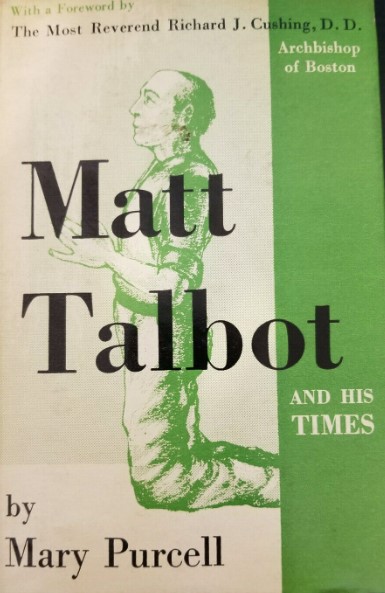
Matt Talbot and His Times - Mary Purcell
Matt Talbot: His Struggle, His Victory over Alcoholism - Susan Helen Wallace 
Matt Talbot - Xavier Carty 
Spotlight on Matt Talbot  - Edward O'Connor, S.J.
Matt Talbot - Simon O'Brynne 
The quest for Matt Talbot - Philip Rooney 
We knew Matt Talbot - Albert H Dolan
Matt Talbot - James F. Cassidy. 
An address to Pope John Paul II from the Parish of Matt Talbot, The Worker. 
Matt Talbot : the Irish worker's glory - James Francis Cassidy 
Matt Talbot - Albon White 
The Story of Matt Talbot - Malachy Gerard Carroll

The Mystery of Matt Talbot - Father Morgan Costelloe

The Mystery of Matt Talbot - Father Morgan Costelloe

The Mystery of Matt Talbot - Father Morgan Costelloe


Saturday, 25 May 2024

Prayer of the Day Matthew Talbot Canonization Prayer

Matthew Talbot Canonization Prayer

O Jesus, true friend of the humble worker, Who hast given us in Thy servant, Matthew, a wonderful example of Victory over vice, a model of penance and of love for Thy Holy Eucharist, grant, we beseech Thee, that we Thy servants may overcome all our wicked passions and sanctify our lives with penance and love like his.  

And if it be in accordance with Thine adorable designs that Thy pious servant should be glorified by the Church, deign to manifest by Thy heavenly favours the power he enjoys in Thy sight, Who livest and reignest for ever and ever.  

Amen. 


I got this from one of the many books I have read about Matt Talbot. 

Relates posts and links:

For all reviews of books about Matt Talbot Click here.

Books about Matt Talbot:
Matt Talbot and His Times - Mary Purcell
Matt Talbot: His Struggle, His Victory over Alcoholism - Susan Helen Wallace 
Matt Talbot - Xavier Carty 
Spotlight on Matt Talbot  - Edward O'Connor, S.J.
Matt Talbot - Simon O'Brynne 
The quest for Matt Talbot - Philip Rooney 
We knew Matt Talbot - Albert H Dolan
Matt Talbot - James F. Cassidy. 
An address to Pope John Paul II from the Parish of Matt Talbot, The Worker. 
Matt Talbot : the Irish worker's glory - James Francis Cassidy 
Matt Talbot - Albon White 
The Story of Matt Talbot - Malachy Gerard Carroll

Friday, 19 January 2024

‘Neath Mary's Mantle The Story of Matt Talbot Dublin Worker 1865-1925 - Rev Marius McAuliffe, OFM - CTS Books

‘Neath Mary's Mantle: 
The Story of Matt Talbot Dublin Worker (1865-1925)
Rev Marius McAuliffe, OFM
Catholic Truth Society of Ireland
CTS Booklet BH361
1952
 
‘Neath Mary's Mantle The Story of Matt Talbot Dublin Worker 1865-1925 - Rev Marius McAuliffe, OFM - CTS Books

This is the tenth volume about Matt Talbot I have read in the last year. With each volume I tracked down and read I appreciate this man, his life, and his witness even more. Also with each volume I wish I had encountered this godly man and been praying to him before my brother overdosed. This is another excellent volume about Matt, it is from the Catholic Truth Society of Ireland and was published in 1952, 27 years after the passing of Matt, the quick spread of his life of piety, prayer and devotion that spread around the world in short order after his death. People often pray to him for those struggling with the drink, as Matt himself did, but he is also becoming a go to for intercession for other kinds of addictions. The subtitle of the book on the title page is:

“The life story of Matt Talbot – Franciscan Tertiary – Dublin Worker 1856-1925”

Even having already read a number of volumes about Matt I highlighted numerous passages while reading this book. Some of them are:

“Fourteen years of hard drinking no prayer, no Sacraments, just a routine attendance at the Sunday Mass - - that is the story of Matt Talbot till the day when, at the age of twenty-six, he broke forever with the reckless, shiftless, forlorn life of drunkard.”

“Hardened drunkard that he was, he begged, borrowed, pawned, and even stole to procure more drink. On the word of his mother, we know that often he had to walk home in his socks because he had sold the boots from his feet for drink. Once he stole a violin belonging to a wandering street musician. This he duly pawned and proceeded to treat himself and its owner to a night of drink. Years after, he vainly searched the streets of Dublin, hoping to find the violinist and pay back the money. Instead, by way of restitution, he had Masses offered for the spiritual and temporal welfare of the victim.”

“One thing was certain: here was the life of no common-place mortal. This happened over twenty-five years ago, Then the name, “Matt Talbot,” was just an entry in the casualty list of a busy city hospital. His death was just a trivial item in an obscure corner of the morning paper, pushed out of the way by wars and rumours of wars, the doings of statesmen, the clamour of stocks and shares, and the results of yesterday’s thrilled sports items.”

“Fanatic or sainted genius, the world asked in 1925, when it first heard the story of the man in chains. Today his story has encircled the world. His life, written by Sir Joseph Glynn, sold 10,000 copies in four days. The first few months saw 120,000 copies sold. Within a year it appeared in France, Germany (five editions), Portugal, Spain, Italy, Holland, Poland, Hungary, Czechoslovakia, Yugoslavia, Russia, and Brittany. Pilgrims from the wide world who foregathered in 1932 for the International Eucharistic Congress in Dublin made sure to visit the humble room where Matt lived; to see the spot where he fell in death, and to pray beside the humble grave in Glasnevin Cemetery. These included a great French Cardinal, who kissed the floor of the room where a great hero of God had lived his hidden life.”

“(A Rake’s Progress) “The picture which Matt presents to us at this period is that of a young fellow going fast on the road to ruin, the craving for drink gradually mastering him, the duties of his religion almost completely neglected, and the duties to his parents entirely ignored.””

“(Conversion) Here is the story of his conversion. It appears that about the year 1884, when he was in his twenty-fifth year, Matt spent a whole week away from work drinking. Naturally, on the Saturday he collected no wage. About midday he went out with a younger brother, hoping to meet his companions and he treated by them to drink. All he got was a nod of the head from a few, and ‘Good-day, Matt.” There was no invitation to drink.” 

“What a revelation of his daily life are those words, “you’re sober!”
He answered simply. “Yes, mother, I am.”
But there was a bigger surprise in store for the poor woman. Later that Saturday afternoon he astounded her by saying, “I’m going to take the pledge.”
She must have wondered was this an answer to a mother’s prayers. However, she encouraged him by saying: “Go, in God’s Name; but don’t take it unless you are going to keep it.”
“I’ll go,” he answered, “in the Name of God.””

“(The Cloister of the Heart) Matt Talbot was no different. Actually, we are told, he “suffered intensely, for the craving for drink was strong in him and the effort to pray after so many years of neglect of prayer was very wearisome.””

“(The Tempter Foiled) So the three months went by. Matt was faithful to his pledged word, which he now renewed for a year, and later for life. Naturally, the priest to whom he had gone to Confession would have advised him to avoid the occasions of intemperance, and to seek strength in the Holy Sacrifice of the Mass and in frequent prayer. It awes hard to avoid the old company during the evenings, so he used to walk to a distant church, where he remained in prayer till it was time to return home to bed. He next joined the Confraternity of the Immaculate Conception at St. Francis Xavier’s Church, where his father was a member.”

“Like all truly spiritual men, Matt talked little of his inner life, and then only to kindred souls who know the value, the necessity of guarding the ‘secret of the King.” He had an original way of overcoming his bad habit of taking the Holy Name irreverently. He fixed two pins in the sleeve of his coat in the form of a Cross, so that he would be reminded of the Crucifixion, and thereby be helped to control his impulse of speaking irreverently.”

“(Devotion to the Mass) His day began with the Holy Sacrifice of the Mass and Holy Communion at 5 a.m. The Mass is to the church what the sun is to the world – the source of all energy.”

“At a late Mass after a night’s drunken carousal, with the now altered man that jumped from his warm bed at 4 o’clock on a very cold morning to undo the years of neglect by daily Mass. For over forty long years he was ever faithful to the daily Mass and Holy Communion. There, morning by morning, he took his place among the thronging worshippers of Dublin’s week-day congregation. There morning by morning, the silent hidden transformation went on within his soul – the world-weary spirit was renewed.”

“(The Daily Round) Rather, he lived prayer. Every opportunity that came during the day, such as slack periods between the loading of lorries, he gave to prayer. He used to retire to a quiet part of the timber yard, and there speak alone with God. Most of his lunch hour was occupied in this way. Then there were the visits to a church on his way to and from work.”

“His biographer tells us that amongst his regular prayers were the fifteen mysteries of the Rosary; the Little Office of the Blessed Virgin; the Dolour beads; the beads of the Holy Ghost; the beads of St. Michael; the beads of the Sacred Heart; the Chaplet for the souls in Purgatory; the principal Litanies; the prescribed novenas for each Church feast.”

“(Growing in Prayer) Matt was well aware of the distinction between ordinary prayer and mystical prayer or contemplation. Among his notes found after his death was the following, “In meditation, we labour to seek God, by reasoning and by good acts, but in contemplation we behold Him without labour, already found.” In meditation, the mind labours, operating with its power, but in contemplation it is God Himself Who operates and the soul merely receives the infused gifts.”

“He very rarely spoke of his prayer, but once he did say to his sister, “Susan, if I could only tell you the great joy I had last night talking to God and the Blessed Virgin.””

“(The oil of the Lamp of Prayer) Matt read for one purpose only, to know more about the purpose of his existence and how better to achieve the end. The list of books given to his biography gives us a clue to his mind. He read the very best spiritual classics beginning of course, with the Bible. He had collected a little library of these books and nothing delighted him more than to lend a book of speak to a confidant on the things he had read. These books ranged from booklets issued by the Catholic Truth Society to large and expensive books which he bought or which were presented to him.”

“(The Man Men Saw) Matt never married, though, indeed he once had a narrow escape from a would-be spouse, who did all the proposing herself! (Perhaps it was a Leap Year!) She was cook at the home of a Protestant clergyman, and was a good and pious girl. The attraction was mutual. He made a novena to Our Lady for enlightenment. The result was that he informed her that Our Lady told him he was never to marry.”

“(Matt “Downs Tools”) Yes, it is a fact that Matt “walked off the job.” He went out on strike. If he ever becomes a canonised saint he will probably have created a record by being the first saint ever to have ‘struck ‘against work. Through the years 1905-1913 there prevailed a period of industrial unrest, both in England and Ireland – strikes and locks-out were frequent. There is no need to go into the details here.”

“(Matt’s Humility) Matt saw all this clearly. He did not deny the greatness of the graces given. St. Teresa smiles pityingly at those who have the false humility to deny God’s graces. No! Humility is truth. Matt’s simple comment on his life was this: “It was God did it all.” No self-depreciation, no hiding of light under a bushel, no seeking of the world’s approval, no fear now of the world’s flattery – just the truth, “It was God did it all.” “

“(Unless Ye become as Little Children) Today his simple grave is a place of pilgrimage. The solitary who lived along with God, and was known in life to only a few, is now preached to the whole world. The saints are witnesses to the truth. They are signposts on the road of life. They point the way to better things. Long ago, St. Augustine declared that “the ignorant and unlettered arc storming Heaven, while we, with all our learning, lie grovelling in the mud.” Matt phrased the Gospel text in his own homely way when he wrote: “The Kingdom of Heaven was promised not to the sensible and educated, but to those that possess the spirit of little children.””

I hope those quotes give you a feel for this wonderful volume. I can easily recommend this volume and many of the others I have read. Some of them are hard to track down. This one I received from the National Library of Ireland through their scanning service. I am thankful I tracked it down and was able to read it. I try and say 2 different prayers to Matt every day. And with each volume I read about him, I am encouraged and strengthened in my own prayer life and in striving to become the man God wants me to be. I can easily recommend this volume to any Catholic, it is well worth tracking down and reading. 

Note: This book is part of a series of reviews: 2024 Catholic Reading Plan

For all reviews of books about Matt Talbot Click here.

Books about Matt Talbot:
Matt Talbot and His Times - Mary Purcell
Matt Talbot: His Struggle, His Victory over Alcoholism - Susan Helen Wallace 
Matt Talbot - Xavier Carty 
Spotlight on Matt Talbot  - Edward O'Connor, S.J.
Matt Talbot - Simon O'Brynne 
The quest for Matt Talbot - Philip Rooney 
We knew Matt Talbot - Albert H Dolan
Matt Talbot - James F. Cassidy. 
An address to Pope John Paul II from the Parish of Matt Talbot, The Worker. 
Matt Talbot : the Irish worker's glory - James Francis Cassidy 
Matt Talbot - Albon White 
The Story of Matt Talbot - Malachy Gerard Carroll

The Mystery of Matt Talbot - Father Morgan Costelloe

The Mystery of Matt Talbot - Father Morgan Costelloe

The Mystery of Matt Talbot - Father Morgan Costelloe


Saturday, 30 December 2023

Top Ten Non-Fiction Books 2023

Top Ten Non-Fiction Books 2023


It has been a very good year for reading, in fact it is my best to date, and not likely ever to be matched. I have read 455 books this year, many great reads, and a few new authors that I had not explored yet, with plans to read more from some of them.  I have read just over a book and a quarter a day, in comparison with the last 7 years:

     455 - 2023 
     438 - 2022
     365 - 2021
     317 - 2020 
     392 - 2019
     359 - 2018
     380 - 2017 
     272 - 2016 

But back to this year by the numbers:

Books Read: 455
First Time Reads: 346
Fiction: 210
Non-Fiction: 246
5/5 Stars: 346

The first half of this year was exceptional. The second half work got fairly busy with a lot of overtime and weekend implementations that cut into reading time. I can state again that looking back 2016 is a bit of an outlier as late that year I switched jobs and have since had much better work – life balance. In the spring of 2016, I worked through Brandon Vogt’s course Read More Books Now (now available on ClaitasU). The year before that I removed all games from my phone and tablet and my reading had doubled. 

Top Ten Non-Fiction Books 2023:

1. Vision Books for Young Readers from Ignatius Press
2. Books about Saint David of Wales       
3. Books by Pope Benedict XVI
5. CTS Biographies from the Catholic Truth Society
6. Books About Matt Talbot 

Bonus Books:

As can be seen by the numbers, my reading has been up over each of the last few years, thought I doubt I will ever match this years total of 455 volumes. And I thought last year would be a high watermark. But this year is proved me wrong, but I doubt I will ever match this level again. This reading success I in part attribute to Brandon Vogt’s course Read More Books Now, removing all games but 1 brain game from my devices. And I was commuting to work on a bus and read on the bus every day. Working from home reading took a little more discipline, and we are now back to a hybrid model with 5 days a month in the office, so things are changing again. 

In April of 2023 I wrote a piece called How I Read So Much? Because I get asked the question so often, read the piece linked above if you are looking for some ideas on ways to read more. 

Note: I do not include books that have been read in previous years and were reread this year in my top ten lists, they are sometimes in the bonus section. But if you want more options check out my favourite books year by year list. Or this year not to flood the list with one specific author.   


Relates Posts: 
Top 10 Fiction Books 1st Quarter 2010
Top 10 Fiction Books 2nd Quarter 2010
Top 10 Reading Goals for 2010
Top 10 Fiction Books 3rd Quarter 2010

Top 10 Fiction Books 4th Quarter 2010
Top Ten Reading Goals For 2010 - Recap

Top 10 Fiction Books 2010
Top 10 Picture Books of 2010
Top 10 Non-Fiction Books of 2010

Top 10 Graphic Novels for 2010
Top Ten Reading Goals For 2011
 

Top Ten Fiction Books 1st Quarter 2011
Top Ten Fiction Books 2nd Quarter 2011
Top Ten Reading Goals for 2011 Update
 
Top Ten Fiction Books 3rd Quarter 2011 
Top Ten Fictions Books 4th Quarter 2011
Top Ten Fiction Books 2011
Top Ten Reading Goals 2011 - Recap
Top Ten Reading Goals 2012
Top Ten Fiction Books 1st Quarter 2012
Top Ten Fiction Books 2nd Quarter 2012

Top Ten Fiction Books 3rd Quarter 2012
Top Ten Fiction Books  4th Quarter 2012
Top Ten Fiction Books 2012
Top Ten Non-Fiction Books 2012
Top Ten Reading Goals 2012 - Recap
Top Ten Reading Goals 2013
Top 10 Fiction Books 1st Quarter 2013
Top 10 Fiction Books 2nd Quarter 2013
Top 10 Books Second Half 2013
Top Ten Fiction Books 2013
Top Ten Non-Fiction Books 2013 
Top Ten Books First Quarter 2014
Top Ten Books Second Quarter 2014
Top Ten Books Third Quarter 2014
Top Ten Books Fourth Quarter 2014
Top Ten Fiction Books 2014
Top Ten Non-Fiction Books 2014
Top Ten Books First Quarter 2015
Top Ten Books Second Quarter 2015
Top Ten Books Third Quarter 2015
Top Ten Books Fourth Quarter 2015
Top Ten Fiction Books 2015
Top Ten Non-Fiction Books 2015
Top Ten Books First Quarter 2016
Top Ten Books Second Quarter 2016
Top Ten Books Third Quarter 2016
Top Ten Books Fourth Quarter 2016
Top Ten Non- Fiction Books 2016
Top Ten Fiction Books 2016
Top Ten Catholic Books
Top Ten Books First Quarter 2017
Top Ten Books Second Quarter 2017
Top Ten Books Third Quarter 2017
Top Ten Books Fourth Quarter 2017
Top Ten Non-Fiction Books 2017
Top Ten Fiction Books 2017
Top Ten Books First Quarter 2018
Top Ten Books Second Quarter 2018
Top Ten Books Third Quarter 2018
Top Ten Books Fourth Quarter 2018
Top Ten Non-Fiction Books 2018
Top Ten Fiction Books 2018
Top Ten Books First Quarter 2019
Top Ten Books Second Quarter 2019
Top Ten Books Third Quarter 2019
Top Ten Books Fourth Quarter 2019
Top Ten Non-Fiction Books 2019
Top Ten Fiction Books 2019
Top Ten Books First Quarter 2020
Top Ten Books Second Quarter 2020
Top Ten Books Third Quarter 2020
Top Ten Books Fourth Quarter 2020 
Top Ten Books First Quarter 2024
...   

All Top Ten Lists on Book Reviews and More

Statistics Books Read By Year:

455 - 2023 
438 - 2022
365 - 2021
317 - 2020 
392 - 2019
359 - 2018
380 - 2017 
272 - 2016 
177 - 2015 
130 - 2014 
88 -  2013
176 - 2012 
163 - 2011
302 - 2010
142 - 2009
98 - 2008
83 - 2007
191 - 2006
151 - 2005
60 - 2004
52 - 2003
97 - 2002
50 - 2001
41 - 2000
71 - 1999
73 - 1998
131 - 1997
101 - 1996


Wednesday, 30 August 2023

The Mystery of Matt Talbot - Father Morgan Costelloe

The Mystery of Matt Talbot
Father Morgan Costelloe
1981
32p
 
The Mystery of Matt Talbot - Father Morgan Costelloe

This is one of two volumes written about Matt Talbot by Father Costelloe, who at the time of writing this volume was the Vice-Postulator for the cause of Venerable Matt Talbot, the other is titled Matt Talbot: Hope for Addicts which had 2 editions in 1989 one by Veritas and one by Hyperion Books. This is one of several volumes I have read about Matt Talbot this year, this is the eighth such volume, and I have at least that many I would still like to track down. This is one I received a scanned copy of from the National Library of Ireland, for they will scan out of print volumes for a price. A service I am very grateful for. This volume received the Nigil Obstat and Imprimi Potest. The copy I have does not have a back cover, so I have no description from the dust jacket. The inside front cover has 5 quotes of how others saw Matt, they are:

“He was a pleasant man and would laugh and talk with visitors. He sought to conceal his prayers and fasts.”
Mrs Mary Andrews, his sister.

“He was a pleasant, approachable and kindly man. He had a lovely smile. He seemed completely oblivious of what happened around him when he was praying.”
Sean T. O'Cea llaigh, altar server, later President of Ireland.

“At our first meeting I tried to ascertain whether the Servant of Cod was quite a normal man - free from eccentricities and with commonsense views on religious matters. He made a most favourable impression on me. Th ere was nothing nervy or over-wrought in his manner.”
Raphael O'Callaghan, Company Director and a close friend.

“He carefully avoided all ostentation, especially as regards his penances. He was a good, conscientious workman. I never met anybody like him. He was totally wrapped up in Cod.”
Daniel Manning, fellow worker in the timber yard.

"Before I was married, I used visit him frequently, and I always found him very gentle, good-humoured and ready to enjoy a joke."
Mrs Annie Johnson, his niece.

The sections in this booklet are:

Introduction
     Irish Monasticism
     Means Towards an End
     Well-tried Faith
     The ‘Hard’ Man
     Change of Life Style
     Hymns from the Top Flat
The Irish Way
     Praising God
     One Full Meal
     Monks at Work
     And So to School
     ‘Green’ Martyrdom
     Pilgrims for Christ
     Queen of Ireland
The Mystery of Matt Talbot
     ‘Old Reliable’
     Lost in Prayer
     The Word of God
     The Good Queen
     A Cluster of Books
     The Thought of Others
     Matt’s Menu
     Unskilled Labourer
     ‘No Time for Money’
     Mission to China
     The Folly of Christ
     ‘A Holy, Old Man.’
     Totus Tuus
     No Half-Measure
     The Irish Dimension

While reading this volume I highlighted numerous passages. Some of them are:

“As the Vice-Postulator of the Cause of Venerable Matt Talbot, I have heard similar remarks in Ireland and abroad. There is an aspect of his spirituality that appears forbidding and mysterious. Where did he get the idea for his fasts, his long night vigils and his awesome asceticism? The answer is that, under the guidance of a spiritual director, he imitated the life of the monks in the early Irish monasteries.”

“This booklet is not another biography of Matt Talbot. It presupposes that the reader has heard his life-story which is well told in Mary Purcell's Matt Talbot and his. Times and Father Edward O'Connor's Spotlight on the Venerable Matt Talbot. The purpose of this booklet is to explain the spiritual programme that led him to close union with God.”

“Many Irish persons today have lost a sense of history. They can name some of the great monasteries like Clonard, Glendalough and Clonmacnois, which became world famous through the visit of Pope John Paul 111979, but they know little about the life of the monks who lived there. They go on pilgrimage to Lough Derg. known as St Patrick's Purgatory, without realising that this penitential exercise has its roots in early Irish spirituality which has always emphasised the need for penance: ' Unless you repent you will all likewise perish' (Lk 13:3).”

“One of the extraordinary events in our history was the widespread interest in the monastic life which manifested itself within a hundred years of the death of St Patrick by the end of the sixth century there were thirty major monastic settlements scattered through the country and we are told of young men and women flocking to consecrate their lives to God. At first a hermit would set up his cell m a secluded spot to communicate with God in private; but the news would spread and others would gather around. him to seek his advice on prayer. Eventually small self-suff1c1ent communities were formed and the hermit's life, in the strict sense, was almost a thing of the past. The spiritual acorn became a mighty oak, some monasteries having as many as four thousand people including overseas students. Glendalough and Clonmacnois became university cities of their day, while remaining. like all the monasteries, places of prayer, solitude and study.”

“Life in the monasteries was summed up by St Columbanus as 'pray daily, fast daily, study daily, work daily' (Opera p.24). The great monks, who were proposed as models, were those who persevered in strict obedience to their Abbot, over forty or fifty years.”

“They held that if they could reduce its need for food, sleep and comfort to a minimum they would produce maximum response to God's inspiration for prayer and charity.”

“Asceticism was the order of the day in monastic I re land. It was so strict that scholars look to the Eastern Church to find anything like it Innumerable prostrations and genuflections during prayer were common.”

“This spiritual father was given the beautiful Irish title of 'anamchara', which translated into English, means ' soul-friend'. He was both confessor and advisor, who constantly reminded the monk that austerity was not an end in itself, only a means towards closer union with God. The need for an individual spiritual director was considered so important that novices were told that a monk without one was 'like a body without a head'.”

“There was nothing easy about life in these (Irish monastic) communities. Their ways of ascetic piety would be regarded by most men of the twentieth century as quite insane'. He goes on: 'All the monks submitted to a penitential regime, which seems astounding to our easy-going ways. The ideal of penance was what these men set out to find in cells lost in the midst of woods or in the most desolate countryside. The finest examples of a well-tried faith we reforged here' (Introduction to Ireland: Isle of Saints by G & B Cerebeland-Salagnance).”

“It was an unlikely beginning of a deep intimacy between him and his Saviour that would bridge the next forty years. To strengthen his resolution further, he decided to attend Mass and receive Holy Communion every day before work It was a revolutionary ideal In Ireland of the 1880's a good-living layman went to the altar just twice a year, at Easter and at Christmas. A nun or a Brother with religious vows went only on Sundays.”

“To fill in his time after hours and to satisfy his increasing interest in religious matters, he joined the Third Order of St Francis attached to the Franciscan Church, Merchant's Quay. He continued to go to Mass and Holy Communion every morning in the Jesuit church, Gardiner Street near his home and became a member of its Workingmen's Sociality dedicated 'to Our Lady Immaculate.”

“Although illiterate when he left school, he gradually learned to read and write. Matt became friendly with another priest, Dr. Michael Hickey, later Monsignor, of Holy Cross College, Clonliffe, who played a major role in his spiritual formation. An enlightened confessor and scholar, he became Matt's director, a true 'anamchara' guiding him in the way of Irish spirituality.”

“When we consider the principal elements in the life of the early Irish monk, it is easy to see how they were parallelled in the life of this Dublin workman. These were: prayer, fasts, mortifications, work, study, devotion to Our Lady and missionary drive. Let us consider each in turn.”

“The monk was a 'miles Christi', a soldier of Christ, who set out to conquer self in order to draw closer to God. It was a kind of martyrdom, as the monks acknowledged. Few Irish monks suffered red martyrdom -shedding their blood for the sake of the Gospel- although St Killian and his companions did when they travelled to Wurtzburg in Germany. But all the Irish monks were expected to achieve what was called 'white' martyrdom•- ·the renunciation of everything one loved, living in complete poverty of spirit. There was a higher stage on the way to perfection, however, for monks who performed additional penance by fasting and labour and sought the profoundest humility. The monks described this as 'green' martyrdom.”

“He continued to attend Mass and to receive Holy Communion at5 o'clock Mass every morning in Gardiner Street Church. But when the time of this first Mass was changed to 6.15 Matt discovered that he was unable to return home for his breakfast and get to work in time, so he changed his job.”

“Even during the Easter Rising of 1916 he made his way through military barricades to attend Mass. Sunday was D-day. He went to first Mass and
stayed in the church until the last Mass concluded with Benediction. Since he was obliged to fast from midnight in order to receive Holy communion, he did not have his breakfast until after 1.30 p.m. Occasionally he moved from one church to another on Sundays, depending on where his various Sodalities met He might slip away from the Jesuit Church, Gardiner Street to the Franciscan Church, Merchant's Quay or to the Dominican Church, Dominick Street.”

“He made himself as inconspicuous as possible, a small, poor man. He never used a prayer book but prayed with his eyes shut He knelt erect in the bench, hour after hour, with his hands joined in front of him. He did not allow them to rest on the seat in front of him and so remained upright without support He did not stand for the gospel, a habit he learned from a saint to retain recollection. To the members of the Franciscan Church choir, who saw him from the gallery huddled in deep prayer, he was affectionately known as the ' old reliable'.”

“His visits to a church were not limited to Mass time. He paid a visit to the Blessed Sacrament on his way to work, 'to see the Lord on the way down', as he said, and again after work 'to see the Lord on the way home'. Remembering that as a rule he returned to a church after his evening meal for a Sodality meeting. he saw a lot of the Lord.”

“His little room at 18 Upper Rutland Street had the bare necessities of a monastic cell. He had an iron bedstead, a chair, a table, a crucifix and a few holy pictures. His bed covering was a sheet and a half blanket, supplemented by an old sack during the cold winter nights.”

“He recited fifteen decades of the Rosary and the Little Office of the Blessed Virgin every day. He made Novenas for her feast days. He turned to her for guidance when a girl proposed marriage. There were five books about Our Lady found in his library and as we will see, it was through his devotion to her that his secret life of prayer, charity and penance was revealed to the world.”

“His spiritual books provided food for prayer, meditation and a deeper understanding of the Faith, but they provided a formidable challenge for a man, who could neither read nor write when he left school. He had painstakingly overcome these handicaps as an adult, but he explained that he read books very slowly, and prayed to the Holy Spirit {or enlightenment.”

“But there were not many ordinary days. Even in the early years of his conversion, be observed a ' black fast' during Lent and again during June in honour of the Sacred Heart. He had a ' black fast' during · Advent to prepare for Christmas and another after Easter in preparation for Pentecost Every Saturday he fasted on dry bread and black tea in honour of Our Lady.”

“He was agreeable and cheerful with the other workmen. He was more silent and recollected than they were but they liked him and respected him.”

“He lived his life of asceticism for almost forty years, largely unnoticed by his workmates and neighbours. On reflection, he struck them as the perfect example of self-abasement - poor, clean and shabbily dressed, but always alert to the needs of others. Towards the end of his life he seemed to live in the presence of God.”

“He concealed his life of asceticism and settled into the _routine of patients, receiving Holy Communion just once a week and eating the ordinary hospital meals. Sister Mary Dolores, who looked after him during that time, was amazed when she discovered, years later, that she had nursed the Servant of God.' Matt Talbot never showed by his conduct' she said later at the sworn inquiry of the Ordinary Process, 'that he was anything more than a sweet-natured, holy, old
man'.”

“In the sections 236 to 242 of the book St Louis Marie points out the difference between a child of Mary and a slave of Mary: a child has rights, a slave has surrendered all. It is summarised in the motto of Pope John Paul 11: Totus Tuus ‘Totally yours’. A Christian who considers himself a 'slave of Mary' will live very close to his mistress and therefore, very close to her Son.”

This was an absolutely fascinating read. It was as much a history of Irish monasticism, Irish spirituality, and history as the story of Matt. And being written by the then postulator it was intriguing to see what he focused on compared to other biographies of this saintly man that I have read.  

This book is an excellent resource and I believe a few different editions were published; I have seen at least three covers for this volume. It is an amazing read, and I can easily recommend it. Matt is a man whose witness we need today even more than in his time. My own brother overdosed at the beginning of the pandemic. I wish I had discovered Matt and his story years ago to share with my brother. The number of people addicted to alcohol, weed, opioids and other drugs are constantly on the rise. I wish this volume was back in print and available as an eBook, there are dozens of people I would recommend it to. It is well worth tracking down and giving a read. 

Note: This book is part of a series of reviews: 2023 Catholic Reading Plan

For all reviews of books about Matt Talbot Click here.

Books about Matt Talbot:
Matt Talbot and His Times - Mary Purcell
Matt Talbot: His Struggle, His Victory over Alcoholism - Susan Helen Wallace 
Matt Talbot - Xavier Carty 
Spotlight on Matt Talbot  - Edward O'Connor, S.J.
Matt Talbot - Simon O'Brynne 
The quest for Matt Talbot - Philip Rooney 
We knew Matt Talbot - Albert H Dolan
Matt Talbot - James F. Cassidy. 
An address to Pope John Paul II from the Parish of Matt Talbot, The Worker. 
Matt Talbot : the Irish worker's glory - James Francis Cassidy 
Matt Talbot - Albon White 
The Story of Matt Talbot - Malachy Gerard Carroll

The Mystery of Matt Talbot - Father Morgan Costelloe

The Mystery of Matt Talbot - Father Morgan Costelloe

The Mystery of Matt Talbot - Father Morgan Costelloe