Showing posts with label ClunyMedia. Show all posts

Saturday, 8 July 2023

The Irish Story - Alice Curtayne - Cluny Media Reprint Edition

The Irish Story
A Survey of Irish History and Culture
Cluny Media Reprint Edition
Alice Curtayne
ISBN 9781952826122
Previous editions:
Kenedy & Sons (1960)
Clonmore & Reynolds (1962)


A few years ago I fell in love with the works of Alice Curtayne. I first encountered the writings of Alice Curtayne through her book Twenty Tales of Irish Saints, I was captivated by her writing style and her style as a hagiographer. And I started tracking down her other writings. This is not proving an easy task. The first problem is that only 2 of her works were in print at that time. Second many of her books never had North American editions, and that made them hard to find in Canada or even copies that would ship to Canada. Her first book was published in 1929 and her last I believe in 1977. I believe this was the second last volume she published. She wrote histories, most focused on saints. She wrote a few novels. And she wrote extensively for newspapers and magazines. I have also found that she wrote pamphlets for the Catholic Truth Society and other Catholic organizations. Cluny Media has released 5 of her books in reprint editions and one she contributed to, The Irish Way.  Most are available as paperbacks or hardcovers, and to date only one has a digital edition, this Cluny reprint edition released in 2020. At the time there was indication that eBooks editions would be forthcoming but 3 years on they have not materialized. This is the seventh volume I have read from Cluny Media. 

The description of this edition of this book states:

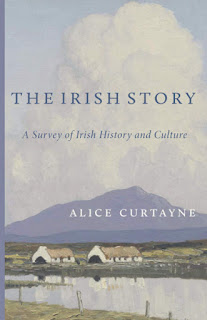
“The Irish Story surveys the history and culture of the Emerald Isle, beginning from the Celtic Sagas and the coming of Christianity to the penal years and the Easter Rising of 1916. In these pages, Curtayne uncovers the roots of the Irish experience, traces its evolution from pagan outpost to the heart of Western civilization, and testifies to its trials and tribulations as an English colony and its struggle for independence. Conscientious and uncompromising, Curtayne focuses on the characters of Ireland: the “Irish story” is drawn from the particular people, the flesh-and-blood men and women, whose faith, fervor, and creativity lent Ireland its shape and its spirit. Originally published in 1960, The Irish Story is an absorbing and rewarding narrative of Ireland from its earliest documented days to the mid-twentieth century, introducing its key people and places and presenting its mythos with heartfelt honesty.”

Before we get to the review of this specific volume I want to restate, that it should be noted that this reprint edition from Cluny is very well done. Unlike many books brought back from the public domain, this volume went through a process of a high quality scan. And a complete re-typesetting. Cluny is dedicated to restoring quality editions of old books, focused on the Catholic Tradition. Their motto is: ‘Promote the tradition. Preserve the Past.’ Which is a very worthy cause. I really appreciate the work of Cluny Media, they are trying to restore Catholic books, bringing them back into print in wonderful physical editions and for a few eBooks. They are excellent editions. I just wish they had eBooks for all volumes.

The chapters in this volume are:

Heroes of the Celts
Ireland Goes Christian
The Art of the Golden Age
The Descent of the Vikings
The Two Archbishops
Norman Conquest and Gaelic Recovery
A Martyr and a Soldier
Another Martyr and Soldier
The Penal Night
O’Connell, Davitt and Parnell
1916
Literature in Twentieth Century Ireland

This was a fascinating read from beginning to end. It begins with the earliest histories and legends and goes right up to the time of writing. It is a history of a nation and a people written in bread strokes, and yet also fine details. It span centuries, but shows what makes us Irish so very Irish. It covers from the year 3000 B.C. to 2000 A.D. and yet it is so riveting the reader will come to the ends of the volume and be desperate for more. 

Curtayne writes in a flowing style that is easy to engage with. Readers are drawn in and become captivated by the events, people and places whose stories she tells. She is a master wordsmith and this is an excellent offering. The volume begins with these words:

““Betcha ye didn’t see Queen Scota’s grave.” This used to be piped in mocking tones by the children in my native town of Tralee in county Kerry. To go on a holiday expedition to Gleann Scotin, or Scota’s Glen, was one thing; to stand on the very flagstone underneath which the Queen is buried was another. The glen is only three miles south of the town, but the miles are uphill and the grave lies almost at the top of the rugged place. As children, we considered it a point of honor to salute Scota when visiting the lovely glade.”

And the volume ends with these words:

“Early in its history, the Gaelic League founded An Toireachtas, an annual festival of the Irish language and culture. This had lapsed during the years of strife, but has since been restored as an annual nine-day event, held in October. It includes competitions for original works in verse and prose, music, drama, traditional singing, story-telling and an important art exhibition.

After a slow start, during which people were confused and inhibited by political catch-cries, aftermath of the troubled years, a wave of national effort at cultural reconstruction is now sweeping the country. There is a new clamor for the products of all creative workers, which is evoking response. Every year sees some exciting development—it may be a set of stained glass windows in a church, a book in Irish, or an original play. No one knows to what crest this wave may yet carry us.”

Having read a number of volumes on Matt Talbot over the last few months including Curtayne’s own, The Holy Man of Dublin or the Silence of Matt Talbot
I see much better how he fits in his times and history. And Much of the history I have been taught in school, in the home, and from extended family here in Canada and from the emerald isle I now look at with much different lenses. I have absolutely loved several of Curtayne’s books about saints for young readers. And this volume rounds out the history of the Irish before and after the eras of those great saints. It was a fascinating and vastly entertaining read!

The Cluny edition with its freshly reset type and artistic covers is a pleasing book to hold and read. As with all titles I have read from Cluny or from the pen of Curtayne I am thankful to have given this a read. And very thankful it is back in print. But I will state again with my dual form of dyslexia I really wish this volume and the other by Curtayne were available digitally so I could change the font, and font and page colour to make it more accessible. That being stated, yet again, I can say this is an excellent volume I can easily recommend!

Note: This book is part of a series of reviews: 2023 Catholic Reading Plan

For All reviews of Books from Cluny Media click here.
For All reviews and articles about Alice Curtayne click here.

Books and Booklets by Alice Curtayne:
A Recall to Dante
Francis Ledwidge: A Life of the Poet
Lough Derg: St. Patrick's Purgatory
Patrick Sarsfield
Saint Anthony of Padua
Saint Bernard and His Friend Saint Malachy
St. Bernard Doctor of The Church 1933

Books Edited by Alice Curtayne:
The Complete works of Francis Ledwidge
...

Books Translated by Alice Curtayne:
Labours in the Vineyard by Giovanni Papin
...

Books Contributed to by Alice Curtayne:
...

Friday, 23 June 2023

House of Cards - Alice Curtayne - Cluny Media Reprint Edition

House of Cards:
Cluny Media Reprint Edition
Alice Curtayne

ISBN 9781950970742
Previous editions:
The Bruce Publishing Company (1939)
Phoenix Publishing (1939)
Talbot Press (1940)


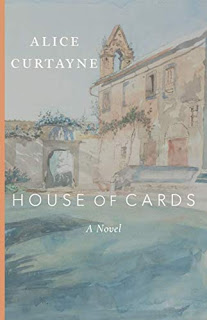
A few years ago, I fell in love with the works of Alice Curtayne. I first encountered the writings of Alice Curtayne through her book Twenty Tales of Irish Saints, I was captivated by her writing style and her style as a hagiographer. And I started tracking down her other writings. This is not proving an easy task. The first problem is that only 2 of her works were in print at that time. Second many of her books never had North American editions, and that made them hard to find in Canada or even copies that would ship to Canada. Her first book was published in 1929. She wrote histories, most focused on saints. She wrote a few novels. And she wrote extensively for newspapers and magazines. I have also found that she wrote pamphlets for the Catholic Truth Society and other Catholic organizations. I believe that Cluny Media has released 5 of her books in reprint editions and one she contributed to, The Irish Way.  Most are available as paperbacks or hardcovers, and todate only one has a digital edition. Alice Curtayne wrote only a couple of novels that I am aware of. This is the first I have read. It was originally published in 1939, though the description of this edition states 1940. I have been able to confirm 4 other editions all between the years 1939 and 1940. Both editions in Ireland and the United States. This Cluny reprint edition released in 2020. At the time there was indication that eBooks editons would be forthcoming but 3 years on they have not materialized. This is the sixth volume I have read from Cluny Media. 

The description of this edition of this book states:

“House of Cards, originally published in 1940, delves into the explicable workings of the human heart. At the age of seventeen, Anne Farrelly leaves her hometown in the West of Ireland for England, eager for the adventure of education and the promise of a career to follow. In the decade that follows, Anne works up from a lowly position at a struggling English school to a directorship at an Italian firm’s Rome offices, all the while contending with the question of whether she must be married in order to find true fulfillment. Through every turn—romantic, tragic, or comedic—Curtayne presents the concrete difficulties, fraught decisions, and testing freedoms in the life of a young woman. Curtayne’s first foray into the realm of fiction, House of Cards is a debut novel worthy of serious consideration for its compelling dramatic arc as much as for its distinctive and credible an ambitious young woman who may stand to lose more than she gains by her choices.”

Before we get to the review of this specific volume I want to restate, that it should be noted that this reprint edition from Cluny is very well done. Unlike many books brought back from the public domain, this volume went through a process of a high quality scan. And a complete re-typesetting. Cluny is dedicated to restoring quality editions of old books, focused on the Catholic Tradition. Their motto is: ‘Promote the tradition. Preserve the Past.’ Which is a very worthy cause. I really appreciate the work of Cluny Media, they are trying to restore Catholic books, bringing them back into print in wonderful physical editions and for a few eBooks. They are excellent editions. I just wish they had eBooks for all volumes.

This book was a very different read for me. It was the first of Curtayne’s novels I have read. I had a pretty good idea early in where the story was going and it took longer to get there than I expected. Anne Farrelly is an easy enough character to like, and appreciated. Based on when it was published I was surprised that the rise of fascism did not play into her decision to leave Italy. For the first two thirds of the book it was good writing, pleasant descriptions, and very realistic story akin to Madeleine L’Engle’s adult fiction that I am familiar with. The final third moved at a much quicker pace and was more relatable. 

If the story were written today, it would be considered historical fiction starting over 100 years ago. But at the time it was just fiction, and it does capture the essence of an orphan striving for meaning and finding her place in the world, even if looking back later there are some regrets. It is not my favourite of Curtayne’s works. It was an entertaining story and well written. It is not the type of story I would pick up today to read and there are several published each year set in and about that time and up to just after WWII. The Cluny edition with its freshly reset type and artistic covers is a pleasing book to hold and read. As with all titles I have read from Cluny or from the pen of Curtayne I am thankful to have given this a read. And very thankful it is back in print. 

Note: This book is part of a series of reviews: 2023 Catholic Reading Plan

For All reviews of Books from Cluny Media click here.
For All reviews and articles about Alice Curtayne click here.


Wednesday, 29 June 2022

Saint Brigid of Ireland - Alice Curtayne - Cluny Media Reprint Edition

Saint Brigid of Ireland:
Cluny Media Reprint Edition
Alice Curtayne

ISBN 9781685950200
eISBN 9781685950507
ASIN B09W6MFQY7
Previous editions:
Browne and Nolan (1934)
Sheed and Ward (1954 Revised Edition)


A few years ago I fell in love with the works of Alice Curtayne. I first encountered the writings of Alice Curtayne through her book Twenty Tales of Irish Saints, I was captivated by her writing style and her style as a hagiographer. And I started tracking down her other writings. This is not proving an easy task. The first problem is that only 2 of her works were in print at that time. Second many of her books never had North American editions. Her first book was published in 1929. She wrote histories, most focused on saints. She wrote a few novels. And she wrote extensively for newspapers and magazines. I have also found that she wrote pamphlets for the Catholic Truth Society. I believe that Cluny Media has released 5 of her books in reprint editions and one she contributed to, The Irish Way.  This is the first to have an eBook edition, the others are a mic of paperbacks and or hardcovers. Alice Curtayne has two works with the title St. Brigid of Ireland, this one a full-length history originally published in 1934 and revised in 1954, and the Cluny edition released in 2022. And also, one of her Catholic Truth Society pamphlets called 'Saint Brigid, The Mary of Ireland'. I have read both this and the pamphlet is a separate work. But I have now read this one twice. A few years back I found an out of print copy from Sheed and Ward, shipping was prohibitive to Canada, so I shipped it to a friend in the country I found it and he scanned me a copy.  This is the fifth volume I have read from Cluny Media. Before we get to the review of this specific volume I want to restate:

It should be noted that this reprint edition from Cluny is very well done. Unlike many book brought back from the public domain, this volume went through a process of a high quality scan. And a complete re-typesetting. Cluny is dedicated to restoring quality editions of old books, focused on the Catholic Tradition. Their motto is: ‘Promote the tradition. Preserve the Past.’ Which is a very worthy cause. I really appreciate the work of Cluny Media, they are trying to restore Catholic books, bringing them back into print in wonderful physical editions and for a few eBooks. They are excellent editions. I just wish they had eBooks for all volume. The description of the Cluny edition of this book is:

“Saint Brigid of Ireland shares with Saint Patrick and Saint Columcille the honor of being patron of the Emerald Isle. In this brief yet highly illuminating biography, Alice Curtayne details the legacy of Brigid with lively descriptions of her character and family history; her virtues and miracles; her monastic foundations and missionary achievements; and her lasting influence on Irish culture. By all accounts, Brigid of Kildare was unique in her own time and place: as a fifth-century woman, she “stood isolated, without prototype, without peer. When she arose it was as though with a decisive movement she pulled back a heavy curtain shrouding the scene. And at that gesture all the other actors on the stage stand transfigured before a landscape where they see for the first time such freedom as they had never dreamed of, and beyond, Vision, the world opened to them by the Faith.”

Proof of both its subject’s enduring greatness and to its author’s obvious talent, Saint Brigid of Ireland is a heartily enjoyable and edifying biography of one of Ireland’s—and the Church’s—greatest saints.”

The chapters in this work are:

One: The Women of 450
Two: The Shaking Sod
Three: The Fiery Arrow
Four: Brigid and the Bishops
Five: Kildare
Six: The Brigidine School of Mystics
Seven: The Bounty of Brigid
Eight: “A Spray of Irish Fioretti”
Nine: The Wisdom of Brigid
Ten: The Tree of Love

This volume received both the Nihil obstat and Imprimatur in 1954. My youngest saw this book cover on my kindle and was wowed by the artwork. She is familiar with the saint as Brigid is her older Sisters confirmation Saint. Even though she is only 11 she wants to reread this book with me. To be honest I have loved everything I have read from Curtayne. And I am very thankful that Cluny Media is bringing her works back into print. Having read several books about St Brigid much in this work was familiar. And even more so this second time through. This book also crosses over and touches upon a number of other Irish Catholic saints, of course Patrick, but also others that came after Brigid. I greatly appreciated the comparison between Saint Brigid's spirituality and that of Saint Francis of Assisi. I highlighted over 34 passages on my first reading of the eBook edition some of them are:

"St. Brigid, who ranks with Patrick and Columcille in Ireland's Great Triad of Saints, arose in that period where certainty begins in our record. She stands in that first shaft of light that illuminates our history, literature, topography, art and architecture. The strength of Irish devotion to her is expressed in the very repetition of our Kilbrides, Templebreedys, Tobarbrides, Kilbreedys, Rathbrides, and Drumbridges. No one having the slightest acquaintance with Ireland can miss her name, so hugely is it scrawled across the landscape. The ancients affixed it to enduring things, like running water and glens that should witness to her forever."

“Her cult is distinguished too, by a certain freshness of enthusiasm. There is still preserved in its texture an element of surprise, a delight, such as men might experience on beholding dawn for the first time. Even after fifteen hundred years her name has never sunk into somnolence, but still vibrates in the ear of the Irish people like a trumpet blast. All this is universally known, but not in the least understood. It is not understood because with the passage of time we have lost sight of the strange singularity of Brigid.”

“Daughters had right of inheritance in Ireland centuries before it was conceded in other countries, and the same liberal tendency is everywhere evident in our ancient literature. The women of 450 had special places or sections in the public assemblies. They had organized games of their own at fairs, and even enclosures reserved for them.”

“Christianity was forbidden to slaves because it was an inconvenience to slave-owners when bond-people asserted a right to respect family ties.”

“The stage is roughly set for St. Brigid’s appearance: a dark stage on which benighted figures flit confusedly. What is remarkable about Brigid is that she did not belong to the women of 450. She stood isolated, without prototype, without peer. When she arose it was as though with a decisive movement she pulled back a heavy curtain shrouding the scene. And at that gesture all the other actors on the stage stand transfigured before a landscape where they see for the first time such freedom as they had never dreamed of, and beyond, Vision, the world opened to them by the Faith.”

“In this war-riven land Brigid was born, as has been said, of the kingdom that was the most persistently belligerent, Leinster of the battles. Her birth-place was Faughart, three miles from Dundalk, in the County Louth, and the date was about the year 453. Her father was Dubthach (pronounced Duffack, its modern equivalent being Duffy), a pagan petty king or chieftain, and her mother was a Christian bondwoman named Brocessa, who belonged to his household.”

“If the account of St. Brigid’s parentage be exact, she derived one advantage from it: that complete disregard for the accident of birth nearly always expressed by the children of unequal unions. As we shall see, it was her habit in later life to converse with kings as with equals and to treat slave-girls as sisters, whose freedom she passionately claimed.”

“It was not so. In Celtic Ireland the muse was exalted. The poet was highly, even excessively, remunerated for his services to the community. He was not then down-at-heel. He wore rich apparel; he dined well; he drank deep; he swaggered. He had property and servants. He travelled about with a retinue and his whole life was passed in visits and entertainment. At table he had to have the seat of honour and the choicest cut from the joint.”

“It was Brigid who changed the face of things and saved the early Irish feminine ascetic movement. She saved it by the innovation of community life. From the moment her mother’s liberty was ensured and her father’s objections silenced, she began the organization of women. She had seven companions with her when she went to be received into the religious life. Those eight seem never again to have separated.”

“Brigid did not live an enclosed life. In her case going into a convent meant becoming one of the most indefatigable travellers in the land. She is one of the most interesting products of Irish monasticism.”

““Founding” in the early Christian sense meant something far more strenuous than blessing the first stone. The convents then were, as a rule, clusters of wattle and clay huts, enclosed by great stone or earthen walls. When Brigid founded such a settlement, she had first to supervise the building. Then she had to provide the furnishings and staff the place with a few competent sisters whom she had trained. When she had the machinery in motion, she left them in charge and hastened on with a companion or two to a fresh field.”

“Once seven bishops went to visit her, and they have become famous as the Seven Bishops of Cabinteely. Do you suppose Brigid was disturbed by that invasion? No. She sent one sister to the cows that had already been milked twice that day, and another sister to a larder that was as empty as Mother Hubbard’s; yet another sister to an ale-vat that was drained dry. But the bishops feasted adequately, for food was a commodity Brigid never failed to find her guests.”

“Very surprising is the discovery that the feminine inspiration which delighted Europe in later centuries down to modern times was already an accepted feature of the early Irish Church. But what particularly distinguished the Brigidine School of Mystics from all faint or imaginable counterparts was its charming pastoral character.”

“But, not to digress too widely, did Brigid herself as a fact push charity beyond its bounds to the point where begins the first faint injustice to others? From the purely human standpoint, it would look almost like that, but since she is a saint of the Church, one is not permitted to suppose that her charity was indiscriminate, or that she was likely to confuse any moral values. We must rather believe, however unpalatable the idea, it is our own religious perceptions that are blunted and confused, and hers that were acute and clear.”

“Our modern tea is probably a more stimulating and a far less wholesome beverage than the fifth-century ale.”

“The affinity between Celtic Christianity and the Franciscan movement is striking. True, a return to the simple life in religion is a stock principle of most reforming movements, but merely a common principle does not explain this special kinship.”

“One would imagine that the Celtic saints knew by divine prescience of the future testing, so cunningly did they build the spiritual fabric, so ruthless was their concentration on essentials, so stark the spirit of abnegation they bred in their disciples. One would imagine that they had devised a special spiritual structure that should weather those four hundred nightmare years of religious persecution, and that long cycle, even eight hundred years, of political oppression. They even taught—those all-wise—an independence of relics and of shrines, which is a principle hardly encountered elsewhere. But it would have gone hard with the Gael had his trust been in shrines.”

This is one of those books that I could easily read again right away, but it took me over 4 years, and yet I will be rereading it again soon with my daughter. Like the works of some of my favourite authors I see myself returning to this book and other writings of Alice Curtayne often. There is something in the writing that speaks to my spirit. Her way with words, her devotion. The way she balances legends, against known facts, and with faith and trust. Saint Brigid is an example to us all, even more so at this time, 80 years after the writing of this book, and almost 1500 years after her death.

In the Catholic Truth Society booklet on Brigid by Curtayne there are two prayers. One I have been praying for myself and over my daughters daily. There are no prayers to Brigid in this book but this book still is a gem. It made me want to read more about Saint Brigid of Ireland, and more by Curtayne, and thankfully it is now available in a new edition both as a paperback and eBook from Cluny Media. This book is a little treasure of faith and it will inspire you, and likely challenge you. It is well worth giving a read.

Note: This book is part of a series of reviews: 2022 Catholic Reading Plan

For All reviews of Books from Cluny Media click here.
For All reviews and articles about Saint Brigid click here.
For All reviews and articles about Alice Curtayne click here.

Books and Booklets by Alice Curtayne:
A Recall to Dante
Francis Ledwidge: A Life of the Poet
Lough Derg: St. Patrick's Purgatory
Patrick Sarsfield
Saint Anthony of Padua
St. Bernard Doctor of The Church 1933

Books Edited by Alice Curtayne:
The Complete works of Francis Ledwidge
...

Books Translated by Alice Curtayne:
Labours in the Vineyard by Giovanni Papin
...

Books Contributed to by Alice Curtayne:
...

Saturday, 19 March 2022

Borne on the Wind - Alice Curtayne

Borne on the Wind
Alice Curtayne

ISBN 9781950970810


I will be honest, I picked this book up never having read a description, review or really knowing anything about it. In fact I had always thought it was one of Curtayne’s novels. I picked it up because it was a new edition of a long out of print book by Alice Curtayne. A few years back I encountered the works of Alice Curtayne. I became fascinated by them. I was able to track down about a dozen of the 32 books and booklets I believe she wrote. It should be noted that this reprint edition from Cluny is very well done. Unlike many book brought back from the public domain, this volume went through a process of a high quality scan. And a complete re-typesetting. Cluny is dedicated to restoring quality editions of old books, focused on the Catholic Tradition. Their motto is: ‘Promote the tradition. Preserve the Past.’ Which is a very worthy cause. Unfortunately, there is not an eBook edition of this, nor of any of the other five Alice Curtayne volumes they have resurrected. It seems to be rather random which of their books end up with electronic editions. More the pity. But back to this volume. The description of the new Cluny edition is:

“Borne on the Wind opens a wide window onto fourteen little-known but remarkably vibrant people, places, and moments of history, spanning fifteen centuries and the entire European continent. Part One, “Today and Yesterday,” covers such figures and events as Blessed Matt Talbot, Theobald Mathew, and the 1932 Eucharistic Congress in Dublin. Part Two, “Far and Wide,” describes an array of topics, ranging from the “Vincete la battaglia del grano” in Italy and the proper time to build a Cathedral to the septecentenary of St. Anthony of Padua and the the letters of St. Catherine de Ricci. First published in 1934, Borne on the Wind evidences the lavish attention to detail, vivid descriptive powers, and resilient humor and hopefulness that marked Curtayne’s career of writing.”

And the sections and chapters in this book are:

I Today and Yesterday
     The Silence of Matt Talbot
     The Eucharistic Congress in Dublin
     An Excursion into the Fifth Century
     The Paradox of Theobald Mathew
     Irish Fioretti
     Derryane
     Saint Patrick and the Cyclops

II Far and Wide
     Italy’s Battle of the Wheat
     The Septecentenary at Padua
     The Truth About Giovanni Papini
     Saint Catherine of Siena
     The Letters of Saint Catherine De Ricci
     On Building a Cathedral When the Time Is Not Ripe
     The Confessions of Saints Augustine and Patrick

Many of the pieces in this volume were previous published in magazines, newspapers, and periodicals. The Acknowledgements states:

“For permission to reprint the various papers that form this book, grateful thanks to the Management of The Clergy Review, London, and to the Editors of The Spectator, London; The Missionary, Washington; The Cathedral Record, Liverpool; The Irish Rosary, The Father Mathew Record, Assisi, and The Standard, Dublin. Since publication, all the essays have been rewritten for the purpose of reprinting in book form.”

This book was originally published in 1934, and all of the pieces would have predated that. And what we have is fourteen wonderful pieces. This volume was very hard to put down once I started. It flowed from one excellent piece to another. A mix of people, places and events. Masterfully written. Finding out about the Battle of Wheat in Italy might not seem fascinating but it was. Reading about Matt Talbot was inspiring. And the comparisons between Saint Patrick and Francis was illuminating. 

This is an excellent volume. And we owe a debt of gratitude to Cluny for bring it back in print. I highly recommend this wonderful collection. If you are already a fan of Curtayne’s I am certain you will enjoy it. It you are unfamiliar with her and her works it is a great starting point. 

Note: This book is part of a series of reviews: 2022 Catholic Reading Plan