Showing posts with label SaintBrigid. Show all posts

Thursday, 1 February 2024

Poem for St. Bridget's Day - Maolsheachlann Tiernan Ó Ceallaigh

Poem for St. Bridget's Day

Your fire has never ceased to burn
A glow by which we live and learn
And when spring dawns our thoughts return
To Bridget, Mary of the Gael.

You are no pagan deity
But God bathed you mysteriously
In lights of ancient piety
Dear Bridget, Mary of the Gael.

Within the Bridget's Cross we find
The fabric of the Gaelic mind
Folklife and faith securely twined
Dear Bridget, Mary of the Gael.

With Patrick and with Colmcille
You guided us to do God's will
In these dark days, be with us still
Dear Bridget, Mary of the Gael.

Ar uair ár mbás bí linn go fóill
To watch, to comfort, and console
Spread out your cloak upon my soul
Dear Bridget, Mary of the Gael.


     (Posted with permission.)


Books by Maolsheachlann Tiernan Ó Ceallaigh:
...

Poems by by Maolsheachlann Tiernan Ó Ceallaigh:
...

Books about Saint Brigid of Ireland:
...


Related Posts:
...


Thursday, 28 September 2023

My Den – Home Office 2023

My Den – Home Office 2023

Last year I wrote a piece called My Den – Home Office 2022, since that time there have been some updates. My youngest daughter has chosen Joan of Arc and I have added another Joan icon for that. I added a St. David of Wales, because my oldest two children attend a school named after him. Last year I stated that I did not have a den or personal space for the last 11.5 years. The house we were in was smaller, 3 bedrooms and 4 of us when we moved in and 5th in under a year. For a long time I had a desk in the basement, beside my wife’s crafting desk and supplies. For the last 2 years with Covin-19 and working from home full time, I had a small desk in the living room. It placed me on the central floor of the house and when all three children were doing remote learning I could hear anything brewing on the floor above or below. Then the house we have been renting for over 11 years was put on the market. We moved to a very beautiful hose. The children each have their own rooms now. And my wife and I share a space. It is my den/home office, and her scrapbooking space. For the first 6 months I did not put anything up in the den. I had stuff that had been around my desk at home, and always had stuff up in my cubicle at work. But I wanted to plan this out. This is what it now looks like almost 18 months later.

After that initial 6 months I put up a few icons I already had. And started planning what I would like my office to look and feel like. It has taken me another 5 months but this is where my set up now. Work, Play, Pray! 


Across the top above the desk:

Pope Benedict Praying the Rosary
Our Lady Immaculate Heart 
Saint Josemaria Escriva
Divine Mercy (a copy of the one in our church.)
Mary (Have had this one for years from my grandmother)
Our Lady of La Salette 
The Father Icon (from St Mark's School of Reading)

The three coming down from these are my children's confirmation saints.


Inside these my:

Beside these:

Saint Gemma Galgani
4 Archangels
Our Lady of Perpetual 
Saint Brendan
Saint Patrick

On the outside of the corner:

Our Lady of the Snows
Saint Kyriaki
Saint George and the Dragon
Saint Nicholas
Saint David of Wales

On the bookcase behind me:

Immaculate Heart of Mary
Saint Joseph

Pope Benedict XVI
Damien of Molokai
Our Lady of La Salette 

Beside bookcase:

Crucifix with soil from Jerusalem
Saint Damien of Molokai
Saint Brigid of Ireland
Saint John Paul II

On the desk:
Memento Mori Skull
Homeless Jesus - Timothy Schmalz
When I Was a Stranger - Timothy Schmalz
Statue of Mary
Pocket Cross

The new icons and artwork come from a variety of sources, for some I have linked to the sites above. Some more detailed pictures below. 


Timothy Schmalz has some incredible sculptures, and they are all over the world.


These are icons from Theophilia on Deviant Art. I love that they are younger versions of the saints than often we encounter. I picked up Saint Patrick for me, Joan of Arc for my 26 year old daughter I just found out about last year. And the other three for my children here at home. 


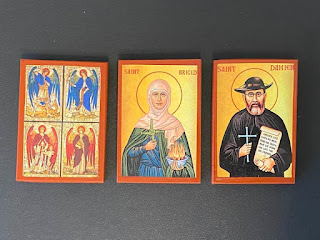
These are 3 of 6 Greek Orthodox Catholic Icons I purchased. They are smaller than I expected. But on a nice thick piece of stained wood. The Smaller icons come from Holy Art.

Finally the two painting on either side of the entrance were both painted by my youngest. She is 11 now Jack Skellington was painted a few years ago. The Fall Scene this last fall at school.

The Divine Mercy at out church was painted by a local artist for a previous pastor. I love her rendition of it.


The main sources for my religious art are:


As a side note about the confirmation saints for my children I pray for them each time the icon catches my attention. When they are older and moving out for work or school I plan on taking them down and giving them to them. I hope you enjoyed the tour of my space. And maybe it will inspire you to add an icon, sculpture or two to your own work space. 

Related Posts:

Wednesday, 29 June 2022

Saint Brigid of Ireland - Alice Curtayne - Cluny Media Reprint Edition

Saint Brigid of Ireland:
Cluny Media Reprint Edition
Alice Curtayne

ISBN 9781685950200
eISBN 9781685950507
ASIN B09W6MFQY7
Previous editions:
Browne and Nolan (1934)
Sheed and Ward (1954 Revised Edition)


A few years ago I fell in love with the works of Alice Curtayne. I first encountered the writings of Alice Curtayne through her book Twenty Tales of Irish Saints, I was captivated by her writing style and her style as a hagiographer. And I started tracking down her other writings. This is not proving an easy task. The first problem is that only 2 of her works were in print at that time. Second many of her books never had North American editions. Her first book was published in 1929. She wrote histories, most focused on saints. She wrote a few novels. And she wrote extensively for newspapers and magazines. I have also found that she wrote pamphlets for the Catholic Truth Society. I believe that Cluny Media has released 5 of her books in reprint editions and one she contributed to, The Irish Way.  This is the first to have an eBook edition, the others are a mic of paperbacks and or hardcovers. Alice Curtayne has two works with the title St. Brigid of Ireland, this one a full-length history originally published in 1934 and revised in 1954, and the Cluny edition released in 2022. And also, one of her Catholic Truth Society pamphlets called 'Saint Brigid, The Mary of Ireland'. I have read both this and the pamphlet is a separate work. But I have now read this one twice. A few years back I found an out of print copy from Sheed and Ward, shipping was prohibitive to Canada, so I shipped it to a friend in the country I found it and he scanned me a copy.  This is the fifth volume I have read from Cluny Media. Before we get to the review of this specific volume I want to restate:

It should be noted that this reprint edition from Cluny is very well done. Unlike many book brought back from the public domain, this volume went through a process of a high quality scan. And a complete re-typesetting. Cluny is dedicated to restoring quality editions of old books, focused on the Catholic Tradition. Their motto is: ‘Promote the tradition. Preserve the Past.’ Which is a very worthy cause. I really appreciate the work of Cluny Media, they are trying to restore Catholic books, bringing them back into print in wonderful physical editions and for a few eBooks. They are excellent editions. I just wish they had eBooks for all volume. The description of the Cluny edition of this book is:

“Saint Brigid of Ireland shares with Saint Patrick and Saint Columcille the honor of being patron of the Emerald Isle. In this brief yet highly illuminating biography, Alice Curtayne details the legacy of Brigid with lively descriptions of her character and family history; her virtues and miracles; her monastic foundations and missionary achievements; and her lasting influence on Irish culture. By all accounts, Brigid of Kildare was unique in her own time and place: as a fifth-century woman, she “stood isolated, without prototype, without peer. When she arose it was as though with a decisive movement she pulled back a heavy curtain shrouding the scene. And at that gesture all the other actors on the stage stand transfigured before a landscape where they see for the first time such freedom as they had never dreamed of, and beyond, Vision, the world opened to them by the Faith.”

Proof of both its subject’s enduring greatness and to its author’s obvious talent, Saint Brigid of Ireland is a heartily enjoyable and edifying biography of one of Ireland’s—and the Church’s—greatest saints.”

The chapters in this work are:

One: The Women of 450
Two: The Shaking Sod
Three: The Fiery Arrow
Four: Brigid and the Bishops
Five: Kildare
Six: The Brigidine School of Mystics
Seven: The Bounty of Brigid
Eight: “A Spray of Irish Fioretti”
Nine: The Wisdom of Brigid
Ten: The Tree of Love

This volume received both the Nihil obstat and Imprimatur in 1954. My youngest saw this book cover on my kindle and was wowed by the artwork. She is familiar with the saint as Brigid is her older Sisters confirmation Saint. Even though she is only 11 she wants to reread this book with me. To be honest I have loved everything I have read from Curtayne. And I am very thankful that Cluny Media is bringing her works back into print. Having read several books about St Brigid much in this work was familiar. And even more so this second time through. This book also crosses over and touches upon a number of other Irish Catholic saints, of course Patrick, but also others that came after Brigid. I greatly appreciated the comparison between Saint Brigid's spirituality and that of Saint Francis of Assisi. I highlighted over 34 passages on my first reading of the eBook edition some of them are:

"St. Brigid, who ranks with Patrick and Columcille in Ireland's Great Triad of Saints, arose in that period where certainty begins in our record. She stands in that first shaft of light that illuminates our history, literature, topography, art and architecture. The strength of Irish devotion to her is expressed in the very repetition of our Kilbrides, Templebreedys, Tobarbrides, Kilbreedys, Rathbrides, and Drumbridges. No one having the slightest acquaintance with Ireland can miss her name, so hugely is it scrawled across the landscape. The ancients affixed it to enduring things, like running water and glens that should witness to her forever."

“Her cult is distinguished too, by a certain freshness of enthusiasm. There is still preserved in its texture an element of surprise, a delight, such as men might experience on beholding dawn for the first time. Even after fifteen hundred years her name has never sunk into somnolence, but still vibrates in the ear of the Irish people like a trumpet blast. All this is universally known, but not in the least understood. It is not understood because with the passage of time we have lost sight of the strange singularity of Brigid.”

“Daughters had right of inheritance in Ireland centuries before it was conceded in other countries, and the same liberal tendency is everywhere evident in our ancient literature. The women of 450 had special places or sections in the public assemblies. They had organized games of their own at fairs, and even enclosures reserved for them.”

“Christianity was forbidden to slaves because it was an inconvenience to slave-owners when bond-people asserted a right to respect family ties.”

“The stage is roughly set for St. Brigid’s appearance: a dark stage on which benighted figures flit confusedly. What is remarkable about Brigid is that she did not belong to the women of 450. She stood isolated, without prototype, without peer. When she arose it was as though with a decisive movement she pulled back a heavy curtain shrouding the scene. And at that gesture all the other actors on the stage stand transfigured before a landscape where they see for the first time such freedom as they had never dreamed of, and beyond, Vision, the world opened to them by the Faith.”

“In this war-riven land Brigid was born, as has been said, of the kingdom that was the most persistently belligerent, Leinster of the battles. Her birth-place was Faughart, three miles from Dundalk, in the County Louth, and the date was about the year 453. Her father was Dubthach (pronounced Duffack, its modern equivalent being Duffy), a pagan petty king or chieftain, and her mother was a Christian bondwoman named Brocessa, who belonged to his household.”

“If the account of St. Brigid’s parentage be exact, she derived one advantage from it: that complete disregard for the accident of birth nearly always expressed by the children of unequal unions. As we shall see, it was her habit in later life to converse with kings as with equals and to treat slave-girls as sisters, whose freedom she passionately claimed.”

“It was not so. In Celtic Ireland the muse was exalted. The poet was highly, even excessively, remunerated for his services to the community. He was not then down-at-heel. He wore rich apparel; he dined well; he drank deep; he swaggered. He had property and servants. He travelled about with a retinue and his whole life was passed in visits and entertainment. At table he had to have the seat of honour and the choicest cut from the joint.”

“It was Brigid who changed the face of things and saved the early Irish feminine ascetic movement. She saved it by the innovation of community life. From the moment her mother’s liberty was ensured and her father’s objections silenced, she began the organization of women. She had seven companions with her when she went to be received into the religious life. Those eight seem never again to have separated.”

“Brigid did not live an enclosed life. In her case going into a convent meant becoming one of the most indefatigable travellers in the land. She is one of the most interesting products of Irish monasticism.”

““Founding” in the early Christian sense meant something far more strenuous than blessing the first stone. The convents then were, as a rule, clusters of wattle and clay huts, enclosed by great stone or earthen walls. When Brigid founded such a settlement, she had first to supervise the building. Then she had to provide the furnishings and staff the place with a few competent sisters whom she had trained. When she had the machinery in motion, she left them in charge and hastened on with a companion or two to a fresh field.”

“Once seven bishops went to visit her, and they have become famous as the Seven Bishops of Cabinteely. Do you suppose Brigid was disturbed by that invasion? No. She sent one sister to the cows that had already been milked twice that day, and another sister to a larder that was as empty as Mother Hubbard’s; yet another sister to an ale-vat that was drained dry. But the bishops feasted adequately, for food was a commodity Brigid never failed to find her guests.”

“Very surprising is the discovery that the feminine inspiration which delighted Europe in later centuries down to modern times was already an accepted feature of the early Irish Church. But what particularly distinguished the Brigidine School of Mystics from all faint or imaginable counterparts was its charming pastoral character.”

“But, not to digress too widely, did Brigid herself as a fact push charity beyond its bounds to the point where begins the first faint injustice to others? From the purely human standpoint, it would look almost like that, but since she is a saint of the Church, one is not permitted to suppose that her charity was indiscriminate, or that she was likely to confuse any moral values. We must rather believe, however unpalatable the idea, it is our own religious perceptions that are blunted and confused, and hers that were acute and clear.”

“Our modern tea is probably a more stimulating and a far less wholesome beverage than the fifth-century ale.”

“The affinity between Celtic Christianity and the Franciscan movement is striking. True, a return to the simple life in religion is a stock principle of most reforming movements, but merely a common principle does not explain this special kinship.”

“One would imagine that the Celtic saints knew by divine prescience of the future testing, so cunningly did they build the spiritual fabric, so ruthless was their concentration on essentials, so stark the spirit of abnegation they bred in their disciples. One would imagine that they had devised a special spiritual structure that should weather those four hundred nightmare years of religious persecution, and that long cycle, even eight hundred years, of political oppression. They even taught—those all-wise—an independence of relics and of shrines, which is a principle hardly encountered elsewhere. But it would have gone hard with the Gael had his trust been in shrines.”

This is one of those books that I could easily read again right away, but it took me over 4 years, and yet I will be rereading it again soon with my daughter. Like the works of some of my favourite authors I see myself returning to this book and other writings of Alice Curtayne often. There is something in the writing that speaks to my spirit. Her way with words, her devotion. The way she balances legends, against known facts, and with faith and trust. Saint Brigid is an example to us all, even more so at this time, 80 years after the writing of this book, and almost 1500 years after her death.

In the Catholic Truth Society booklet on Brigid by Curtayne there are two prayers. One I have been praying for myself and over my daughters daily. There are no prayers to Brigid in this book but this book still is a gem. It made me want to read more about Saint Brigid of Ireland, and more by Curtayne, and thankfully it is now available in a new edition both as a paperback and eBook from Cluny Media. This book is a little treasure of faith and it will inspire you, and likely challenge you. It is well worth giving a read.

Note: This book is part of a series of reviews: 2022 Catholic Reading Plan

For All reviews of Books from Cluny Media click here.
For All reviews and articles about Saint Brigid click here.
For All reviews and articles about Alice Curtayne click here.

Books and Booklets by Alice Curtayne:
A Recall to Dante
Francis Ledwidge: A Life of the Poet
Lough Derg: St. Patrick's Purgatory
Patrick Sarsfield
Saint Anthony of Padua
St. Bernard Doctor of The Church 1933

Books Edited by Alice Curtayne:
The Complete works of Francis Ledwidge
...

Books Translated by Alice Curtayne:
Labours in the Vineyard by Giovanni Papin
...

Books Contributed to by Alice Curtayne:
...

Thursday, 17 March 2022

My Den – Home Office 2022

My Den – Home Office 2022

I did not have a den or personal space for the last 11.5 years. The house we were in was smaller, 3 bedrooms and 4 of us when we moved in and 5th in under a year. For a long time I had a desk in the basement, beside my wife’s crafting desk and supplies. For the last 2 years with Covin-19 and working from home full time, I had a small desk in the living room. It placed me on the central floor of the house and when all three children were doing remote learning I could hear anything brewing on the floor above or below. Then the house we have been renting for over 11 years was put on the market. We moved to a very beautiful hose. The children each have their own rooms now. And my wife and I share a space. It is my den/home office, and her scrapbooking space. For the first 6 months I did not put anything up in the den. I had stuff that had been around my desk at home, and always had stuff up in my cubicle at work. But I wanted to plan this out. 

After that initial 6 months I put up a few icons I already had. And started planning what I would like my office to look and feel like. It has taken me another 5 months but this is where my set up now. Work, Play, Pray!


Across the top above the desk:

St Benedict Praying the Rosary
Our Lady Immaculate Heart 
Saint Josemaria Escriva
Divine Mercy (To be replaced by a copy of the one in our church.)
Mary (Have had this one for years from my grandmother)
Our Lady of La Salette 

The two coming down from these are 2 of my children's confirmation saints, a third will be added next year.


Beside these:

4 Archangels
Our Lady of Perpetual 
Saint Brendan
Saint Patrick

On the bookcase behind me:

Immaculate Heart of Mary
Saint Joseph

Beside bookcase:

Crucifix with soil from Jerusalem
Saint Damien of Molokai
Saint Brigid of Ireland
Saint John Paul II

On the desk:
Memento Mori Skull
Homeless Jesus - Timothy Schmalz
When I Was a Stranger - Timothy Schmalz
Statue of Mary
Saint Benedict Cross

The new icons and artwork come from a variety of sources, for some I have linked to the sites above. Some more detailed pictures below. 


Timothy Schmalz has some incredible sculptures, and they are all over the world.


These are icons from Theophilia on Deviant Art. I love that they are younger versions of the saints than often we encounter. I picked up Saint Patrick for me, Joan of Arc for my 26 year old daughter I just found out about last year. And the other three for my children here at home. 


These are 3 of 6 Greek Orthodox Catholic Icons I purchased. They are smaller than I expected. But on a nice thick piece of stained wood. The Smaller icons come from Holy Art.

Finally the two painting on either side of the entrance were both painted by my youngest. She is 11 now Jack Skellington was painted a few years ago. The Fall Scene this last fall at school.

The Divine Mercy at out church was painted by a local artist for a previous pastor. I love her rendition of it.


The main sources for my religious art are:


As a side note about the confirmation saints for my children I pray for them each time the icon catches my attention. When they are older and moving out for work or school I plan on taking them down and giving them to them. I hope you enjoyed the tour of my space. And maybe it will inspire you to add an icon, sculpture or two to your own work space. 


Monday, 28 May 2018

Irish Saints for Boys and Girls - Alice Curtayne

Irish Saints for Boys and Girls
Alice Curtayne

Eileen Coghlan (Illustrator)
Helicon Limited Edition (1978)
Sheed and Ward (1938)


This book appears to be a precursor to her book Twenty Tales of Irish Saints. The 19 stories contained within this book all appear in the Twenty tales book, which contains 1 more story and a section at the end of the book with brief paragraph length biographical summary of the saints in alphabetical order at the end of the book. When I tracked down this book I was surprised how similar it was to Twenty Tales. The wording is slightly different but the texts for these 19 saints are Essentially the same. The big difference is that this volume has illustrations. 15 illustrations to be exact. The illustrations seem to be either pen and ink or block cut prints. Most are plain black and white and could be either format, but a few have such shading that they could not be block prints. But either way the illustrations are wonderful and add to the tales of the saints, and my son loved them. The 19 saints of whom there are stories in this book are:

Patrick
Brigid
Finnian
Columcille
Colman of Kilmacduagh
Adamnan
Benignus 
Ciaran
Cormac
Modomnoc
Flannan
Finbarr
Colman-Elo
Canice
Columbanus
Laurence O'Toole
Thaddeus MacCarthy
Gall
The Young Monk

In the story on Colmcille, Curtayne states:

"Ireland has many saints - almost a countless number - and three great ones. The great ones are Patrick, Brigid, and Colmcille. These three are like sparkling jewels in a crown, and it would be hard to say which sparkled the most; perhaps it would depend on the light in which you looked at the jewels. In one light, at any rate, Colmcille sparkles the brightest; Irishness. He loved Ireland with all his might and hated to having to leave it for Scotland, and with - another thing - he was very Irish in himself."

This book is a wonderful read and even though it overlapped almost completed with Twenty Tales of Irish Saints I am very thankful to have tracked down a copy and been able to read it. I discovered the writings of Curtayne through the aforementioned Twenty Tales, and in the last few months have tracked down 11 of her works, read 7 and now reviewed 7. Every time I finish one of her works I begin the quest anew to find and read all her books. I give this book and all her books I have read to date my highest recommendation. If you can lay your hands on them give them a read, you will be in for a treat.


Note: This book is part of a series of reviews: 2018 Catholic Reading Plan!

Books and Booklets by Alice Curtayne:
A Recall to Dante
Francis Ledwidge: A Life of the Poet
Lough Derg: St. Patrick's Purgatory
Patrick Sarsfield
Saint Anthony of Padua
St. Bernard Doctor of The Church 1933

Books Edited by Alice Curtayne:
The Complete works of Francis Ledwidge
...

Books Translated by Alice Curtayne:
Labours in the Vineyard by Giovanni Papin
...

Books Contributed to by Alice Curtayne:
...


Friday, 25 May 2018

Saint Brigid The Mary of Ireland - Alice Curtayne

Saint Brigid The Mary of Ireland
Alice Curtayne

Catholic Truth Society 
Booklet No. 696 
Published 1936, reissued 1960


Alice Curtayne has written about Saint Brigid of Ireland many times. There is a chapter in her book Twenty Tales of Irish Saints, a nearly identical chapter in Irish Saints for Boys and Girls, and yet another in More Tales of Irish Saints. She also published the full-length biography Saint Brigid of Ireland in 1934. And then a few years later this booklet for the Catholic Truth Society. At first, I wondered if this booklet was just an excerpt from some of her other writings about Saint Brigid, but that is not the case, at least from the four books mentioned above. With every book or booklet, I read by Curtayne I want to read more. I am thankful this one is available online currently and was much easier to access than many of her works.

This booklet is primarily about Saint Brigid, but it begins with setting the historical stage. Curtayne states:
"CERTAINTY attaches to Irish records only from the coming of Saint Patrick. Before that, all is cloudy surmise; after it, the nation begins to emerge in a clear light. In that early clarity of record three names linked together will stand out for all time. No one can write our Irish history without reference to them. No account of our native literature can be presented if they be ignored, for the three have been our abiding inspiration through the ages. No account, even of native art, can be written without explaining them. Archaeologists work backwards and arrive at them. Geographers have to consider them, for these three names are everywhere woven into the topography of the country. If, therefore, through some mystery of iniquity the Church were silenced in Ireland and there were an end to native literature and art, still the very stones would cry out those names; wells, ruins, raths, and town-lands would tell their story. Mountains would have to be levelled to blot out their memory. These three upon whom abut all our history, literature, art, building and topography are: Patrick, Brigid, and Columcille (or Columba). Their memory is our spiritual banner. When that flag is surrendered, the Gael is no more."
And that centrality of these three saints if prevalent in this booklet and other writings on the saints by Curtayne. But first she addresses the overlap of Saint Patrick with Saint Brigid saying:
"Every one of her nine or ten first biographers assigns a different date to her birth, but no date is very far distant from the year 450. One must, therefore, be content with saying that she was born about the middle of the fifth century. The new chronology of Patrick's life, outcome of extensive research, places his death in the year 461. This makes it impossible for Saint Patrick to have known Brigid in her maturity. As a fact, in the oldest "Lives" of the Apostle, she is mentioned only once. She can have been little more than a child when he died."
Curtain then states:
"If I begin by saying, Brigid was a flame, I risk the charge of taking a caption from the cinema, yet that is the term used by her first biographers in describing her. Her singularity must be emphasized. The idea of perpetuating her memory by keeping a fire constantly burning as a symbol of her was strictly appropriate. All who approached her in life testified that she communicated a sort of illumination and warmth. She stood out luminously against a background of gloom. Some authorities affirm that her name means "fiery arrow". She certainly shot up like a dart of fire out of utter darkness."
This booklet is a clear concise look at Brigid's life and lasting impact. It concludes with a synopsis of the history of the Brigidine Nun's. And two prayers for devotion to Saint Brigid. I have read this booklet through a couple of times now. And am currently reading it with my oldest daughter, she has chosen Saint Brigid as her confirmation saint and we are working through Curtayne's works on Saint Brigid as our start point. And it is a wonderful place to begin.

Like all Curtayne's works I recommend you give this a read. It is easily read over of coffee or tea break. It can be read again and again for inspiration and motivation. Another wonderful booklet from a master wordsmith and gifted hagiographer. 

It should be noted this booklet is available online on several sites. You can find it here, here, and here in various formats as just a sampling.


Note: This book is part of a series of reviews: 2018 Catholic Reading Plan!


Books and Booklets by Alice Curtayne:
A Recall to Dante
Francis Ledwidge: A Life of the Poet
Lough Derg: St. Patrick's Purgatory
Patrick Sarsfield
Saint Anthony of Padua
St. Bernard Doctor of The Church 1933

Books Edited by Alice Curtayne:
The Complete works of Francis Ledwidge
...

Books Translated by Alice Curtayne:
Labours in the Vineyard by Giovanni Papin
...

Books Contributed to by Alice Curtayne:
...