Showing posts with label AlexandreHavard. Show all posts

Wednesday, 4 February 2026

Discovering A Mission - Alexandre Havard - My Way to Virtuous Leadership

Discovering A Mission
My Way to Virtuous Leadership
Anthony T. Salvia (Translator)
ISBN 9781594174889
eSIBN 9781594174896
ASIN B0CTW6TV1N

Discovering A Mission - Alexandre Havard - My Way to Virtuous Leadership

This volume was previously published as My Russian Way: A Spiritual Autobiography, this new edition contains a note from the author in 2023 when it released. That note states:

“Delving into one’s past and discerning its meaning are tasks everyone should undertake.

In my Virtuous Leadership classes I always call on my students to discover their own essence in order to identify a mission. And to help determine what that is, I ask them to write the story of their lives to that point.

I suggest that in the writing they will begin to see themselves for who they are, to develop a concept of self, and, in the process, discern a mission—the thing they were born to do.”

I read the older edition of t5his after reading From Temperament to Character: On Becoming A Virtuous Leader, I became fascinated with this book. I am thankful this is now available as an eBook in English, as now all of Havard’s volumes in English now have digital editions. . This book was a fascinating read, even this second time through. While reading it I have mentioned it to numerous people and shared numerous quotes from the book with friends, family and co-workers. This edition omits the original 2013 Preface, which was significantly more indepth than the authors note in this edition.

The chapters and sections in this volume are:

Dedication
Contents
The Passionate Ones
The Gentle Ones
The Magnanimous Ones
The Martyrs
The Russian Idea
Vocation
Tbilisi
Escrivá
Wojtyla & Soloviev
Paris
Helsinki
Tallinn-Vilnius
Mission
Moscow
Epilogue
Postscript

There are also full page icons of: 

     Saint Josemaria Escriva
     Our lady of Fatima

Alexandre begins with his grandparents. And works his way through their history, and his own history. He writes clearly and succinctly. And yet there is a passion and power in his prose. He is writing about his life but more importantly about his spiritual life. One quote appears twice in the book, in the dedication and as part of a longer quotation later on, from Anton Chekhov’s The Student: 

“The past is linked with the present by an unbroken chain of events flowing one out of another. It seemed to him … that when he touched one end the other quivered.”

Alexandre writes about the strings that impacted him, and he writes about some of the impact he has had. Other than a brief conclusion the book ends with:

“I sense that my life is about to take a new turn. I feel this is not the end of my Russian way but merely the end of the beginning. I feel I am entering into one of the most rewarding periods of my life – even if, objectively, all if fraught with uncertainty. But that is a story for another time. For now, enough is enough.”

I hope someday he writes that next story, and that it becomes available in English. Alexandre was shaped and influenced by men whom I have only known through their writings, writings about them, and their impact on others. Specifically, Saint Josemaria Escriva and Blessed Alvaro del porta. Their impact on his life, it’s direction, and his lifelong mission is undeniable. And as the chains travel through time, their impact on Alexandre has ripples and impacted me, and I believe will impact any who read this volume. 

I cannot share all the quotes that impacted me while reading this volume but a random selection below will give you a sampling. 

Speaking about Modern Education:

“The modern university outs the accent more and more on information, and less and less on education in the broad sense of the term. It produces managers rather than leaders, knowledge rather than wisdom, techniques rather than courage. It Concerns itself more and more with things, and less and less with persons. The Crisis of the modern world is not a crisis of information, it is a crisis of formation, a crisis of authentic education.”

Recalling part of his family heritage:

“The descendants of Gedeon and Elioz—the Gedevanishvilis — were charged by royal decree with protecting the cloak and the cathedral. On my family’s coat of arms are the Ten Commandments engraved on two tablets (indicative of our Jewish origins), the cloak of Christ, the episcopal miter and scepter, the sword and the banner, and the keys to the cathedral at Mtskheta.”

Remembering his grandfather:

“Pavel is an intense worker. He is tough and persistent. His motto is: “As long as the ball isn’t punctured, it bounces back.”

He is highly intelligent. He listens a lot and says little.

Everyone comes to him for advice.

This man who suffered so much has a hard time smiling,
but he is gentle and humble of heart.”

Family wishes:

“In 1991, the Soviet regime falls. A year later, my parents move to Georgia, thus fulfilling my maternal grandfather’s most cherished dream—that the family return to liberated Georgia. My mother is 54 years old.”

About his attraction to Russian literature:

“What strikes me about Russian literature is its moral and Christian content. It is aimed at the reader’s heart. It seeks to ennoble and transform.”

Speaking on Vocation:

“It is 1979 and I am 17 years old. In a few months, I will graduate from secondary school.

I must decide on a career but am more concerned about what kind of life I will lead, what kind of man I will be. I know that if I do not decide the matter soon, others will do it for me—my parents, my friends, the girls I know, French
society with its empty slogans and fads.
I seek refuge at the famous Sacré Coeur Basilica at the summit of the Montmartre butte. Sacré Coeur is French for the Sacred Heart of Jesus, in which I now find comfort and consolation.”

“One of the most important Russian theologians of the emigration, Alexander Schmemann, says that the Christian’s on-going flight from the world stems from an inability to square the circle of a basic Christian paradox: to be “in the world” but “not of this world.”

Saint Pope John Paul II:

“During my university years, it is John Paul II who shapes my thinking.

Later, I would have the chance to be in his presence, to listen to him and speak to him in Rome, Helsinki and Tallinn.

John Paul II, like Escriva, is a giant. For me, he is also a father and a master.”

And a final quote:

“The years pass and nothing happens.

Or so it seems outwardly. In reality, these are years of great spiritual intensity.”

This book is an excellent read. It is also an inspiring read. I have loved his leadership material I have read, and now I want to read the rest of his works. I can easily recommend this volume, it will inspire, encourage and challenge readers of all ages. 

Note: This book is part of a series of reviews: 2026 Catholic Reading Plan!

Books by Alexandre Havard:
Virtuous Leadership: An Agenda for Personal Excellence
Created for Greatness: The Power of Magnanimity


Thursday, 28 April 2022

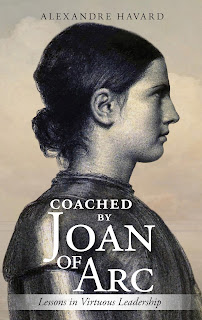
Coached By Joan of Arc - Alexandre Havard - Lessons in Virtuous Leadership

Coached By Joan of Arc
Lessons in Virtuous Leadership
Anthony T. Salvia (Translator)
ISBN 9781594174506
eISBN 9781594174513


I have read a few books now from the pen of Alexandre Havard and I believe this is the third translated by Anthony T. Salvia. I have yet to read one that I did not benefit from. They are always challenging to my spiritual life, how I see myself, and where I see myself going. They are books that really make me pause and think. They are well worth the time and effort to read. The description of this volume is:

“This book is a dialogue between the reader and Joan of Arc, the woman Mark Twain called “easily and by far the most extraordinary person the human race has ever produced.”

As we explore her virtue-infused life, this astonishingly modern woman takes us by the hand, coaches us, whispers wise advice in our ear. Far from being anachronistic, her way of life and virtuous example is eternally new, for she follows precepts that are above human weakness.

Joan is for all of us – men and women of today, living and working in the midst of the world. She is for us all a coach, a mother, and an excellent teacher of the elevated, virtuous, and courageous life.”

And the chapters are:

Preface
One: Finding Victory in Defeat
Two: Be Aware of Your Strength
Three: Magnanimity Trumps Self-Esteem
Four: Create a Plan for Personal Growth
Five: Cultivate Filial Piety
Six: Help Yourself and Heaven Will Help You
Seven: Put Your Intelligence into Everything You Do
Eight: Discover Your Mission
Nine: Do Not Confuse Your Objectives with Your Mission
Ten: Work for the Long Term
Eleven: Flee from Voluntarism
Twelve: Banish Sentimentalism
Thirteen: Purify Your Intentions
Fourteen: Do Not Fear Public Opinion
Fifteen: Reject Perfectionism
Postscript
Chronology of Joan’s Life

We are informed at the beginning of this volume that:

“Alexandre Havard created the Virtuous Leadership system, which is now taught in countries the world over. His books Virtuous Leadership (2007), Created for Greatness (2011), From Temperament to Character (2018), and Free Hearts (2019) have been translated into some twenty languages. After graduating from Paris Descartes University with a degree in law, he served as a barrister in Strasbourg and Helsinki. He is the founder of the Virtuous Leadership Institute, which has affiliates in numerous countries on five continents.”

Then the volume opens with a quote from Saint Josemaría Escrivá:

“There are many Christians who are persuaded that the Redemption will be completed in all environments of the world, and that there have to be some souls—they do not know which ones—who will contribute to carrying it out with Christ. But they think it will take centuries, many centuries. It would be an eternity, if it were to take place at the rate of their self-giving. That was the way you yourself thought, until someone came to “wake you up.””

Before the main text of the book Alexandre shares with us a revelation. That revelation relates to his life, leaving the practice of law, founding Virtuous Leadership, and specifically why Joan. He atets:

“An insipid-looking girl mounted on a muscular war horse, nearly asphyxiated and crushed by her armor—that was the way I imagined Joan of Arc during my years at school and in college. Joan of Arc did not move me at all. After all, it was no longer the patriotic time of 1914. Rather, it was “The Deserter,” written by the eccentric Boris Vian and sung by the very melancholic Serge Reggiani, which I retain in my memory from that time. His magnificent despair grabbed me in the gut.

Joan of Arc entered into my life at the turn of the millennium. I was approaching my forties. I had been living in Finland for more than ten years. France was far away. And suddenly, in the icy darkness of a winter’s night very much like so many others, I perceived a face radiating light and purity!

The face of Joan. A smiling, rather mischievous face said to me, “Let’s go.” She said it in English. These words resonated in the deepest, most intimate part of my soul with a power preventing me from doubting for a single instant.

A grace of God—I have never had the slightest doubt, so much had her presence filled me with joy and peace. This grace led me to give up the practice of law and devote myself to the teaching of virtuous leadership all over the world.”

He has lived out that revelation and this book goes back to the beginning and gives us leadership examples from the life of Saint Joan of Arc. This volume has 15 leadership lessons, each chapter ends with a section called “Some practical advice”, and the book would be worth the price just for these 15 exercises. This is followed by an image of Joan from art work, a wide variety of paintings, sculptures, etchings, and prints. I highlighted several passages my first time through this book, some of them were:

“It is thanks to my trial, and this testimony—the like of which history had never seen—that today I continue to work in the hearts of men. It is thanks to my judges, to the often absurd and humiliating questions they posed, that the whole world knows of my life and spirit. Bishop Pierre Cauchon, the head of the tribunal and the main negotiator of the Treaty of Troyes, which gave France to the English, wanted to preside over a “beautiful trial,” as he said. And it is because he wanted the trial to be “beautiful” that my words were recorded, timed, and sealed. He wanted to tarnish my memory forever, but the more he tarnished it, the more it served the plans of God. Unknowingly, he was building a monument to my glory.”

“Put your trust in God, as I trusted in him. Where you see defeat, God sees victory.”

“Some practical advice: Identify three major defeats in your life and discover in them all of the victories you derived or could have derived from them: 1) for your personal growth; 2) for the benefit of others; 3) for the quality of your professional, familial, and social life.”

“I was confident in my talents. Everyone who knew me agreed that I was tall and beautiful, strong and at the same time profoundly feminine. I had a soft voice and spoke in a way admired by others. I was sensitive and did not hide my tears. I liked to laugh and make others laugh. I had a proud look and a joyous face. I took care over my appearance when necessary. I had a religious soul in a robust, magnificent, and healthy body. I was conscious of all of these gifts, of all of these qualities of body and spirit.”

“In recognizing our talents, we give thanks to God, who created us. Refusing to recognize our talents is not humility but ingratitude.”

“Recognizing our talents, increasing them, and using them well is the virtue of magnanimity, the virtue of the great.”

“I expected everything of God as if I could do nothing myself, and I expected everything of myself as if God did not exist. I was a child before God, but a giant before men.”

“This is what I wanted to tell you today. Be aware of your talents. Multiply them. Live at full tilt. May your humility not be pusillanimity! May your humility never deviate from your magnanimity! Develop your human potential to the point of exhaustion, and do not be afraid of humanists spewing hatred.”

“We have been talking about humility in the wrong way. It is true that man by himself is absolute nothingness, a non-being, but the man who was created in the image of God, ransomed by the Son and divinized by the Holy Spirit, is a true wonder. Man was constituted as a son of God. This intimate truth, this sublime reality, should impel you to accomplish great things. You are a son of God—there is no greater dignity than that. This dignity should encourage you to dream and convert your dream into a mission.”

“Remember: evil is not what others do, it is the good that you, personally, do not do.”

“I was aware that without God I was nothing. I constantly sought his presence and naturally had recourse to him. I did not confine myself to the requirements religion prescribed. I passionately sought the face of God and communion with him. I was a pious and religious soul from my earliest childhood. I owe my piety to my mother, Isabelle. Everything I knew about Christian life I took from her teaching and example.”

“Piety begins with the truth. The great truth is that without God, you do not exist. Anyone not understanding this simple fact cannot be humble or pious. If life is a gift of God, religious indifference is an abomination. If God wanted you to be, justice demands that you love him with all of your heart, all of your mind, and all of your soul. So, I encourage you to be pious. May your piety be that of a child—natural, sincere, and trusting.”

“You have to pray, but you also have to act. “Help yourself and heaven will help you.” I often repeat these words. They have entered into history. When the theologians of Poitiers asked me why I needed an army if it was the will of God to deliver the French people, I told them, “The soldiers will fight, and God will grant the victory.” They were stupefied by the profundity and simplicity of my theology.”

“The war in which you are engaged is a total war. It is no longer a question of saving France from the English; it is a question of saving humanity from self-destruction. Your world sacrifices the dignity and freedom of millions of human beings on the altar of pleasure every day.”

“Many would like to make me a symbol of patriotism. That is because they do not, or do not want, to understand me. The Church canonized me very late—five hundred years after the annulment of my trial—to avoid all confusion in this regard. I am not a “patriot.” I am someone who loves the will of God.”

“If I were above all a patriot, my name would not have spread through the whole world; men like Winston Churchill, G. K. Chesterton, and Mark Twain would probably never have been interested in my story. I was a gift of God to all of humanity. To make me into the incarnation of nationalist sentiment is not only unjust, it is also blasphemy.”

“For you, things are different. What God expects of you, he communicates through the usual channels of the interior life, not through angels, visions, or voices. Although he uses ordinary means, therein lies their interest. They presume that you will bring to bear your heart, mind, will, imagination, and memory, and that you will free yourself once and for all of the thirst for certainty and security that is devouring you.”

“You will always have doubts about your mission and how to accomplish it. If you are pious, God will not abandon you. He will grant you his grace and light, as you make choices bringing you closer to achieving your mission. This mission demands imagination and creativity on your part. Even if it does not descend from heaven, it is an integral part of God’s plan for you.”

“You are a voluntarist, and probably think I was, too. You think I submitted coldly to God’s will like the heroine in a Greek tragedy, who submits stoically to her fate. I am not a stoic but a Christian. I loved the will of God more than I submitted to it. I rejoiced in his will much more than in my submission to it. I did good with my will, most certainly, but I did it also and above all with my heart—with my feelings and emotions, with my senses and flesh. I had learned from earliest childhood to revel in the good. I knew sorrow, but I learned to discover charm, transcendence, and mystery in every moment.”

“Some practical advice: Learn to be happy. Be convinced that happiness is not a sin! Refuse to base your life on things that have nothing to do with you, your interests or nature, and which serve a task or moral obligation existing only in your imagination. Know yourself; discover your own substance and God’s will for you. Love God, love yourself, and love others in your own way. Learn to live.”

“Some practical advice: Does the image you give of yourself correspond to reality? Do you take care that the impression you make faithfully reveals your intentions, virtues, and talents? Are you doing too much, or not enough? Are you prepared to sacrifice your image in the name of truth and the good, in the name of your conscience?”

“Some practical advice: Are you demoralized by failure? Are you overwhelmed by your mistakes, weaknesses, and shortcomings? At the end of each day, put your miseries in the hands of God. Submerge yourself in his mercy. Forget the past. Renew yourself. Get up each morning with a healthy enthusiasm, which is not a reflection of naivete, but of a warrior spirit full of faith, hope, and charity.”

“In making Joan your coach, you cannot go wrong. Joan, as you will have noticed, is a universal model accessible to all men and women, whatever their cultural or religious background. The interest Joan arouses today in all parts of the world comes as no surprise. The heroine of Orléans is an astonishingly modern woman. There is nothing strange about her, nothing inappropriate or anachronistic. Joan is eternally new. The “Case of Joan of Arc” is unique in history. We know everything about her life, even though it was lived in the fifteenth century. Nothing we know about her is the stuff of legend; our knowledge is based on archival documents. God wanted it to be so. He wanted Joan to be for all of us—men and women working at the very heart of society and worldly affairs—a coach, a teacher, and a mother. May 16, 2020 Centennial of Joan of Arc’s canonization.”

I hope at least a few of the passages that really spoke to me, will also speak to you, and inspire you to pick up this volume and give it a read. It is another excellent volume from the pen of Harvard, and I am certain if you read with an open heart your life will be changed. An excellent offering from the masterful pen of Harvard!

Note: This book is part of a series of reviews: 2022 Catholic Reading Plan!

Books in the Scepter Coached by Series:
Coached By Joan of Arc - Alexandre Havard
Coached by Josemaría Escrivá - Henry Hanson, O. Praem.
Coached by Paul the Apostle - Fr. Nathan Cromly
Coached by Philip Neri - Rob Marco
Coached by the Curé - Kevin Wells

Books by Alexandre Havard:
Virtuous Leadership: An Agenda for Personal Excellence
Created for Greatness: The Power of Magnanimity


Thursday, 31 March 2022

Top Ten Fiction and Non-Fiction Books First Quarter 2022

Top Ten Fiction and Non-Fiction Books First Quarter 2022


It has been a very good beginning to the year. Many great reads. I have read just over a book and a half a day. I read 146 books this quarter, in comparison with the last 6 years:

     2022 – 145
     2021 – 97
     2020 – 96
     2019 – 123
     2018 – 91
     2017 – 100
     2016 – 52

In fact, I believe it is my best quarter ever. Part of it is due to my youngest two children’s reading skills really growing and they read to/with me for 20 minutes for or five days a week. And this Lent I have tried to read a different Stations of the Cross booklet each day. Looking back 2016 is a bit of an outlier as late that year I switched jobs and have since had much better work – life balance. In the spring of 2016, I worked through Brandon Vogt’s course Read More Books Now (now available on ClaitasU). The year before that I removed all games from my phone and tablet and my reading had doubled. 

But back to this quarter. By the numbers:

Books Read: 146
First Time Reads: 131
Fiction: 41
Non-Fiction: 105
5/5 Stars: 114

Here is my top ten fiction and non-fiction books of the fourth quarter of 2020.

Top Ten Non-Fiction Books:
11. Prayer books:
A Simple Prayer Book For Prisoners - Catholic Truth Society
12. Books by Deacon Nick Donnelly

Bonus Books:
(For the bonus section I am highlighting sever Stations of the Cross)
The Way of the Cross: Praying the Psalms with Jesus - Father Mark Toups
Way of the Cross - Pope Benedict XVI - CTS Meditations and Prayers (2005)
Top Ten Fiction Books:
1. Poetry by Jan Twardowski
3. Even - Andrew Grant - David Trevellyan Book 1
4. Our Daily Bread - Karina Fabian - A Rescue Sisters Story
5. Perdition's Heirs - Jane Lebak - Seven Archangels Book 6
6. The Golden Spear - Arthur Slade - Dragon Assassin Book 11
7. Homestead - A.K. Frailey
8. Dark Visions of Torment - J.E. Mayhew - DCI William Blake Book 8
9. Sweet Briar Rose - Alex Smith - DCI Kett Book 8
10. Mortlock - Jon Mayhew - Mortlock Book 1
11. Better off Dead - Lee Child and Andrew Child - Jack Reacher Book 26  

Bonus Books:

The beginning of 2022 has been a great quarter for reading. A few new authors, some favorites. Books in old series, and the beginnings of some new series. Again this year, at least so far, I managed to write reviews for all books read for the only the second time. 

Note: I do not include books that have been read in previous years and were reread this year in my top ten lists, they are sometimes in the bonus section. But if you want more options check out my favorite books year by year list.  


Relates Posts: 
Top 10 Fiction Books 1st Quarter 2010
Top 10 Fiction Books 2nd Quarter 2010
Top 10 Reading Goals for 2010
Top 10 Fiction Books 3rd Quarter 2010

Top 10 Fiction Books 4th Quarter 2010
Top Ten Reading Goals For 2010 - Recap

Top 10 Fiction Books 2010
Top 10 Picture Books of 2010
Top 10 Non-Fiction Books of 2010

Top 10 Graphic Novels for 2010
Top Ten Reading Goals For 2011
 

Top Ten Fiction Books 1st Quarter 2011
Top Ten Fiction Books 2nd Quarter 2011
Top Ten Reading Goals for 2011 Update
 
Top Ten Fiction Books 3rd Quarter 2011 
Top Ten Fictions Books 4th Quarter 2011
Top Ten Fiction Books 2011
Top Ten Reading Goals 2011 - Recap
Top Ten Reading Goals 2012
Top Ten Fiction Books 1st Quarter 2012
Top Ten Fiction Books 2nd Quarter 2012

Top Ten Fiction Books 3rd Quarter 2012
Top Ten Fiction Books  4th Quarter 2012
Top Ten Fiction Books 2012
Top Ten Non-Fiction Books 2012
Top Ten Reading Goals 2012 - Recap
Top Ten Reading Goals 2013
Top 10 Fiction Books 1st Quarter 2013
Top 10 Fiction Books 2nd Quarter 2013
Top 10 Books Second Half 2013
Top Ten Fiction Books 2013
Top Ten Non-Fiction Books 2013 
Top Ten Books First Quarter 2014
Top Ten Books Second Quarter 2014
Top Ten Books Third Quarter 2014
Top Ten Books Fourth Quarter 2014
Top Ten Fiction Books 2014
Top Ten Non-Fiction Books 2014
Top Ten Books First Quarter 2015
Top Ten Books Second Quarter 2015
Top Ten Books Third Quarter 2015
Top Ten Books Fourth Quarter 2015
Top Ten Fiction Books 2015
Top Ten Non-Fiction Books 2015
Top Ten Books First Quarter 2016
Top Ten Books Second Quarter 2016
Top Ten Books Third Quarter 2016
Top Ten Books Fourth Quarter 2016
Top Ten Non- Fiction Books 2016
Top Ten Fiction Books 2016
Top Ten Catholic Books
Top Ten Books First Quarter 2017
Top Ten Books Second Quarter 2017
Top Ten Books Third Quarter 2017
Top Ten Books Fourth Quarter 2017
Top Ten Non-Fiction Books 2017
Top Ten Fiction Books 2017
Top Ten Books First Quarter 2018
Top Ten Books Second Quarter 2018
Top Ten Books Third Quarter 2018
Top Ten Books Fourth Quarter 2018
Top Ten Non-Fiction Books 2018
Top Ten Fiction Books 2018
Top Ten Books First Quarter 2019
Top Ten Books Second Quarter 2019
Top Ten Books Third Quarter 2019
Top Ten Books Fourth Quarter 2019
Top Ten Non-Fiction Books 2019
Top Ten Fiction Books 2019
Top Ten Books First Quarter 2020
Top Ten Books Second Quarter 2020
365 - 2021
317 - 2020 
392 - 2019
359 - 2018
380 - 2017 
272 - 2016 
177 - 2015 
130 - 2014 
88 -  2013
176 - 2012 
163 - 2011
302 - 2010
142 - 2009
98 - 2008
83 - 2007
191 - 2006
151 - 2005
60 - 2004
52 - 2003
97 - 2002
50 - 2001
41 - 2000
71 - 1999
73 - 1998
131 - 1997
101 - 1996


Thursday, 29 July 2021

Free Hearts - Alexandre Havard - Understanding Your Deepest Motivations

Free Hearts: 
Understanding Your Deepest Motivations
Anthony T. Salvia (Translator)
ISBN 9781594173950
eISBN 9781594173967
ASIN B08XY5V1Y7


I have read a few books now from the pen of Alexandre Havard and I believe th is the second translated by Anthony T. Salvia. His books move me and they challenge me. They are well worth the time and effort to read. The description of this volume is:

“Beauty, greatness, love, freedom, mercy, and suffering expand the heart, purify it, and make it burn with love and desire.

In the words of Alexandre Havard, “A free heart says ‘yes’ to transcendent values, to the divine inspirations and impulses in the depths of our being.”

For our hearts to be free, we must transform our interior selves. Alexandre Havard shows us the way.

His important new book will help you achieve the optimal balance between the heart, the mind, and the will, heal your heart when it is troubled and has been wounded, and enable your most noble aspirations to grow in strength and maturity.”

And the chapters are:

Preface
From the Author
1 The Heart: Source and Center
2 The Spirituality of the Heart 
3 The Rationalist
4 The Religious Voluntarist
5 The Macho Voluntarist
6 The Ideological Voluntarist
7 The Conventional Voluntarist
8 The Voluptuous Sentimentalist
9 The Insane Sentimentalist 
10 The Cowardly Sentimentalist
11 Desiccated Hearts
12 Wounded Hearts
13 Beauty
14 Greatness
15 Love
16 Freedom
17 Mercy
18 Suffering
Conclusion

I have been on a streak lately with some excellent reads. And this is one of the best of those. This is not a long volume but it is packed full of wisdom. Some of the passages that I highlight during my first read through are:

“The human being possesses three centers of freedom and responsibility: reason, the will and the heart. Reason and the will are exclusively spiritual faculties. The heart is spiritual and physical at the same time.”

“A person without a heart does not exist, nor one whose heart is empty, because it cannot be empty. It is always full. It holds the good (vision, drive) and the evil (blindness, impotence), and if the good decreases, the bad increases.”

“Before the West discovered Aristotle, it was St. Augustine—author of the Confessions—who provided intellectual guidance. For him, the heart is a faculty both physical and spiritual, even if he refuses to grant it a value on par with reason and the will.”

“Be that as it may, the West has emphasized the mind and the will in the life of man, whereas the East has paid greater attention to the heart. The West often accuses the East of sentimentalism, and the East often reproaches the West for its rationalism and voluntarism. Both approaches are false if they do not take into account this elementary fact: the heart, the mind, and the will can only function together.”

“One can only practice the good with a pure heart, an enlightened intelligence, and a strong will.”

“Our virtues ennoble our emotions, our vices corrupt them.”

“As Dietrich von Hildebrand wrote: “A person can develop all the spiritual richness to which he is called only if he is penetrated, imbibed by the values which he perceives and only if his heart is stirred and inflamed by these values and responds to them with the fire of joy, enthusiasm and love.””

“Freedom is the quality of a heart accustomed to saying “yes” to transcendent values. The “yes” demands the humility which predisposes us to be attentive to the calls of beauty, truth, and the good. The proud person resists being moved by transcendent values because nothing in this world exceeds himself. He thinks he should do the moving. Pride is the greatest obstacle to the education of the heart.”

“Strengthen your will. Do not renounce the good on the pretext that it could be a source of conflict. Learn to manage conflicts with sincerity and firmness.”

“The experience of beauty, greatness, love, freedom, mercy, and suffering expands and exalts our heart. It purifies it and makes it burn.”

“A humble heart is always listening. It is open and receptive. It is full of gratitude. It is happy.”

As can be seen from those sampling of quotes this book is pack full of wisdom. It is easily accessible. It is great for the scholar, hobbyist, or a general audience. Anyone wanting to grow in the virtues, grow spiritually, and really grow in understanding themselves and others this is the book for you. 

Another excellent read from the masterful pen of Alexandre Havard.

Note: This book is part of a series of reviews: 2021 Catholic Reading Plan!

Books by Alexandre Havard:
Virtuous Leadership: An Agenda for Personal Excellence
Created for Greatness: The Power of Magnanimity


Tuesday, 25 June 2019

My Russian Way - Alexandre Havard - A Spiritual Autobiography

My Russian Way: 
A Spiritual Autobiography
Alexandre Havard
Anthony T. Salvia (Translator)
University of Mary Press
ISBN 9780965288095


After reading From Temperament to Character: On Becoming A Virtuous Leader, I became fascinated with this book. It is currently the only one by Alexandre Havard that is not available as an eBook in English. This book was a fascinating read. While reading it I have mentioned it to at least 20 people and shared numerous quotes from the book with friends, family and co-workers. Here are some numbers based on my first reading of this book:

91 pages of text
52 quotes or references in the book
43 highlights
4 pages of photos
2 full page icon’s: 
     Saint Josemaria Escriva
     Our lady of Fatima

Alexandre begins with his grandparents. And works his way through their history, and his own history. He writes clearly and succinctly. And yet there is a passion and power in his prose. He is writing about his life but more importantly about his spiritual life. One quote appears twice in the book, in the dedication and as part of a longer quotation later on, from Anton Chekhov’s The Student: 

“The past is linked with the present by an unbroken chain of events flowing one out of another. It seemed to him … that when he touched one end the other quivered.”

Alexandre writes about the strings that impacted him, and he writes about some of the impact he has had. Other than a brief conclusion the book ends with:

“I sense that my life is about to take a new turn. I feel this is not the end of my Russian way but merely the end of the beginning. I feel I am entering into one of the most rewarding periods of my life – even if, objectively, all if fraught with uncertainty. But that is a story for another time. For now, enough is enough.”

I hope someday he writes that next story, and that it becomes available in English. Alexandre was shaped and influenced by men whom I have only known through their writings, writings about them, and their impact on others. Specifically, Saint Josemaria Escriva and Blessed Alvaro del porta. Their impact on his life, it’s direction, and his lifelong mission is undeniable. And as the chains travel through time, their impact on Alexandre has ripples and impacted me, and I believe will impact any who read this volume. 

I cannot share all the quotes that impacted me while reading this volume but a random selection below will give you a sampling. 

Speaking about Modern Education:
“The modern university outs the accent more and more on information, and less and less on education in the broad sense of the term. It produces managers rather than leaders, knowledge rather than wisdom, techniques rather than courage. It Concerns itself more and more with things, and less and less with persons. The Crisis of the modern world is not a crisis of information, it is a crisis of formation, a crisis of authentic education.”

Recalling part of his family heritage:
“The descendants of Gedeon and Elioz—the Gedevanishvilis — were charged by royal decree with protecting the cloak and the cathedral. On my family’s coat of arms are the Ten Commandments engraved on two tablets (indicative of our Jewish origins), the cloak of Christ, the episcopal miter and scepter, the sword and the banner, and the keys to the cathedral at Mtskheta.”

Remembering his grandfather:
“Pavel is an intense worker. He is tough and persistent. His motto is: “As long as the ball isn’t punctured, it bounces back.”

He is highly intelligent. He listens a lot and says little.

Everyone comes to him for advice.

This man who suffered so much has a hard time smiling,
but he is gentle and humble of heart.”

Family wishes:
“In 1991, the Soviet regime falls. A year later, my parents move to Georgia, thus fulfilling my maternal grandfather’s most cherished dream—that the family return to liberated Georgia. My mother is 54 years old.”

About his attraction to Russian literature:
“What strikes me about Russian literature is its moral and Christian content. It is aimed at the reader’s heart. It seeks to ennoble and transform.”

Speaking on Vocation:
“It is 1979 and I am 17 years old. In a few months, I will graduate from secondary school.

I must decide on a career but am more concerned about what kind of life I will lead, what kind of man I will be. I know that if I do not decide the matter soon, others will do it for me—my parents, my friends, the girls I know, French
society with its empty slogans and fads.

I seek refuge at the famous Sacré Coeur Basilica at the summit of the Montmartre butte. Sacré Coeur is French for the Sacred Heart of Jesus, in which I now find comfort and consolation.”

“One of the most important Russian theologians of the emigration, Alexander Schmemann, says that the Christian’s on-going flight from the world stems from an inability to square the circle of a basic Christian paradox: to be “in the world” but “not of this world.”

Saint Pope John Paul II:
“During my university years, it is John Paul II who shapes my thinking.

Later, I would have the chance to be in his presence, to listen to him and speak to him in Rome, Helsinki and Tallinn.

John Paul II, like Escriva, is a giant. For me, he is also a father and a master.”

And a final quote:
“The years pass and nothing happens.

Or so it seems outwardly. In reality, these are years of great spiritual intensity.”

This book is an excellent read. This book was also an inspiring read. I have loved his leadership material I have read, and now I want to read the rest of his works. I just wish an eBook was available or it was easier to lay your hands on. This is a book I will keep buying copies of to give away. I give it my top recommendation. 

Note: This book is part of a series of reviews: 2019 Catholic Reading Plan! You can access a PDF of this book at the Virtuous Leadership Institute site.

Books by Alexandre Havard:
Virtuous Leadership: An Agenda for Personal Excellence
Created for Greatness: The Power of Magnanimity
From Temperament to Character: On Becoming A Virtuous Leader
My Russian Way: a spiritual autobiography