Showing posts with label VivianBoland. Show all posts

Thursday, 17 April 2025

Spiritual Warfare Fighting the Good Fight - Vivian Boland - CTS Deeper Christianity Series

Spiritual Warfare: 
Fighting the Good Fight
Vivian Boland
Catholic Truth Society
ISBN 9781784692728
eISBN 9781784692728
ASIN B071SJBYHM
CTS Booklet SP16

Spiritual Warfare Fighting the Good Fight - Vivian Boland - CTS Deeper Christianity Series

Over the last several years, I have read many books from the Catholic Truth Society, over 430 of them in fact, many read more than once; this all since the spring of 2018. Most were good reads; some were great reads; and a few are exceptional. This is another excellent offering, as are the others in this series I have read. It is the fifteenth in the Deeper Christianity Series that I have read, many of them have been read twice.  I have also read a few other volumes by Father Vivian Boland across a few of the CTS Series. This series is one of my favourites. This booklet was originally published 2007 and the eBook was released in 2017. The description of this volume is:

“This booklet enlightens the struggle against the self and temptation by searching the wisdom of the scriptures, giving us hope because Christ has defeated death and is always by our side to help us in every battle.

Every Christian is engaged in an ongoing struggle against the self, and against temptation, striving to gain the blessings of the Kingdom of God. This booklet enlightens the struggle by searching the wisdom of the scriptures. It gives hope to everyone, because Christ is always by our side to help us in every battle, and he has already defeated death and sin.”

The chapters in the book are:

Introduction
The Struggle with Ourselves
Not Just Flesh and Blood
Wrestling with God
Christ, Our Champion

I highlighted numerous passages while reading this volume, some of them are:

“In recent years Scupoli’s work is not so well known, perhaps because the themes of self-denial, self-distrust, and even doing violence to oneself in order to follow Christ, trouble rather than encourage people. But any serious spiritual teaching involves discipline and the practice of asceticism, a readiness to engage in the struggle with oneself, with the powers of the spiritual world, and with the mystery of how we come to prefer God’s will to our own.”

“In 1943 a French Jesuit, Henri de Lubac, wrote an essay called Spiritual Warfare. In this work the future Cardinal identifies the attack on it by the German philosopher Friedrich Nietzsche as the greatest contemporary challenge facing Christianity.”

“The warfare in which the Christian must engage is on many levels, then, not just the personal moral and spiritual quest but also the social intellectual and political contest, what has more recently come to be called ‘the culture war’.”

“The language of combat and warfare is not fashionable in spirituality or theology today. It is clearly open to misunderstanding and abuse.”

“In 1996 John Paul II wrote that spiritual combat is ‘a demanding reality which is not always given due attention today’ (Vita consecrata § 38).”

“Spiritual warfare, the struggle against sin and temptation, involves battles at each corner of this triangle, sometimes in relation to oneself, sometimes in relation to the challenges posed to us by others and our dealings with them, sometimes with regard to God.”

“The threefold asceticism of Lent, which is the threefold asceticism of the Christian life at any time, consists of almsgiving, prayer and fasting.”

“Over indulgence in food and drink is always possible and it is often easier to find excuses for it than to recognise it simply as temptation.”

“Fasting cannot be simply a personal challenge to see if we can meet certain spiritual targets, a visit to a kind of spiritual gymnasium. Modesty in our intake of food and drink, and even abstinence from them, supports concentration and meditation, reminds us of the needs of others, and helps us to acknowledge the gifts of God.”

“Anyone who follows Christ must be poor, chaste and obedient. In publicly making profession of these vows, religious thus become a witness and sign to the Church as a whole of its own deepest reality and calling.”

“The struggle with temptation brings about a growth in self-knowledge. We learn about our weaknesses and blind spots, about the depth of our commitments and about the extent to which we are ready to serve God.”

“In practice it is only through temptation that we come to distinguish what we really value from what we think we value. The struggle with temptation helps to clarify this difference for us.”

“The ascetical practices of fasting, almsgiving and prayer already strengthen us in virtue and prepare us for temptation. In Lent we turn our minds to the testing and training that Christian life requires but Lent serves simply to recall us to things that ought to mark our life always:”

“In his Spiritual Combat, Scupoli identifies four ‘most sure and necessary weapons’ in the spiritual warfare against self • distrust of oneself • trust in God • spiritual exercises • prayer.”

“In the first chapter we proposed a triangular model for the spiritual struggle: temptation has three aspects (lust of the flesh, lust of the eyes, pride of life), there is a triangle in which we must live (relating to self, others, God), the classical works of asceticism are three (fasting, almsgiving, prayer), and the vows of religion, seeking to confront directly the threefold root of sin in us, are also three (chastity, poverty, obedience).”

“Sin is a power working through us for which we cannot be asked to bear full responsibility. Although we strengthen the power of sin by our choices and actions, sin itself is more powerful than us, something in which we are unavoidably caught up. This has always been part of the Church’s doctrine of original sin: we find ourselves in a situation not of our own making which nevertheless means we are alienated from God.”

“It is not an evasion of responsibility to say we must contend with powers that are more than flesh and blood. It is, once again, simply to recognise the reality of our situation. The moral and spiritual struggle of the individual Christian is his way of participating in the great battle.”

This is an excellent volume. I have been aware of Scupolis volume and even picked up 2 different editions of it and have read both:

The Spiritual Combat - Lorenzo Scupoli

This book served as a great refresher and reminder. Much of the material I was familiar with, but at this stage in life really needed the reminder. There are some things going on at work and home; that needed approaching from different angles, and this book helped with that.

This book is one of those ones that I believe we really need today, in our current day and age with all that is going on in the world, and even the church. We need solid teaching, and spiritual nourishment, and to be prepared for the battles. I will likely return to this booklet again. This is an excellent read in a wonderful series. The CTS Deeper Christianity Series of books is written in such a way that they can easily be read in any order. Pick and choose the ones that interest you, read them in order, or jump around. I have been blessed by all the book in this series that I have read and can easily recommend this book and the series.

Note: This book is part of a series of reviews:  2025 Catholic Reading Plan! For other reviews of books from the Catholic Truth Society click here.


Books in the Deeper Christianity Series:
7 Gifts of the Holy Spirit 
8 Deadly Sins Learning to Defend the Life of Grace
 

Books by Father Vivian Boland:
Ideas in God According to Saint Thomas Aquinas
8 Deadly Sins: Learning to Defend the Life of Grace
Spiritual Warfare Fighting the Good Fight  
Reconciliation: The Mercy of Christ
Don't Put Out the Burning Bush
Watchmen Raise Their Voices


Wednesday, 21 June 2023

Reconciliation: The Mercy of Christ - Vivian Boland - Sacraments Meeting Christ Series

Reconciliation: The Mercy of Christ
Sacraments Meeting Christ Series
Father Vivian Boland OP
ISBN 9781860822360
eISBN 9781784693749
ASIN B073H16PWL
CTS Booklet DO716


Over the past few years I have read almost 350 volumes from the Catholic Truth Society. This is the second I have read from the Sacraments Meeting Christ Series, and my third from Father Vivian Boland. This one was originally published in 2004, and the eBook was released in 2017. There is another similar CTS series on Living the Sacraments. Both are excellent series, this one focuses more on the theology and history and the other series more on the personal practice, though this volume could have easily been in either series. 

The description of this volume is:

“The joy of repentance and forgiveness is at the heart of Christian life. Here, Fr Vivian Boland explains how this can be experienced in Confession, inviting us all to encounter Christ’s mercy.

The sacrament of Reconciliation is where every Christian can experience that the joy of repentance and forgiveness is at the heart of Christian life. In a time when the sacrament is experiencing somewhat of a revival Fr Vivian Boland explains and invites all to an encounter with Christ's mercy.”

And the sections and chapters in the book are:

1. The Sound of Angels Cheering
     A culture of no regrets
     Forgiveness in the Gospels
     The Early Church

2. Dramas of Sin and Repentance
     Forgiveness after Baptism
     The Sacrament in the Early Church
     Penitence
     Frequent Confession
     Penance
     The New Rite of Reconciliation
     Individual Confession

3. The Good Sinner
     Contrition
     The Importance of Remembering
     Remembering the Old Testament
     Remembering the New Testament
     The Examination of Conscience
     The Confession of Sins

4. The Good Confessor
     Tasks of the Confessor
     Absolution
     Penance
     Interior and External Penance
     Forgive as you have been forgiven

5. Some Saints on the Sacrament of Reconciliation
Further Reading

I Highlighted numerous passages my first time through this volume. Some of them are:

“Imagine an Olympic stadium packed to capacity on the last day of the games. The marathon is almost over. The crowd waits impatiently for the first runner to enter the stadium. When he or she does there is an explosion of joy and admiration as the crowd shouts its support to help the runner finish the race. When a sinner repents he or she does so to the sound of angels cheering. It is as if a heavenly stadium were packed with angels who roar their joy and support whenever a sinner appears through the tunnel and limps, however tiredly, towards the finishing line.”

“If the sacrament of reconciliation is a sacrament in crisis as John Paul II has often said, and as pastoral experience seems to bear out, then part of the explanation for this might be that remorse has become practically impossible in our culture.”

“The evil in some of the things that have been done in recent history can seem too deep for forgiveness. Who is entitled to forgive people involved in the Holocaust and other genocidal campaigns? What does forgiveness and reconciliation mean in South Africa, the north of Ireland, or after the attacks of September 11th?”

“Those who seek to follow Christ and to live by his way must be ready to be forgiven and they must be ready to forgive.”

“Forgiveness is not to be miserly or reluctant but generous and free: seventy seven times perhaps, or even seventy times seven (Matthew 18). If it lives by this rule, the community of disciples will reverse the pattern of sinful humanity so vividly described in the early chapters of the Bible. As they insisted on a seventy-fold retribution, so the new community seeks to live by a seventy-fold absolution (Genesis 4: 24).”

“The missions of the Son and the Spirit are with a view to reconciling the world to God. We can describe them as the arms of the Father, with which he reaches out to draw the world to Himself, bringing it into relationship with Him by rescuing it from the power of evil, death and sin, and so establishing it securely in His peace. For the Christian tradition this is what happens with the sending of Christ and the Spirit and it is what continues to happen through the Church, the community of Christ’s disciples who continue to make him present through its life of worshipping God and serving humanity.”

“From the beginning the Church realised that the mysteries entrusted to it by Christ and the Spirit included the authority and power to reconcile sinners who had already been baptised. The sacramental life of the Christian community included not only the great sacraments of Baptism and the Eucharist, celebrated at the Lord’s explicit command and in memory of him, but others too that were relevant to crucial experiences and responsibilities of the Christian life and that were understood to originate in the ministry and paschal work of Christ and so to have been instituted by Him.”

“From such texts we learn many things. We learn that there is a danger of under-estimating the seriousness of the decisions to which the Christian faith calls us. We learn that there is a danger of presumption in relation to God’s grace and the promise of salvation. It is true that despair is a sin against the virtue of hope but so too is presumption.”

“The important thing is that penance and reconciliation were public even where confession was not. The sacrament of reconciliation referred, then, to the formal conclusion of the process by which penitents were restored to the communion of the Church by the bishop.”

“The call to repentance is extended to all and conversion is not just a once off experience but a daily task for the believer. The liturgical celebration of Lent made this very clear, an annual recalling of the evangelical summons to metanoia, a change of heart and mind. The virtue of penitence or penance was practised through prayer, almsgiving, other works of service, and various kinds of mortification and self-denial.”

“At about the beginning of the 7th century there is a change. The discipline of once in a lifetime and public penance and reconciliation is replaced by the practice of frequent and private penance and reconciliation. This change came about largely through the influence of monks in Celtic lands. It emerged from their practice of spiritual direction in which they checked in now and again with a spiritual father and spoke with this teacher or guide about the difficulties they were experiencing in living according to the gospel.”

“Suffice it to conclude this chapter by repeating that what is required for the celebration of the sacrament of reconciliation is a sinner who is contrite, ready to confess and ready to do penance, and a priest from whom the sinner will receive encouragement, guidance and absolution.”

“At the heart of the sacrament of reconciliation is the encounter between a sinner and a priest. For the purposes of celebrating this sacrament a ‘good’ sinner and a ‘good’ confessor are required. The good sinner is one who is contrite, confesses his sins, intends not to sin again, and undertakes some penance or ‘satisfaction’ as a way of completing the sacramental celebration.”

“The reason for this acceptance is because the Church knows that ‘perfect contrition’ is a gift of God’s grace and not something we can generate from within our own resources. Imperfect contrition means we are turning back towards home, beginning the journey back to reconciliation with God.”

“Good remembering of the past is essential for wise counsel about the future.”

“To celebrate reconciliation is to remember our sins and our need for forgiveness. It is also to remember Jesus the Lamb of God who takes away the sins of the world. It is to remember God, the Father of Jesus and our Father also, who does not desire the death of the sinner but rather that he should turn from his sins and live (Ezekiel 18: 23). We are to think of ourselves as dead to sin but alive for God in Christ Jesus (Romans 6: 11).”

“There are two main images applied to the confessor in the Church’s explanations of his role. He is a judge and he is a physician or healer. These analogies arise from the fact that the priest acts here in persona Christi, in the person of Christ, who although he is our Judge is also our Healer.”

“Sin disrupts all the relationships in which we are involved. It disrupts our relationship with God whose goodness and holiness are offended by sin. It disrupts our relationship with others who are often the direct victims of our wrongdoing but who are always affected by our sins even those that seem hidden and private. Sin disrupts our relationship with the human environment given us by God to be our garden but at odds with us now as a result of our greed (Genesis 3: 17-19). And sin disrupts our relationship with ourselves - if we may put it like that - because the freedom we exercise in sinning is actually weakened by sin to the extent that our hearts become set on what is less than truly good.”

“Once again it is important that we remember, remember more and remember better, remember above all how we have been forgiven by God. Remembering this ought to equip us to forgive. It ought to help us find our way through the obstacles there undoubtedly are to forgiving others. It may also be, of course, that the one we find difficult to forgive is God.”

I am certain that the two greatest things about Catholicism are the Eucharist, and Reconciliation. And this one highlights clearly the importance of making a good confession and frequent confession. This volume is a clear and concise presentation of what Catholics understand about the sacrament of reconciliation. It is very well written. It is an engaging read and can easily be read by any Catholic. It does a wonderful job highlighting some of the history of the sacrament and some of the theology. For most readers it can be read in a few hours or spread out reading a chapter or section a day. The material is well researched and clearly organized and presented. This volume has left me wanting to track down and to read the other works of Father Boland. This is another great resource from the Catholic Truth Society, I can easily recommend it.

Note: This book is part of a series of reviews: 2023 Catholic Reading Plan! For other reviews of books from the Catholic Truth Society click here.

Books by Father Vivian Boland:
Ideas in God According to Saint Thomas Aquinas
8 Deadly Sins: Learning to Defend the Life of Grace
Spiritual Warfare Fighting the Good Fight  
Reconciliation: The Mercy of Christ
Don't Put Out the Burning Bush
Watchmen Raise Their Voices

CTS Sacraments Meeting Christ Series:
Baptism 
Eucharist 
Anointing 
Marriage 
Holy Orders 
...


Wednesday, 23 February 2022

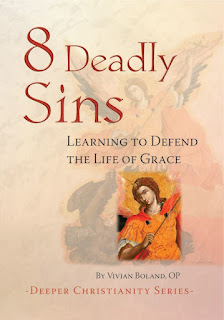
8 Deadly Sins Learning to Defend the Life of Grace - Vivian Boland - CTS Deeper Christianity Series

8 Deadly Sins: 
Learning to Defend the Life of Grace
Father Vivian Boland OP
Catholic Truth Society
ISBN 9781860824609
eISBN 9781784692704
ASIN B071ZJWDVV
CTS Booklet SP21


Over the last few years, I have read many books from the Catholic Truth Society. Most were good reads; some were great reads; and a few are exceptional. This is an excellent offering. It is the ninth in the Deeper Christianity Series that I have read, over half of them I have now read twice, and the second volume from the pen of by Vivian Boland. I have read over 250 offerings from the CTS over the last few years. This series is one of my favorites. This booklet was originally published 2007 and the eBook was released in 2017. Note it is currently only available in eBook format. The description of this volume is:

“The Church has settled on a list of 7 mortal sins but the Fathers of the Church more often referred to 8. The deadly or capital sins – covetousness, envy, sloth, gluttony, lust, anger, vainglory and pride – are the most significant and insidious temptations with which we must contend. A first step in countering their influence is understanding their psychological and spiritual roots in human experience. Standing humbly in the truth about ourselves, we will appreciate the power of God's love to heal and strengthen our nature, for love is not jealous or boastful, not arrogant or rude, not irritable or resentful.”

The chapters in the book are:

Introduction
Covetousness
Envy
Sloth
Gluttony
Lust
Anger
Pride – and Vainglory
Conclusion

And there is an excellent set of recommendations for ‘Further Reading’ at the end of the volume, as well as previews of three other volumes in this series, two of which I can not come across yet. And are now on my wish list. This volume begins with a section called What’s In A Number, which has sub sections and 3, 4, 7 and concluded with a section called Seven or Eight? It gives a brief history of numbers that humans seem drawn to, in other religions, Christianity, and even culturally. At first, I questioned this extensive introduction and it’s relation to the subject at hand. Further in the book I went back and reread this section with a much greater clarity and understanding. And the conclusion of the book returns to these numbers at the beginning:

“The monastic teacher Evagrius Pontus spoke of eight ‘generic thoughts’ in which every thought is contained. These he named as gluttony, fornication, love of money, depression, anger, listlessness, vainglory and pride. These were to become the seven deadly sins of Christian tradition, written about by Chaucer, Dante, John of the Cross, and many others, and still informing popular culture today. Gregory the Great and Thomas Aquinas combine the idea of eight with the tradition of seven by regarding pride as a ‘super sin’, the root of the other seven.
Evagrius immediately adds this important observation:

Whether these thoughts come to disturb the soul or not is not something we can control; but whether they linger or not, and whether they arouse passions or not, that is subject to our control.”

And it concludes with:

“A first step in countering their influence is to understand their psychological and spiritual roots in human experience. This is what this booklet has tried to do. If we stand, humbly, in the truth about ourselves, we will appreciate the power of God’s love to heal and strengthen our nature, for love is not jealous or boastful, not arrogant or rude, not irritable or resentful. If we understand the origins and nature in us of these ‘generic thoughts’, these ‘phantasies’ or ‘demons’, we are already in possession of a truth that sets us free. For that understanding assures us, in case we are tempted to doubt it, that our wellbeing and our salvation consists only, and always, in love. This will then sustain us in the discipline and practices of the spiritual life.”

This book is an excellent volume. I have been greatly blessed by reading it, and know that like many others from the CTS it is one I will return to. I wish I had read books like this when I was younger. That I had encountered the books and booklets from the Catholic Truth Society in my teens or even twenties. I am sure they would have had an immense impact on my formation and growth. And that Is in part why I read and review so many of them today. This book and series are excellent reads, for teens, young adults, and even those of us past middle age. I highly recommend this book and series! 

Note: This book is part of a series of reviews: 2022 Catholic Reading Plan! For other reviews of books from the Catholic Truth Society click here.


Books in the Deeper Christianity Series:
7 Gifts of the Holy Spirit 
8 Deadly Sins Learning to Defend the Life of Grace
 

Books by Father Vivian Boland:
Ideas in God According to Saint Thomas Aquinas
Don't Put Out the Burning Bush
Watchmen Raise Their Voices


Monday, 13 April 2020

Thomas Aquinas The Mind In Love - Vivian Boland - CTS Great Saints

Thomas Aquinas 
The Mind In Love 
CTS Great Saints
Vivian Boland 
Catholic Truth Society
ISBN 9781860826092
eISBN 9781784693992
ASIN B073H1DKGK
CTS Booklet B723


Over the last few years I have read and reviewed over 100 books from the Catholic Truth Society. There have been many excellent reads, both standalone and from series. And I love the biographies that are broken down into several sub-series. I have several series on the go from the Catholic Truth Society. First this series the CTS Great Saints Series. I have also read many in the CTS Biographies and also Saints of the Isles Series. And have loved almost all of them. Lately I have been focused more on this series, and a couple of others, almost alternating books in each series, and this one was another excellent read. It was my first by Fr Vivian Boland but it will not be my last, in fact, I have already picked up three other of his from the CTS. 

Probably my two favorite series currently from the CTS are; Saints of the Isles Series and CTS Great Saints Series. The latter of which this book is part of. The description for this volume is rather brief:

“Thomas is an unusual saint. He spent most of his life teaching in universities and writing in his Friary, yet his thought has defined Catholic theology for almost eight hundred years. Not just a theologian, he was also a philosopher, mystic and poet, and responsible for some of the most beautiful hymns used in the Catholic liturgy.”

And the chapters are:

Introduction
Providentiae Particeps - Participant in Providence
Early Years
Studying Aristotle
Albert the Great, Paris and Cologne
The Young Professor
Aquam in Vino - Water into Wine
Naples and Orvieto, 1259-1264
The Summa Theologiae: A Great Unfinished Symphony
Faith and Reason
Verbum Spirans Amorem - Word Breathing Love
Thomas of God the Creator
Doctor of Humanity
Interruption: Back to Paris
The Incarnate Word - Our Way to Happiness
O Sacrum Convivium - O Sacred Banquet
Life in the Spirit
The Sacred Banquet - Happiness Anticipated
Conclusion
Further Reading

I have been reading more and more about Saint Thomas Aquinas of late. Several authors I greatly respect have written about him or applied his style and methodology. One I read towards the end of last year was 12 Life Lessons from St. Thomas Aquinas: Timeless Spiritual Wisdom for Our Turbulent Times by Kevin Vost and it is an excellent volume. But this book would have been great to have read before working my way through that volume. And who knows some day I might even brave the Summa. 

The introduction of this volume begins with:

“Normally the life of a saint is a story filled with action and characters. His or her personal story links with great events in the history of the Church and of the world. To write a life of St Thomas Aquinas is a bit of a challenge, however. The main action of his life took place in classrooms and libraries. The most significant characters in his story are not so much his contemporaries as they are great figures from the history of theology and philosophy, people like St Augustine and St John Chrysostom, Aristotle and Plato.

Although Thomas is not a popular saint in the way St Francis of Assisi, St Thérèse of Lisieux or St Martin de Porres are, his contribution to the life of the Church has been second to none. Since immediately after his death, philosophers and theologians have used his work to think out and present an understanding of the Catholic faith, to develop ways of teaching the faith in very different times and places, and to engage with the many objections and difficulties brought against the faith in the centuries since he lived. He is called the ‘Angelic Doctor’ for the clarity of his mind, and the ‘Common Doctor’ because countless philosophers and theologians have based their work on his approach and on his central ideas.”

And it goes on to illustrate why he is a great saint for our times. This volume was published in 2009 and the eBook edition in 2017. And I would say we need him as a saint even more so in 2020 at the time of writing this review. The final section of the book deals with the process of his canonization and also the legend of a final piece he supposedly dictated on Song of Songs. 

This book is an excellent read. A great introduction to the life and works of the doctor. It is well written. It is easily accessible. Another great read about a great saint from the Catholic Truth Society!

Note: This book is part of a series of reviews: 2020 Catholic Reading Plan! For other reviews of books from the Catholic Truth Society click here.


Books by Father Vivian Boland:
Ideas in God According to Saint Thomas Aquinas
8 Deadly Sins: Learning to Defend the Life of Grace
Spiritual Warfare Fighting the Good Fight  
Reconciliation: The Mercy of Christ
Don't Put Out the Burning Bush
Watchmen Raise Their Voices

Books in the CTS Great Saints Series:
Antonio Rosmini - J.B. Midgley
Bernard of Clairvaux - J.B. Midgley
Benedict Patron of Europe - J.B. Midgley
Charles Borromeo - J.B. Midgley
Dominic - J.B. Midgley
Elizabeth of the Trinity The Great Carmelite Saint - Jennifer Moorcroft
Francis de Sales - J.B. Midgley
Gemma Galgani Gem of Christ John Paul Kirkham
George: Patron of England - J.B. Midgley
John Baptist de La Salle - J.B. Midgley
John of the Cross - Jennifer Moorcroft
John Vianney - J.B. Midgley
Martin de Porres - Glynn MacNiven-Johnston
Patrick Missionary to the Irish - Thomas O’Loughlin