Showing posts with label RaymondEdwards. Show all posts

Saturday, 4 June 2022

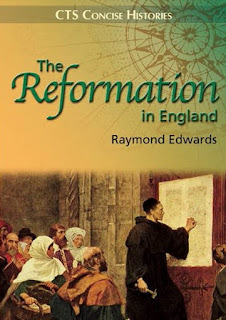
Reformation in England - Raymond Edwards - CTS Concise Histories

Reformation in England
Dr Raymond Edwards
Catholic Truth Society
ISBN 9781860823855
eISBN 9781784693145
ASIN B072XPZL49
CTS Booklet H505


This is the ninth volume from Dr Raymond Edwards that I have read. Over the last several years, I have read over 275 volumes from the CTS. I have read books from many series, and many authors. I have read several books that are part of the CTS Devotions and Prayer Series. I have read many in the CTS Biographies including biographies from the Saints of the Isles Series, and the Great Saints Series. Of the books I have read by Dr Edwards they have been a mix of Biographies, Concise Histories or Prayer books. This is the second book by him that I have read in the CTS Concise Histories Series.

The description of the booklet is:

“The events of the Reformation led to centuries of bitter theological disputes, wars, persecutions and power struggles. This summarises the events which led up to the Reformation in Europe, and particularly in England.

The events of the Reformation led to centuries of bitter theological disputes, wars, persecutions and power struggles, and its consequences endure to this day. This booklet looks at the events which led up to the Reformation in Europe, and particularly in England. It shows how much that was good was lost in this conflict.”

About the series we are informed that:

“CTS Concise Histories reveal the truth behind some of the most important and controversial events in the Church’s history.”

The chapters in the book are:

Introduction
The Continental Background
The Church in England
Popular Resistance
Queen Mary
Elizabeth I
How Catholic was England under Elizabeth?
James VI and I
Conclusion
Bibliographical Note
Endnotes

This volume was published in 2006 the eBook edition was released in 2017. Currently it is only available as a digital volume. I have been absolutely fascinated reading about English Catholicism. I was raised Irish Catholic and my Maternal side is Scottish, family and teachers had not much good to say about the English. Reading about the English Martyrs and the English Reformation has been fascinating. Some of the volumes from the CTS have opened my eyes to so much that had been missing in my education. And this volume was an excellent read. I highlighted many passages when reading this booklet. Some of them are:

“English-speaking Catholics are at a disadvantage when considering the history of their faith. For generations, and throughout the English-speaking world, the accepted accounts of the great religious upheavals of the sixteenth and seventeenth centuries, which led to the division of historic Western Christendom into Catholic and Protestant camps, were almost all written by non-Catholics, who saw these religious changes as an inevitable and wholesome part of the growth and development of the modern democratic state.”

“So what actually did happen? How, and when, and why did England stop being a Catholic country?”

“In the account that follows, I focus on events in England, for a number of reasons. The majority of my readers are likely to be most familiar with this story, or some version of it; the course of events in Scotland, at this time an independent country, is quite distinct, although the stories do at times intersect; I do not have the space to treat it here in extenso.”

“Religious life in England was flourishing. There were roughly nine and a half thousand parish churches, and upwards of eight hundred religious houses (of monks, nuns, and friars, of dozens of different orders); plus countless lay institutions - craft guilds, pious associations and confraternities - devoted to charitable works and to prayer for the dead, which was also the main activity of countless small chantry chapels endowed for the purpose.”

“Nor was this religion stagnant; detailed studies of the early 1500s have shown a high level of voluntary expenditure on renewing church fabric and decoration (English woodcarving and statuary was internationally famous) and a rich devotional life centred around processions on great feast days, mystery plays, pilgrimages, intense devotion to local patron saints, and the broader social cohesion brought by fund-raising activities such as parish ales. At every level, English society was saturated with the Catholic faith.”

“As in every age, the Church was in need of reform: bishops and clergy were often worldly, unfaithful to their vows, preoccupied with money and status, heedless of those notionally under their care. Some critics, more extreme, saw superstition and wilful misleading everywhere. None of this agitation was new, or necessarily unhelpful; there is nothing in Erasmus, say, that you cannot also find in Bernard of Clairvaux, or a host of other medieval churchmen exercised about the state of Christendom.”

“This provision affected over four hundred houses. The majority of the monks and nuns either accepted nominal pensions, or requested transfer to other larger houses (these transfers typically never happened). The evidence of irregular living collected by the commissioners is highly suspect; at best, it may represent the type of internal gossip invariable in religious communities; at worst, simple invention practised for gain. The Crown’s need for immediate money was so acute that a large proportion of former monastic land was quickly alienated at bargain prices.”

“It does not seem likely, as has been suggested, that the desire to seize monastic wealth was in itself a reason for Henry’s breach with Rome; but it was an undoubtedly convenient by-product.”

“Other consequences of the dissolution are less quantifiable; the disruption to the social fabric by the removal of the substantial practical charities of the religious foundations must have been considerable; whilst the sheer aesthetic loss of buildings, painting and woodcarving, metal and jewel-work, not to mention the vast numbers of manuscripts destroyed, is simply incalculable, but can only be accounted a cultural, educational and literary disaster. The surviving fragments of England’s medieval artistic heritage can only hint at the magnitude of our loss.”

“1574 also saw the arrival of the first ‘seminary priests’, ordained from amongst the Catholic exiles at colleges in Douai and Rome; they were joined by Jesuits six years later. Something like six hundred priests came to England on the mission before 1603. Counter-reformation standards finally penetrated into the English Church with these seminary priests and Jesuits. Royal policy had previously been one of passive waiting for obstinately Catholic clergy, survivors of Mary’s reign, to die off, and adherence thus to perish by inanition. With this infusion of new priests, the Government moved to active persecution.”

“Three quarters of a century after Henry VIII’s break with Rome, Catholicism in England was still numerically strong; small but devoted groups of priests brought the sacraments where they could, and in places local magnates and gentry were able to offer some measure of protection from legal penalties. But Catholics were disbarred from Royal service, from the Universities, and all but the lowest reaches of the Law: public life was effectively closed to them. Recusancy fines were enforced sporadically, but could be in the long term crippling.”

This booklet was a fascinating read. Over the last few years I have read several biographies from this period, about English Saints and Martyrs. This book is an amazing volume to help give an overview of the period. It gives great history, looks at a few ‘what if’s’ and gives a solid history. It is an excellent read in a wonderful series.   

Note: This book is part of a series of reviews: 2022 Catholic Reading Plan! For other reviews of books from the Catholic Truth Society click here.

For reviews of other books in the CTS Concise Histories series click here.


Monday, 24 January 2022

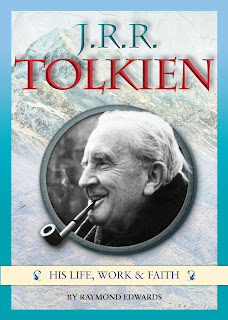
J.R.R. Tolkien: His life, Work and Faith - Raymond Edwards - CTS Biographies

J.R.R. Tolkien: His life, Work and Faith
Raymond Edwards
Catholic Truth Society
ISBN 9781860828270
eISBN 9781784694678
ASIN B075P2XP84
CTS Booklet B750


I bumped this way up my reading list after reading C.S. Lewis Apostle to the Sceptics by Walter Hooper from the same series. I have read several books by and about Tolkien. I have also read several by Dr Raymond Edwards from the Catholic Truth Society. I have read over 250 volumes from the Catholic Truth Society over the last handful of years. I was greatly surprised by this booklet and have recommended it to a few friends whom I know are fans of Tolkien and his works, both Catholic’s and non-Catholics. And I have added Edwards longer work on Tolkien to my ‘to be read’ list. But back to this booklet, the description of it is:

“J.R.R Tolkien (1892-1973) is best known as the author of the enduringly popular fantasy novels The Hobbit and The Lord of the Rings, now made into a series of well-regarded blockbuster films. He was also a world-renowned scholar of ancient language, who married the childhood sweetheart who inspired his stories, and was father to four children. He was also a devout Catholic whose faith was central to his writing. This booklet shows how an orphan from Birmingham came to write books that forever changed the way we read.”

And the chapters are:

Introduction
The Making of a Philologist
The Young Scholar
Oxford and Storytelling
A Wilderness of Dragons - Beowulf and The Hobbit
The Lord of the Rings
Last Years
Posthumous Publications
Tolkien the Catholic
Further Reading
Endnotes

This volume was published in 2012 and the eBook edition released in 2017. This volume begins with two quotes from Tolkien’s Letters, it stated:

 “Out of the darkness of my life, so much frustrated, I put before you the one great thing to love on earth: the Blessed Sacrament... There you will find romance, glory, honour, fidelity, and the true way of all your loves on earth, and more than that: Death: by the divine paradox, that which ends life, and demands the surrender of all, and yet by the taste - or foretaste - of which alone can what you seek in your earthly relationships (love, faithfulness, joy) be maintained, or take on that complexion of reality, of eternal endurance, which every man’s heart desires.”

“The only cure for sagging or fainting faith is Communion. Though always Itself, perfect and complete and inviolate, the Blessed Sacrament does not operate completely and once for all in any of us. Like the act of Faith it must be continuous and grow by exercise. Frequency is of the highest effect. Seven times a week is more nourishing than seven times at intervals.”

These quotes are from the volume The Letters of JRR Tolkien, pp. 53-54, 338-339. And they set the tone for the work that follows. Having read several works by Dr Edwards I had high expectations for this volume, they were met and exceeded. The introduction begins with these words:

“It is late in the year; under the vast domed Great Hall of the new University of Birmingham, rows of temporary beds are set up, filled with sick men, most newly back from France. One of them is writing in a small school exercise book.

The year is 1916, and he has been some months with his battalion on the Somme. Already many of his school and university friends have been killed. Compared with them, he is lucky; he has been struck down with a debilitating persistent fever, spread through the trenches by the ubiquitous lice. He is getting better, now, although still weak and exhausted and unfit to return to his unit. Soon, he will be discharged, and able to go to a Staffordshire village to stay with the wife he had married only eight months ago, two months before he was sent to France. Meanwhile, he is writing: stories of an age of myth, of elves and dragons and love and despair and hope lost and renewed. His name is Ronald Tolkien.

The stories he wrote at this time were not published for another seventy years; but the themes and characters he described in them gradually found shape and led directly to his famous books, The Hobbit and The Lord of the Rings. Here, whilst first recovering in hospital, then on a series of home service postings, began his life’s work: a corpus of imaginative writing whose overmastering theme, he declared late in life, was Death.”

This book does an amazing job of examining the life of Tolkien and doing so through his own faith and devotional practices. It looks at the successes and the failures, the highs and lows, and his struggles personally and professionally. It examines his and his wife’s health issues and the impact they had upon is output. And it does a good job showing us his riff with C.S. Lewis It is easily read in a sitting or two. 

This is a great read for fans of Lewis, Tolkien and the inklings. It is excellent for those who appreciate Tolkien’s fiction, or even just fans of the movies. Well written, engaging and entertaining. It presents a man of great intellect, deep faith, sincere devotion. And a man who struggled with confidence in his works, and who did so many different things, some of what he wanted to do it started was never finished. A great read in an excellent series from the Catholic Truth Society. 

Note: This book is part of a series of reviews: 2022 Catholic Reading Plan! For other reviews of books from the Catholic Truth Society click here.

For reviews of other books in the CTS Biographies series click here.


Tuesday, 21 December 2021

A Book of Novenas - Raymond Edwards (Editor) - Catholic Truth Society CST Devotions

A Book of Novenas
Raymond Edwards (Editor)
Glynn MacNiven-Johnston
Philip G. Bochanski
Kristina Cooper
Walter Macken
Miguel Cuartero
Catholic Truth Society
ISBN 9781784691714
CTS Booklet D820


Over the last few years I have read over 250 volumes from the Catholic Truth Society. There are many wonderful books, series and authors. I ordered this book under the suspicion that it was made up of many Novenas I had encountered in other volumes. And that is exactly what it is. This volume contains the book by Glynn MacNiven-Johnston and Raymond Edwards:


As well as:

Novena to the Holy Spirit - Philip G. Bochanski
Our Lady, Untier of Knots - Miguel Cuartero

The description of this volume is:

“Containing a rich selection for many different needs, this beautiful collection of novenas encourages intercession of the saints and making prayer in the tradition of the great figures of Scripture.

The Church encourages us to ask for the intercession of the saints, to locate our prayer within the annual round of the Church’s year, and to make our prayer in the tradition of the great figures of Scripture. The novenas in this beautifully bound collection help us to pray in all of these ways. It contains a rich selection for many different needs and intentions, including popular novenas to our Lady and the Holy Spirit.”

The chapters in this book are:
Introduction
     What is a novena?
     How to use this book

Part I Novenas Through the Church’s Year
     Advent
     St Andrew (November 30th)
     Blessed Charles de Foucauld (December 1st)
     Immaculate Conception
     Christmas
     Epiphany
     St Thomas Aquinas (January 28th)
     St Josephine Bakhita (February 8th)
     St David (March 1st)
     St John of God (March 8th)
     St Patrick (March 17th)
     St Joseph (March 19th; May 1st)
     St Benedict (March 21st; July 11th)
     Annunciation
     Easter
     St George (April 23rd)
     St Peregrine (May 1st)
     The English Martyrs (May 4th)
     St Damien of Molokai (May 10th)
     St Dymphna (May 15th)
     St Rita (May 22nd)
     Pentecost
     St Anthony of Padua (June 13th)
     St Thomas More (June 22nd)
     St John Fisher (June 22nd)
     Sacred Heart
     St Christopher (July 25th)
     St Anne (July 26th)
     St Martha (July 29th)
     Transfiguration
     St Teresa Benedicta of the Cross (Edith Stein) (August 9th)
     St Maximilian Kolbe (August 14th)
     Assumption
     St Helena (August 18th)
     St Monica (August 27th)
     Exaltation of the Cross
     St Joseph of Cupertino (September 18th)
     St Pio of Pietrelcina (Padre Pio) (September 23rd)
     St Raphael (September 29th)
     St Thérè se of Lisieux (October 1st)
     St Gerard Majella (October 16th)
     St Jude (October 28th)
     St Martin de Porres (November 3rd)
     Christ the King

Part II Scriptural Novenas
     Moses - discerning and accepting our vocation 
     Elijah - finding strength in God 
     Tobit - Marriage Hannah - the gift of children
     Hannah: The gift of Children 
     Joseph & his brothers - for peace in the family 
     David & Absalom and the Prodigal Son - estranged children 
     Martha - being the one that does all the work 
     Ruth and Naomi - feeling abandoned and forgotten 
     Deborah and Barak - when things seem too much for us. 
     Jonah - when God’s plan doesn’t seem to make sense 
     Job - being honest with God
     Abraham - old age

Part III Four Longer Novenas:
     To the Holy Spirit
     For Pentecost
     To the Blessed Virgin Mary
     Our Lady Untier of Knots

The book begins with these words:

“A novena is a way of praying, often for a particular need or grace. It consists of a prayer or prayers said over nine days. The word novena is originally Latin, and means “in a group of nine”. 1 This is because a novena lasts for nine consecutive days; on each day, there is a particular prayer to be said, or devotional practice to be made.”

We are also informed in the introduction that:

“There are many different sorts of novena; you can make a novena using any prayer you want: the main thing is to pray it regularly for nine days in a row. Nevertheless most people will make a novena using a prayer composed for the purpose. Some novena prayers are long, and may include litanies, or meditations; others are short. You can make a novena using the same prayer nine times, or nine different prayers, one for each day. There are no rules; what follows are only suggestions.”

And they are some wonderful suggestions. I have set calendar reminder’s to do a few of these Novena’s over the next year leading up to specific Saints feast days. I had read all of the Novenas in this book through the various source booklets.  Part I of this book is compiled from all the novenas in:


But they are ordered following the church year. Section II has the novenas in the same order as the booklet. And section III has either the whole booklet or an excerpt of just the novena. But even though I have eBooks of all of these Novenas I am thankful to have picked up this volume. First it is a stunning and it is well crafted book. It is printed in colour, great page and font sizing. And made to last. I am not usually a physical book guy, I tend to pass on all the physical books I read, but this one is going sit on my bedside table and be used for praying my way around the church year, and for other intentions.

This is an excellent volume for personal devotion, for use with a prayer group, or family. And it would make a wonderful gift. An excellent collection from the Catholic Truth Society and I highly recommend it.

Note: This book is part of a series of reviews: 2021 Catholic Reading Plan! For other reviews of books from the Catholic Truth Society click here.


Books by Glynn MacNiven-Johnston:
Biographies:
Maria Goretti Teenage Martyr
Pier Giorgio Frassati Inspiration for Students
Father Damien Apostle to the Lepers
Martin de Porres

Rita of Cascia 
...

Prayer Books:
Handbook of Novenas for Feasts and Seasons
Devotions to Our Lady of Perpetual Succour
The Infant of Prague
Handbook of Novenas to the Saints: Short Prayers for Needs & Graces
Handbook of Scriptural Novenas: For Various Needs and Intentions
Devotion to St Jude: Patron of Hopeless Cases

A Book of Novenas
...


Books by Dr Raymond Edwards:
Catholic Traditionalism
The Dowry of Mary 
Handbook of Novena to the Saints
Handbook of Novenas for Feasts and Seasons
Handbook of Scriptural Novenas for Various Needs and Intentions
J.R.R. Tolkien - His Life, Work & Faith
Prayer on the Go
A Simple Glossary of Catholic Terms
Stories of World War I
The Miraculous Medal
The Reformation in England
Tolkien
A Book of Novenas
...


Monday, 28 June 2021

Handbook of Scriptural Novenas - Glynn MacNiven-Johnston and Raymond Edwards - CTS Devotions

Handbook of Scriptural Novenas
For Various Needs and Intentions
Glynn MacNiven-Johnston
Raymond Edwards
Catholic Truth Society
ISBN 9781784690663
eISBN 9781784694302
ASIN B073H24XB4
CTS Booklet D798


I picked this up after reading and preparing reviews for the companion volumes:


All three Hanbooks of Novena’s are great booklets. It is the eighth volume from Glynn MacNiven-Johnston that I have read, and the sixth from Raymond Edwards. Over the last several years I have read almost 200 books from the Catholic Truth Society. They have many great series, and books. And the CTS Devotions is among my favourites. The description of this booklet is:

“These newly composed novena prayers present figures from Scripture form whom we learn lessons in faith and prayer. The situations and difficulties they faced frequently mirror our own worries and concerns. Thus Hannah prays for the gift of children, Job learns to be honest with God, Martha complains that she does all the work, Deborah and Barak learn what to do when overwhelmed, and Jonah too when God's plan doesn't seem to make sense. These and other figures open the Scriptures to us, and we learn more of the Novenas as a form of prayer.”

The chapters in this booklet are:
Introduction
Advent
Immaculate Conception
Christmas
Epiphany
Annunciation
Easter
Pentecost
Sacred Heart
Transfiguration
Assumption
Exaltation of the Cross
Christ the King

In the introduction we are told:

“The novenas in this book are slightly different. They focus on particular figures from the Bible, most from the Old Testament (the Hebrew Scriptures) because from the start, the Christian life has been lived after the model of the Old Covenant. 4 Scripture is a record of God’s mighty deeds with his people, which are the pattern for his deeds with us today. Biblical figures are not given to us for our imitation, not in all the details of their lives (King David was a murderer and an adulterer, Jacob deceived his father and cheated his brother, Jonah was grumpy and rebellious) but rather in one particular - their ability to accept, often after a struggle, the action of God in their lives, and his will for them. This acceptance, however it was mediated and however it played out, allowed their lives to assume a particular shape and conform to the providential pattern God intended.”

We are also informed in the introduction that:

“There are many different sorts of novena; you can make a novena using any prayer you want: the main thing is to pray it regularly for nine days in a row. Nevertheless most people will make a novena using a prayer composed for the purpose. Some novena prayers are long, and may include litanies, or meditations; others are short. You can make a novena using the same prayer nine times, or nine different prayers, one for each day. There are no rules; what follows are only suggestions.”

And they are some wonderful suggestions. I have set calendar reminder’s to do a few of these Novena’s over the next year. There is also a companion volume we are informed:

“Many novenas (including those in the companion volumes Handbook of Novenas to the Saints (CTS, 2010) and Handbook of Scriptural Novenas (CTS, 2015)) ask the intercession of a particular saint or biblical figure for whatever our intention may be. As well as interceding (praying) on our behalf, the saints are also examples of how the Christian life has been lived.”

At the end of the introduction is a section called How To Use This Booklet and it states:

“Each novena in this booklet focuses on one or more figures from the Bible. You may want to read the relevant passages from Scripture, so at the start of each novena we have said where these can be found. You do not have to read these passages before making a novena; but you may find it helpful. Then each novena is arranged into nine days. For each day, there is a short passage of Scripture, then a short reflection and prayer. 

On each day of the novena, say these, and add your particular intention, if you have one; then say the Our Father, the Hail Mary, and the Glory Be. Do this on each of the nine days. 

You may find it helpful to keep a short time of silence after reading the passage from Scripture. Scripture is the Word of God; God speaks to us through it. But to hear what he wants to say to us, we need to be quiet and listen. We may have much to say to God; he surely has something to say to us.”

The novena’s included are:

Moses - discerning and accepting our vocation 
Elijah - finding strength in God 
Tobit - Marriage Hannah - the gift of children 
Joseph & his brothers - for peace in the family 
David & Absalom and the Prodigal Son - estranged children 
Martha - being the one that does all the work 
Ruth and Naomi - feeling abandoned and forgotten 
Deborah and Barak - when things seem too much for us. 
Jonah - when God’s plan doesn’t seem to make sense 
Job - being honest with God
Abraham - old age

We have 11 excellent novenas. This is an wonderful little volume. A great book to have in your collection. And pray the novena’s around specific needs. It is an excellent resource that I highly recommend. And you will likely want to pick up the companion volumes as they are just as good.

Note: This book is part of a series of reviews: 2021 Catholic Reading Plan! For other reviews of books from the Catholic Truth Society click here.


Books by Glynn MacNiven-Johnston:
Biographies:
Maria Goretti Teenage Martyr
Pier Giorgio Frassati Inspiration for Students
Father Damien Apostle to the Lepers
Martin de Porres

Rita of Cascia 
...

Prayer Books:
Handbook of Novenas for Feasts and Seasons
Devotions to Our Lady of Perpetual Succour
The Infant of Prague
Handbook of Novenas to the Saints: Short Prayers for Needs & Graces
Handbook of Scriptural Novenas: For Various Needs and Intentions
Devotion to St Jude: Patron of Hopeless Cases

A Book of Novenas
...


Books by Dr Raymond Edwards:
Catholic Traditionalism
The Dowry of Mary 
Handbook of Novena to the Saints
Handbook of Novenas for Feasts and Seasons
Handbook of Scriptural Novenas for Various Needs and Intentions
J.R.R. Tolkien - His Life, Work & Faith
Prayer on the Go
A Simple Glossary of Catholic Terms
Stories of World War I
The Miraculous Medal
The Reformation in England
Tolkien
A Book of Novenas
...


Wednesday, 23 June 2021

Handbook of Novenas to the Saints - Glynn MacNiven-Johnston and Raymond Edwards - CTS Devotions

Handbook of Novenas to the Saints
Short Prayers for Needs & Graces
Glynn MacNiven-Johnston
Raymond Edwards
Catholic Truth Society
ISBN 9781860826870
eISBN 9781784694456
ASIN B073GXWNT2
CTS Booklet D733


I picked up this book right after finishing the companion volume, Handbook of Novenas for Feasts and Seasons, and both are excellent volumes. This is the seventh volume from Glynn MacNiven-Johnston that I have read, and the fifth from the pen of Dr. Raymond Edwards. Over the last several years I have read almost 200 books from the Catholic Truth Society. They are many great series, and books available from the CTS. And the CTS Devotions is among my favourites. The description of this booklet is:

“A novena is a way of praying, often for a particular intention or need. It consists, very simply, of a prayer or prayers said for nine (usually consecutive) days.

This booklet contains specially composed novena prayers asking for the intercession of various saints. The long experience of praying Christians, and the teaching of the Church, assure us that the duty of Christians to support each other with prayer does not end with this life, and the saints delight to add their voices to ours when we make our requests to God our Father.

Each novena is prefaced with a short biography of the saint, which gives some suggestions of the particular intentions or needs where their intercession has been found especially powerful.”

The chapters in this booklet are:
What is a Novena?
How to use this booklet
January
St Thomas Aquinas (January 28th)
February
St Josephine Bakhita (February 8th)
March
St David (March 1st)
St John of God (March 8th)
St Patrick (March 17th)
St Joseph (March 19th; May 1st)
St Benedict (March 21st; July 11th)
April
St George (April 23rd)
May
St Peregrine (May 1st)
The English Martyrs (May 4th)
St Damien of Molokai (May 10th)
St Dymphna (May 15th)
St Rita (May 22nd)
June
St Anthony of Padua (June 13th)
St Thomas More (June 22nd)
St John Fisher (June 22nd)
July
St Christopher (July 25th)
St Anne (July 26th)
St Martha (July 29th)
August
St Teresa Benedicta of the Cross (Edith Stein) (August 9th)
St Maximilian Kolbe (August 14th)
St Helena (August 18th)
St Monica (August 27th)
September
St Pio of Pietrelcina (Padre Pio) (September 23rd)
St Joseph of Cupertino (September 18th)
St Raphael (September 29th)
October
St Thérè se of Lisieux (October 1st)
St Gerard Majella (October 16th)
St Jude (October 28th)
November
St Martin de Porres (November 3rd)
St Andrew (November 30th)
December
Blessed Charles de Foucauld (December 1st)

This book was originally published in 2010 and the eBook edition released in 2017. The book begins with these words:

“A novena is a way of praying, often for a particular need or grace. It consists of a prayer or prayers said over nine days. The word novena is originally Latin, and means “in a group of nine”. 1 This is because a novena lasts for nine consecutive days; on each day, there is a particular prayer to be said, or devotional practice to be made.”

We are also informed in the introduction that:

“There are many different sorts of novena; you can make a novena using any prayer you want: the main thing is to pray it regularly for nine days in a row. Nevertheless most people will make a novena using a prayer composed for the purpose. Some novena prayers are long, and may include litanies, or meditations; others are short. You can make a novena using the same prayer nine times, or nine different prayers, one for each day. There are no rules; what follows are only suggestions.”

And they are some wonderful suggestions. I have set calendar reminder’s to do a few of these Novena’s over the next year. At the end of the introduction is a section called How To Use This Booklet and it states:

“On each day of the novena, say the short prayer for that day, and add your intention (if any); then say the Our Father, the Hail Mary, and the Glory Be. Do this on each of the nine days.

Some of the novenas have only one prayer, which you should say each day for the nine days.”

What follows is 31 wonderful novenas. Several of which I have set calendar reminders to pray this year. And have plans to go back for some of the ones I missed this year and do them next year. The variety of saints presented in these novenas is a wonderful cross section of saints spanning time, from around the world, and different stations in life. I have read biographies from the Catholic Truth Society for many of these saints and have several others on my wish list. Each of the novena’s begins with an introduction to the person, a bit about them and what they are known for. Some are a few lines, and others a few pages.

This is another excellent little volume. A wonderful book to have in your collection., and pray the novena’s throughout the year. It is an excellent resource that I highly recommend. You will likely want to pick up the companion volume for they are both great!

Note: This book is part of a series of reviews: 2021 Catholic Reading Plan! For other reviews of books from the Catholic Truth Society click here.


Books by Glynn MacNiven-Johnston:
Biographies:
Maria Goretti Teenage Martyr
Pier Giorgio Frassati Inspiration for Students
Father Damien Apostle to the Lepers
Martin de Porres

Rita of Cascia 
...

Prayer Books:
Handbook of Novenas for Feasts and Seasons
Devotions to Our Lady of Perpetual Succour
The Infant of Prague
Handbook of Novenas to the Saints: Short Prayers for Needs & Graces
Handbook of Scriptural Novenas: For Various Needs and Intentions
Devotion to St Jude: Patron of Hopeless Cases

A Book of Novenas
...


Books by Dr Raymond Edwards:
Catholic Traditionalism
The Dowry of Mary 
Handbook of Novena to the Saints
Handbook of Novenas for Feasts and Seasons
Handbook of Scriptural Novenas for Various Needs and Intentions
J.R.R. Tolkien - His Life, Work & Faith
Prayer on the Go
A Simple Glossary of Catholic Terms
Stories of World War I
The Miraculous Medal
The Reformation in England
Tolkien
A Book of Novenas
...