Showing posts with label CTSConciseHistories. Show all posts

Saturday, 4 June 2022

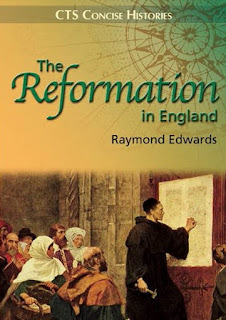
Reformation in England - Raymond Edwards - CTS Concise Histories

Reformation in England
Dr Raymond Edwards
Catholic Truth Society
ISBN 9781860823855
eISBN 9781784693145
ASIN B072XPZL49
CTS Booklet H505


This is the ninth volume from Dr Raymond Edwards that I have read. Over the last several years, I have read over 275 volumes from the CTS. I have read books from many series, and many authors. I have read several books that are part of the CTS Devotions and Prayer Series. I have read many in the CTS Biographies including biographies from the Saints of the Isles Series, and the Great Saints Series. Of the books I have read by Dr Edwards they have been a mix of Biographies, Concise Histories or Prayer books. This is the second book by him that I have read in the CTS Concise Histories Series.

The description of the booklet is:

“The events of the Reformation led to centuries of bitter theological disputes, wars, persecutions and power struggles. This summarises the events which led up to the Reformation in Europe, and particularly in England.

The events of the Reformation led to centuries of bitter theological disputes, wars, persecutions and power struggles, and its consequences endure to this day. This booklet looks at the events which led up to the Reformation in Europe, and particularly in England. It shows how much that was good was lost in this conflict.”

About the series we are informed that:

“CTS Concise Histories reveal the truth behind some of the most important and controversial events in the Church’s history.”

The chapters in the book are:

Introduction
The Continental Background
The Church in England
Popular Resistance
Queen Mary
Elizabeth I
How Catholic was England under Elizabeth?
James VI and I
Conclusion
Bibliographical Note
Endnotes

This volume was published in 2006 the eBook edition was released in 2017. Currently it is only available as a digital volume. I have been absolutely fascinated reading about English Catholicism. I was raised Irish Catholic and my Maternal side is Scottish, family and teachers had not much good to say about the English. Reading about the English Martyrs and the English Reformation has been fascinating. Some of the volumes from the CTS have opened my eyes to so much that had been missing in my education. And this volume was an excellent read. I highlighted many passages when reading this booklet. Some of them are:

“English-speaking Catholics are at a disadvantage when considering the history of their faith. For generations, and throughout the English-speaking world, the accepted accounts of the great religious upheavals of the sixteenth and seventeenth centuries, which led to the division of historic Western Christendom into Catholic and Protestant camps, were almost all written by non-Catholics, who saw these religious changes as an inevitable and wholesome part of the growth and development of the modern democratic state.”

“So what actually did happen? How, and when, and why did England stop being a Catholic country?”

“In the account that follows, I focus on events in England, for a number of reasons. The majority of my readers are likely to be most familiar with this story, or some version of it; the course of events in Scotland, at this time an independent country, is quite distinct, although the stories do at times intersect; I do not have the space to treat it here in extenso.”

“Religious life in England was flourishing. There were roughly nine and a half thousand parish churches, and upwards of eight hundred religious houses (of monks, nuns, and friars, of dozens of different orders); plus countless lay institutions - craft guilds, pious associations and confraternities - devoted to charitable works and to prayer for the dead, which was also the main activity of countless small chantry chapels endowed for the purpose.”

“Nor was this religion stagnant; detailed studies of the early 1500s have shown a high level of voluntary expenditure on renewing church fabric and decoration (English woodcarving and statuary was internationally famous) and a rich devotional life centred around processions on great feast days, mystery plays, pilgrimages, intense devotion to local patron saints, and the broader social cohesion brought by fund-raising activities such as parish ales. At every level, English society was saturated with the Catholic faith.”

“As in every age, the Church was in need of reform: bishops and clergy were often worldly, unfaithful to their vows, preoccupied with money and status, heedless of those notionally under their care. Some critics, more extreme, saw superstition and wilful misleading everywhere. None of this agitation was new, or necessarily unhelpful; there is nothing in Erasmus, say, that you cannot also find in Bernard of Clairvaux, or a host of other medieval churchmen exercised about the state of Christendom.”

“This provision affected over four hundred houses. The majority of the monks and nuns either accepted nominal pensions, or requested transfer to other larger houses (these transfers typically never happened). The evidence of irregular living collected by the commissioners is highly suspect; at best, it may represent the type of internal gossip invariable in religious communities; at worst, simple invention practised for gain. The Crown’s need for immediate money was so acute that a large proportion of former monastic land was quickly alienated at bargain prices.”

“It does not seem likely, as has been suggested, that the desire to seize monastic wealth was in itself a reason for Henry’s breach with Rome; but it was an undoubtedly convenient by-product.”

“Other consequences of the dissolution are less quantifiable; the disruption to the social fabric by the removal of the substantial practical charities of the religious foundations must have been considerable; whilst the sheer aesthetic loss of buildings, painting and woodcarving, metal and jewel-work, not to mention the vast numbers of manuscripts destroyed, is simply incalculable, but can only be accounted a cultural, educational and literary disaster. The surviving fragments of England’s medieval artistic heritage can only hint at the magnitude of our loss.”

“1574 also saw the arrival of the first ‘seminary priests’, ordained from amongst the Catholic exiles at colleges in Douai and Rome; they were joined by Jesuits six years later. Something like six hundred priests came to England on the mission before 1603. Counter-reformation standards finally penetrated into the English Church with these seminary priests and Jesuits. Royal policy had previously been one of passive waiting for obstinately Catholic clergy, survivors of Mary’s reign, to die off, and adherence thus to perish by inanition. With this infusion of new priests, the Government moved to active persecution.”

“Three quarters of a century after Henry VIII’s break with Rome, Catholicism in England was still numerically strong; small but devoted groups of priests brought the sacraments where they could, and in places local magnates and gentry were able to offer some measure of protection from legal penalties. But Catholics were disbarred from Royal service, from the Universities, and all but the lowest reaches of the Law: public life was effectively closed to them. Recusancy fines were enforced sporadically, but could be in the long term crippling.”

This booklet was a fascinating read. Over the last few years I have read several biographies from this period, about English Saints and Martyrs. This book is an amazing volume to help give an overview of the period. It gives great history, looks at a few ‘what if’s’ and gives a solid history. It is an excellent read in a wonderful series.   

Note: This book is part of a series of reviews: 2022 Catholic Reading Plan! For other reviews of books from the Catholic Truth Society click here.

For reviews of other books in the CTS Concise Histories series click here.


Saturday, 28 May 2022

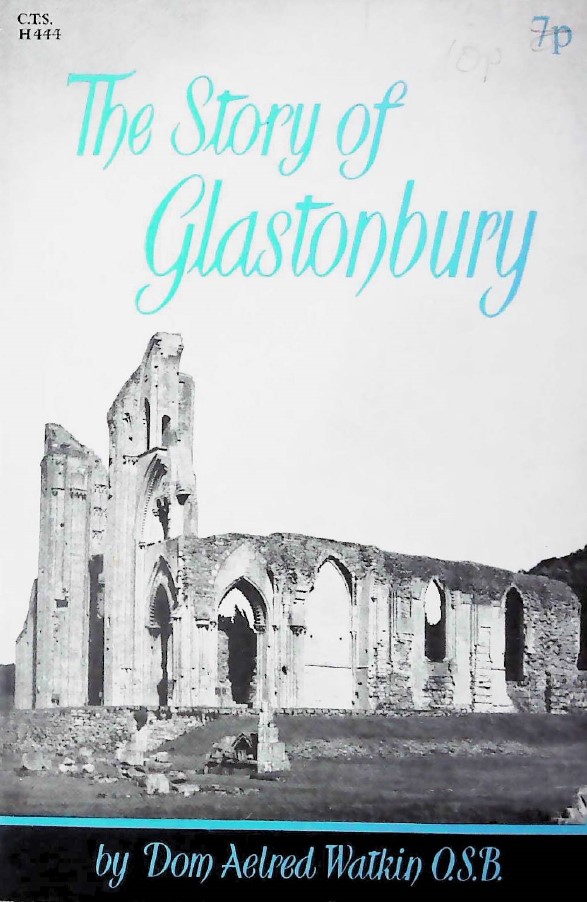
The Story of Glastonbury - Dom Aelred Watkin O.S.B. - CTS Histories

The Story of Glastonbury 
Dom Aelred Watkin O.S.B. 
ISBN 9780851835068
ISBN 0851835066
CTS Booklet H444


Over the last several years, I have read over 275 volumes from the CTS. I have read books from many series, and many authors. I have read several books that are part of the CTS Devotions and Prayer Series. I have read many in the CTS Biographies including biographies from the Saints of the Isles Series, and the Great Saints Series. This is the first book by Dom Aelred Watkin O.S.B. that I have read. This volume predates the CTS Concise Histories Series that I have been enjoying and also the Christian Shrines Series of which I greatly enjoyed Glastonbury - A Pilgrim's Companion by David Baldwin. The edition of this booklet I tracked down was from 1973, I found reference while researching the book of editions as early as 1966, and as late at 1983. The edition I tracked down did not even have a description on the back, but only and advertisement for a CTS Paperback Bible for 60p. I was not able to find a description of the booklet anywhere online. The text has reference of dates up to and including 1965. And it is a fascinating little read.
The preface by Joseph Bishop of Clifton states:

“Glastonbury is one of the earliest centres of the Catholic Church in this country. It is also by tradition one of the earliest places where special devotion was given to Our Lady. But perhaps more than most places, the history of the Church in Glastonbury, and particularly of the origin of the shrine of Our Lady, is overladen with legend. No true devotion ought or can be built except on the truth. It is therefore highly important, in speaking of Glastonbury, to be quite clear and explicit on the reliability of and authority for all statements made.

This small account of the Catholic history of Glastonbury is meticulous in this matter. At the same time it gives proper weight to tradition and even to legend.

It seems beyond reasonable doubt that in days gone by Glastonbury was noted for an intense devotion to Our Blessed Mother. May this short history be a powerful help towards the reviving of that ancient devotion.”

The chapters and sections in the booklet are:

Preface
The Story of Glastonbury
     The Situation at Glastonbury
     The Town of Glastonbury
     Earliest History
     The Early Monastery at Glastonbury
     The Saxon Monastery of Glastonbury
A Full Page Map of Glastonbury Abbey
     Glastonbury in the days of the Normans and Angevins
     Glastonbury in the Middle Ages
Diagram of Glastonbury Abbey
     The End of Glastonbury
     The years of Desolation
     Our Lady of Glastonbury
     Our Lady’s Return

I highlighted several passages my first time through this work. They were:

“Glastonbury can easily be recognized from afar. From miles away in every direction the eye is caught by a high, conical hill topped by a ruined tower. This is Glastonbury Tor with the remains of its fourteenth-century chapel of St Michael the Archangel. The town itself and the abbey lie at the foot of the complex of hills of which the Tor is the chief, and it is surrounded by an immense tract of flat land intersected with artificial drainage ditches (known as rhines) which are lined by pollarded willows.”

“The story of Glastonbury reaches back into a past so remote that it is impossible for us to say what its origins were or when it began. Legends have sprung up at various dates and times which try to illuminate this darkness, but these stories may rather be likened to ivy which, while obscuring the outline of an ancient building, testifies to the reality of its structure. It is perhaps significant that the greater bulk of these legends take their origin in the later part of the Middle Ages and that one or two of the most startling date from after the dissolution of the abbey.”

“We can say, therefore, that from about the fifth century onwards there was a large Celtic monastery on the site of the later abbey. The names of one or two of the early abbots are known and the Welsh Triads speak of a ‘perpetual choir’ of singers at Glastonbury, while a visit of St David of Wales to the spot is better authenticated than some of the early stories.”

“It is impossible to go into the history of ‘King Arthur’ and the stories which connect him with Glastonbury, but it seems very probable that this ancient leader did exist and there is evidence which could show that he was in fact buried in the ancient cemetery at Glastonbury.”

“In some ways more mysterious still is the tradition which connects St Patrick with Glastonbury. The fact that the Irish, from at least the eighth century onwards, believed him to have been buried here is quite certain.” 

“Whether the Irish saint buried at Glastonbury was the great apostle of Ireland or whether he was another of the same name it does not as yet seem possible to discover. That Glastonbury was a holy spot to the Irish at a very early date is
abundantly clear.”

“It was from Glastonbury that St Dunstan and his followers reformed the monasteries throughout the country. Indeed, Glastonbury may well be termed the mother-house of almost every medieval monastery in England, for all the ancient foundations were renewed and revived under the direction of St Dunstan and of the monks he had trained.”

“During the following years the abbey buildings changed hands again and again. Slowly, vaults, walls and towers disappeared, although the inhabitants of Glastonbury to their credit retained such a reverence for the Lady Chapel that none could be found to take part in its demolition and it is thus the most complete part of the ruins yet remaining.”

“It is impossible to say at what date the Wattle Church became known as the Church of Our Lady. It is certain that it was so known in the eighth century and we may say with confidence that Glastonbury was one of the earliest shrines of Our Lady to exist north of the Alps.”

“It is interesting in this connexion to note that Glastonbury was one of the few places in England to develop a devotion to St Joseph before the Reformation; there exists in a Glastonbury manuscript a hymn written about the year 1500 in which St Joseph is honoured together with his namesake of Arimathea.”

“There is evidence that even in the darkest years of persecution some recusant Catholics used to gather round the ruin of the Lady Chapel to pray and the memory of the shrine never quite wholly perished. But it is during the last seventy years that
Catholicism has begun to return to Glastonbury. Towards the end of the last century the Fathers of the Sacred Heart established a novitiate in a house at the foot of the Tor.”

“The 20th July 1955 was a great day in the history of Glastonbury, for it was then that the Apostolic Delegate (Archbishop O’Hara) by blessing and enthroning a new statue of Our Lady of Glastonbury in the presence of Bishop Rudderham of Clifton and of no less than 18,000 Catholics, restored in the name of the Holy See the ancient shrine of Our Lady of Glastonbury. Since then pilgrimages have multiplied and in the year 1958, when special indulgences were granted, the pilgrims came literally in their thousands.”

“The revival has been more than remarkable and we may hope that in God’s own time we may see the shrine of Our Lady of Glastonbury once more, as of old, the centre of a Catholic England.”

This booklet was a fascinating read. It is very concise and yet it provides a lot of information. When you combine it with Glastonbury - A Pilgrim's Companion by David Baldwin and even the historical fiction novels the Glaston Tor Series by Donal Anthony Foley it makes for intriguing history, wonderful faith, and continued witness. I am thankful I was able to track this little volume down and add the knowledge within to my growing understanding of Catholicism in England, over the ages.

An excellent little volume from the CTS. 

Note: This book is part of a series of reviews: 2022 Catholic Reading Plan! For other reviews of books from the Catholic Truth Society click here.


Related Posts:

Saturday, 29 January 2022

A History of the Papacy - Father Nicholas Schofield - CTS Concise Histories

A History of the Papacy 
Father Nicholas Schofield
Catholic Truth Society
ISBN 9781860826726
CTS Booklet H510


Over the last several years, I have read over 250 volumes from the CTS. I have read books from many series, and many authors. I have read several books that are part of the CTS Devotions and Prayer Series. I have read many in the CTS Biographies including biographies from the Saints of the Isles Series, and the Great Saints Series. This is the third book by Father Nicholas Schofield that I have read and it is also the third in the CTS Concise Histories Series.

The description of the booklet is:

“Over its 2000-year history, the papacy has lived the full range of human experience, including war, murder and exile. The Popes themselves have at times been men of vison and zeal – true saints – and at other times scheming politicians and great sinners; yet the institution founded by Christ himself has survived. This extraordinary booklet surveys the changing role of the Supreme Pontiff, giving an overview of the many ways it has affected the spiritual and temporal history of the world, starting with the Galilean fisherman right up to Pope Benedict XVI.”

About the series we are informed that:

“CTS Concise Histories reveal the truth behind some of the most important and controversial events in the Church’s history.”

The chapters in the book are:

Introduction
From Christ to Charlemagne
The Medieval Papacy
Exile and the Great Schism
Reformation and Revolution
The Modern Papacy
Bibliography

About the author we are informed that:

“Fr Nicholas Schofield is a Parish Priest and Archivist of the Archdiocese of Westminster. He has co-written ‘The English Cardinals’ and ‘The English Vicars Apostolic’ and writes a history column for ‘The Catholic Times.”

A few of the passages I highlighted my first time through this volume were:

“The papacy had not yet developed the bureaucratic structures of later centuries. However, there is little doubt that Christians recognised the bishop of Rome as having a unique authority. St Clement I (c.91 – C.101) wrote a famous letter to the church in Corinth around 95, the first surviving example of the bishop of Rome intervening in affairs beyond his own city.”

“Constantine’s conversion also added a new dimension that would dominate subsequent centuries – the relationship between Church and State, between Pope and Emperor. The potential for conflict became immediately apparent when Constantine took upon it himself to call a Council at Nicaea to examine the teachings of Arius, who denied Christ’s Divinity.”

“For several years two popes were present in Rome, one at the Lateran (Liberius), the other on the Via Aurelia (Felix), each claiming to have imperial sanction as bishop of Rome.”

“Relations between Constantinople and Rome were often strained not only by political disagreements but theological controversies. In reality, the pope had a great deal of freedom but it was felt that imperial support was needed against the Lombards, who not only threatened Rome but subscribed to the heresy of Arianism.”

“Referring to himself as servus servorum Dei (servant of the servants of God), Pope Gregory did much to reorganize the lands belonging to the papacy (the ‘patrimony of Peter’), tighten church discipline and liturgical practice and, like St Leo the Great, prevent Rome from being sacked, this time by King Agilulf the Lombard (593). Familiar with the ways of the East, he asserted the Roman primacy in his dealings with the Emperor and, like his predecessor Pelagius II (579-90), criticised the Patriarch of Constantinople’s adoption of the title ‘Ecumenical Patriarch’.”

“Moreover, when English monks such as St Boniface helped bring the Gospel to Germany and other parts of northern Europe, they took with them this love for Peter.”

“The high point of the medieval papacy was undoubtedly the reign of Innocent III (1198-1216). A Roman nobleman and lawyer, he was only thirty-eight at his election and had been made a cardinal by his uncle, Clement III (1187-91). Trained in law, he combined genuine piety and zeal with a sharp intellect and understanding of human affairs. Innocent not only claimed supreme spiritual and temporal authority, like most medieval popes, he actually exercised it.”

And the volume concludes with these words:

“Such is the mystery of the Church, that a Divine institution is administered by sinners. Despite the current obsession with ‘celebrity’, the importance of the pope lies in the office rather than the person. Even the ‘bad popes’ have safeguarded the deposit of faith and encouraged the mission of the Church.

Along with the bishops, the popes defend the truth of the Gospel and constantly teaches us in the face of indifference, secularism, doubt, and scepticism that we encounter in the modern world. We need Peter today just as much as the first followers of Christ. And so let us pray:

Lord Jesus, shelter our Holy Father the Pope under the protection of Thy Sacred Heart. Be Thou his light, his strength and his consolation.”

Therefore I challenge you to be praying for the pope, bishops, cardinals, and all priests. And to learn about the popes and the history of the papacy, use this book to start then branch out.

This is an excellent book in a great series. It is perfect for dipping your toes. But I have a feeling you will come away from this book with two or three Popes that you want to learn more about or some writings from Popes that you will want to pursue. It is well written, engaging, and honest. It does not sanitize the history. It is fairly balanced. The only drawback is that Father Schofield covered so much in such a limited space. I feel he could have written a concise history on each of the periods the chapters in the volume cover. That being said it is still a great little read! 

Note: This book is part of a series of reviews: 2022 Catholic Reading Plan! For other reviews of books from the Catholic Truth Society click here.

For reviews of other books in the CTS Concise Histories series click here.

Books by Nicholas Schofield:
The English Cardinals
Saints of the Roman Calendar
A Brief History of English Catholicism
The English Vicars Apostolic (1688-1850)
Roman Miscellany
History of the Papacy
William Lockhart
A History of the Papacy 
...


Tuesday, 11 January 2022

The Inquisition What Really Happened - Fernando Cervantes - CTS Concise Histories

The Inquisition: 
What really happened?
Fernando Cervantes
Fernando Cervantes
Catholic Truth Society
ISBN 9781860823794
eISBN 9781784692780
ASIN B0723F6C2P
CTS Booklet H504


This is one of nine volumes written or edited by Fernando Cervantes, but I believe it is the only one available from the Catholic Truth Society. I have read a few of the other volumes in the CTS Concise Histories series and considered them great little volumes. I can easily state the same about this booklet. Over the last few years I have read over 250 books and booklets from the Catholic Truth Society, and I have nearly that many on my want to read list. This is another great resource from the CTS. The description of this volume is:

“The Inquisition has become a byword for persecution and intolerance, and is often given as a reason for distrusting the Catholic Church. This booklet looks at what led up to this most controversial chapter in the Church's history, what really happened during it, and what changes of perspective led to Pope John Paul's famous apology in 1997.”

And the chapters in the book are:

Introduction
     Changes in Attitude
     John Paul II’s ‘Apology’
The Background
      “Political Augustinianism”
     Catharism
     Responding to Heresy
     Heresy as Treason
The Medieval Inquisition
     Abuses
     An unbalanced picture
The Spanish Inquisition
     Religion in the medieval Spanish Kingdoms
     Jews and Conversos
     Violence against Conversos
     Expulsion of Jews
      “To convert or to depart”
     Judaisers
     Muslims and Moriscos
     Tolerance towards Moriscos
     A harder line
     Expulsion of Moriscos
     The Alumbrados
     Protestantism
     Lutheranism
     Suppression of Protestantism
     Auto de Fé
Conclusion
     Upholding the Truth

The book was first published in 2006 and the eBook Edition released in 2017. It is not a long volume, coming in at under 75 pages. But those pages are chock full. The introduction begins with these words:

“The Inquisition is undoubtedly one of the most readily available excuses for distrusting the Catholic Church. The very word inquisitio - first developed in the twelfth century as a legal term to describe a supervisory authority that investigated and judged suspected heretics - has become almost synonymous with obscurantist bigotry, intolerance, and cruelty.”

Not exactly what you would expect in a book by a Catholic and for Catholics. But this volume does not start with the Inquisition directly. It starts with Vatican Council II, and the statements from popes since that council. It uses the framework of looking back and recognizing past issues, mistakes and abuses. The section on John Paul II’s Apology concludes with these words:

“The question is therefore more complex than it appears at first sight, and it is clear that it cannot be adequately addressed without some knowledge of the historical circumstances that led to the various justifications of religious violence in the history of the Church. More than ever, it would seem, there is a clear need to separate fact from fiction in the history of these movements. It is the purpose of this booklet to attempt to give some historical context to this delicate topic with specific reference to the history of the Inquisition.”

From there it jumps back all the way to Augustine’s though on forced conversions. The book is a very academic work. And to be honest not necessarily an easy read. I do however believe it is an important read. The beginning of the conclusion states:

“After this brief historical survey, it would be impossible to deny that the Church has at various stages in her history been directly implicated in religious violence and persecution, and that the history of the Inquisition provides ample evidence of this. On the other hand, it is also clear that the widely accepted image of the Inquisition as an unacceptable instrument of power, bent on the maintenance and propagation of ignorance, superstition and obscurantism through the indiscriminate use of cruelty and torture, is not merely misleading but fundamentally mistaken. As we have seen, more often than not, the Inquisition compares quite favourably with other mechanisms of justice and social control, not least some that are still used nowadays in ostensibly secular, and even liberal and democratic states. Would even the worst Inquisitors, we might legitimately ask ourselves, have tolerated the indiscriminate imprisonment of suspects of terrorism in Guantánamo by the government of the United States?”

And it then contrasts that with:

“The real challenge for Christians in the current intellectual climate, therefore, is precisely this need to defend and uphold the truth. For there is a widespread and very persuasive opinion, one which emerged with particular force in the various critical media reactions to Pope John Paul II’s initiative, that a firm belief in the truth can constitute an affront on tolerance, peace and mutual respect. The fundamental value of the modern world seems to be freedom. Therefore, anything that conflicts with freedom, or that threatens to restrict it in any way, is immediately stigmatised as a relic of archaic prohibitions and “taboos” that the modern world has superseded.”

This book is an important read. And it is part of a great series. The CTS has published many excellent volumes, and I encourage you to give this one a read, in part to sweep away misconceptions, in part to have a clearer view, and ultimately to grow in truth. Another valuable read from the Catholic Truth Society.

Note: This book is part of a series of reviews: 2022 Catholic Reading Plan! For other reviews of books from the Catholic Truth Society click here.

Thursday, 21 May 2020

The Early Church From Christ to Constantine - Fr Anthony Meredith SJ - CTS Concise Histories

The Early Church From Christ to Constantine
CTS Concise Histories
Fr Anthony Meredith SJ
Catholic Truth Society
ISBN 9781860824203
CTS Booklet H506


This is the third volume I have read in the CTS Concise Histories series. I have enjoyed the few books I have read in this series. This volume could almost serve as an introduction for the first book in the new series Reclaiming Catholic History Series, The Early Church by James L. Papandrea. This book was a great little read. 

The chapters in this small volume are:

Introduction
The Pre Constantinian Church
Apologists for the Church
The Church in North Africa
The Church and Culture
Schism and Heresy
Conclusion

The description of the volume is:

“The growth of the Church in her first three hundred years was faster and stronger than can easily be accounted for on purely historical grounds. While Christianity offered a brighter hope to a weary world than rival religions, it demanded a drastic change of life: the courage of Christians under persecution and their care for the poor and widows were remarkable, but in the end Fr. Meredith attributes her remarkable vigour to her message about Jesus and the continuous guidance of the Holy Spirit.”

This book is a great resource. It is truly a concise volume. Coming in at 48 pages of text. The book does a great job of showing the mixed blessing of Constantine’s conversion and the change in the church from a persecuted minority to much bigger role. Fr Meredith has written a clear history. He presents both the growth of the church. The apostolic age, and the early heresies. 

This is a volume you can read on an afternoon over a large mug of tea. It is a great starting point or jumping off place. It is a wonderful read in an excellent series. 

Note: This book is part of a series of reviews: 2020 Catholic Reading Plan! For other reviews of books from the Catholic Truth Society click here.

Books in the CTS Concise Histories Series:
A Brief History of English Catholicism - Nicholas Schofield
Heresy through the Ages - Jerome Bertram
The Crusades What Really Happened - Jonathan Riley-Smith 
The Reformation in England – Raymond Edwards
The Inquisition – Fernando Cervantes
The Early Church From Christ to Constantine – Fr. Anthony Meredith SJ
The Dowry of Mary - Dr Raymond Edwards and Mgr John Armitage


Friday, 1 May 2020

The Dowry of Mary - Dr Raymond Edwards and Mgr John Armitage - CTS Concise Histories

The Dowry of Mary
CTS Concise Histories
Dr Raymond Edwards
Mgr John Armitage
Catholic Truth Society
ISBN 9781784696320
CTS Booklet H515


Over the last few years I have read and reviewed over 100 books from the Catholic Truth Society. As soon as I saw the title of this book, I was intrigued. And the book did not disappoint. It is the latest title in the CTS Concise Histories series. The description of this volume is:

“On 29th March 2020, the Bishops of England will formally rededicate our country as the Dowry of Mary. This booklet explores this beautiful tradition and its importance for a rekindling of the historically famous Marian piety of England centred on the shrine at Walsingham.”

The sections in this volume are:

Part I
England as Mary’s Dowry: its Meaning and History 
by Raymond Edwards

Part II
Devotion to Our Lady in England 
by Mgr John Armitage
     1. Mary’s Yes at the Annunciation – Our Response
     2. Share My Joy
     3. The Rededication of England as Mary’s Dowry 2020
     The Act of Dedication

On March 29th 2020 the Bishops of England rededicated the country as the Dowry of Mary. This rededication took place in cathedrals, parishes, schools and religious houses. People could also make their own dedication at home. We are told in the preface:

“To many, Catholics, and probably to most non-Catholics, this may seem a curious thing for our bishops to do, and to invite us to take part in. But it is worth taking a moment to understand the history and theology of this event before passing it over with only a raised eyebrow. This pamphlet tries to answer some obvious and reasonable questions we may have about the Dowry of Mary. It also says something about its place in English history, and in the devotional life of the people of England for centuries.”

The book is a fascinating read. It is interesting to follow the history and development of England being devoted as The Dowry of Mary. The way the authors traced back through the legends and appearances through history of the imagery and name. It is wonderful to read about the history and this historic rededication.

Another excellent resource from the Catholic Truth Society!

Note: This book is part of a series of reviews: 2019 Catholic Reading Plan! For other reviews of books from the Catholic Truth Society click here.

...
...

Books in the CTS Concise Histories Series:
A Brief History of English Catholicism - Nicholas Schofield
Heresy through the Ages - Jerome Bertram
The Crusades What Really Happened - Jonathan Riley-Smith 
The Reformation in England – Raymond Edwards
The Inquisition – Fernando Cervantes
The Early Church From Christ to Constantine – Fr. Anthony Meredith SJ
The Dowry of Mary - Dr Raymond Edwards and Mgr John Armitage

Books by Dr Raymond Edwards:
Catholic Traditionalism
The Dowry of Mary 
Handbook of Novena to the Saints
Handbook of Novenas for Feasts and Seasons
Handbook of Scriptural Novenas for Various Needs and Intentions
J.R.R. Tolkien - His Life, Work & Faith
Prayer on the Go
A Simple Glossary of Catholic Terms
Stories of World War I
The Miraculous Medal
The Reformation in England
Tolkien
A Book of Novenas
...

Books by Fr Antonio Ritaccio:
Finding God in Times of Stress
Finding God in Anxiety and Depression
Finding God in Loneliness
The Dowry of Mary
...