Sunday, 5 June 2022

Nurturing the Young - J.B. Midgley - CTS Family Matters Series

Nurturing the Young 
Thoughts for Parents and Educators
J.B. Midgley
Catholic Truth Society
ISBN 9781860824555
CTS Booklet D688


A few years ago, I encountered the works of J.B. Midgley and was very impressed with his writing. I worked at tracking all his books down. And it took me a few years. This was one of the last to be read. I now have all the volumes and after this one have 2 others left to read and review. I still have a few to read but it has been well worth tracking down all 28 books by J.B. Midgley. Twenty-six of those books were for the Catholic Truth Society.  And 6 of those were from the CTS Great Saints Series. I have also read many in the CTS Biographies and also Saints of the Isles Series. And have loved most of them. I first read a book by Midgley almost exactly 4 years ago. This volume is a great read but is very different than most of the other volumes by Midgley. 

The description on the back of the book is:

“Motherhood, fatherhood, parenting and educating your children, are the principal themes addressed by this booklet. Turning to the timeless wisdom of the Christian faith and human experience, this little collection of thoughts and sayings is intended to inspire the parents and educators of today. The eternal demands of love, forgiveness, correction, education, family life, happiness, innocence, and patience, face us all, and require one thing only: a willingness to learn – even from our mistakes.”

The chapters in this booklet are:

Marriage
Family
Mothers
Fathers
Parenting
Children
Educating

Across the 7 chapters there is just shy of 200 quotes. There is no preamble, introduction. Either to the book as a whole or to the individual chapters. There is no index of contributors or sources. A list of contributors most contributors have one piece, a few 2, a couple have 11 and 13 from the documents of Vatican II. 

Abraham Lincoln
Anna Maria Bidegain
Antoine de Saint-Exupery
Archbishop Donald Coggan
Archbishop Fulton Sheen
Archbishop William Temple
Bernie Wiebe
Billy Graham
Bishop Jeremy Taylor
Bishop John Cosin
C. Myers
C.H. Spurgeon
C.S. Lewis
Cardinal Basil Hume (9)
Carlo Carretta
Charles Dickens
Daniel Webster
David Wilkerson
Don Marquis
Eberhard Arnold
Ecclesiasticus
Edith Schaeffer
Erich Fromm
Fitus Plautus
Fr F. W. Faber (3)
Fr Gerald Vann OP (2)
Fr Staretz Silouan
Francis Bacon
Franklin P. Jones
French Proverb
George Bernard Shaw
George Eliot
H.W. Beecher
Harold Loukes
Henri Amiel
Henry Adams
Henry Drummond (2)
Hilaire Belloc
Hubert van Zeller OSB
J. Heinrich Arnold
J.B. Priestley
J.C. Arnold
J.W. von Goethe
James M. Barrie
Jean Paul Eixhter
Jesus Christ
Jewish Proverb
Joseph Barth
Joseph Rice (2)
Kenneth Clarke
Leo Tolstoy
Leontine Young
Louise Guiney
Macarius of Optino (2)
Maria Bingemar
Mary ]oseph Rossello
Mary Slessor
Mgr Robert Hugh Benson
Michael Green
Olive Wyon
Pablo Cassals
Paul Tournier
Pope Benedict XVI (7)
Pope John Paul II (11)
Pope John XXIII (2)
Pope Leo XIII
Pope Paul VI
R. W. Emerson
Rabbi Brickner
Rainer Maria Rilke
Richard Baxter
Robert Ingersoll
Robert Lynd
Ruth Graham
Samuel
Samuel Johnson
Second Vatican Council (13)
Sheila Cassidy
Sigmund Frnud
St Anthony of Padua
St Athenasius
St Augustine of Hippo
St Benildus
St Charles Borromeo
St Francis de Sales
St Francis Xavier
St Gregory of Nyssa
St Ignatius of Loyola
St Isidore of Seville
St Jerome
St John Baptist de La Salle (11)
St John Bosco (7)
St John Chrysostom (2)
St John of the Cross (2)
St Joseph Calasanza
St Lawrence Giustiniani
St Paul (2)
St Therese of Lisieux
T. S. Eliot
Tbomas Traherne
The Mother of St Symphorian, Martyr
Theodore Hesburgh
Thomas a Kempis (2)
Thomas Merton
Tyron Edwards
Victor Hugo
W.L. Phelps
W.M. Thackeray
William Makepeace Thackerey
Winston Chuchill (2)
Y. Yevtushenko

I highlighted several of the quotes my first time reading this book. And a few I shared immediately with friends of family. The book begins with this quote prior to the first chapter:

“You always have joy in the evening if you spend the day fruitfully.”
     -Thomas a Kempis

The other quotes I highlighted were:

“Successful marriage is always a triangle: a man, a woman, and God.”
      C. Myers

“Love seeks one thing only: the good of the one loved. It leaves all the other secondary effects to take care of themselves. Love, therefore, is its own reward.”
     Thomas Merton

“Love does not consist in gazing at each other but in looking outward together in the same direction.”
     Antoine de Saint-Exupery

“The sum that two married people owe to one another defies calculation. It is an infinite debt that can only be discharged through all eternity.
     J.W. von Goethe

“Success in marriage is more than finding the right person. It is a matter of being the right person.”
     Rabbi Brickner

“Christian marriage is a sacrament of salvation and the pathway to holiness for all members of the family. Let your homes be centres of prayer, where families are at ease in the presence of God, where others are invited to share hospitality, prayer and the praise of God.”
     Pope John Paul II

“The task of handing on the faith to children is first the responsability of the parents to whom God has entrusted their children. The ways in which God speaks to us of His love - as a Father to His children - is in the language of family relationships. It is not for nothing that the family is called "the domestic Church.” It is the first school of life and love.” 
     Cardinal Basil Hume

“It is the purest sign that we love someone if we choose to spend time idly in their presence when we could be doing something more constructive.”
     Sheila Cassidy

“It is easier for a father to have children than for children to have a real fat her.”      Blessed Pope John XXIII

“The supreme happiness of life is the conviction of being loved for yourself, or more correctly, of being loved in spite of yourself.”
     Victor Hugo

“The most important thing a father can do for his children is to love their mother.”
     Theodore Hesburgh

“Train your child in the way in which you know you should have gone yourself.”
     C.H. Spurgeon

“The language of faith is learned in homes where this faith grows and is strengthened through prayer and Christian practice.”
     Pope Benedict XVI

I have read a few other volumes in the CTS Family Matters Series and as mentioned almost all the books from J.B. Midgley. Both are worth reading. This is an excellent volume for teachers, principals, parents and grandparents. You can randomly flip the book open to read a few quotes. Or read from beginning to end. There is a great deal of motivating and inspirational quotes in this volume. A great read, another one that was worth tracking down. I have already shared a copy with a friend who is a school principal. And have shared about a half dozen specific quotes with friends and family. It is another excellent resource from the Catholic Truth Society.

Note: This book is part of a series of reviews: 2022 Catholic Reading Plan! For other reviews of books from the Catholic Truth Society click here.

Books by J.B. Midgley:

Advent & Christmastide with the Saints
Antonio Rosmini
Benedict - Patron of Europe
Bernard of Clairvaux – CTS Great Saints
Charles Borromeo  - CTS Great Saints
Companion to St. Joseph
Companion to the Feasts of Mary
Companion to Saint Peter
Companion to Saint Paul
Companion to the Angels
Companion to the Feasts of Our Lord
Companion to the Passion of Our Lord
Dominic - CTS Great Saints
George: Patron of England - CTS Great Saints
Dewi Sant: St David Patron of Wales
Francis de Sales – CTS Great Saints
John Baptist de La Salle – CTS Great Saints
John Vianney – CTS Great Saints
Lent with the Saints
Nurturing the Young
Robert Bellarmine
Saint John the Baptist 
Stations of the Cross and Resurrection with the Saints
The Eucharist with the Saints
The Four Evangelists
Thomas Becket – CTS Saints of the Isles
Vincent de Paul – CTS Great Saints
Witchcraft, Sorcery and Magic


Contributed to:
First Fridays and First Saturdays The Devotions Explained 
...

Books in the CTS Family Matters Series:
Facing Difficulties in the Christian Family Life - Peter Kahn
Passing on Faith to Your Children - Peter Kahn
Prayer in the Family – John Viatori & Beth Viatori
Sex Education A Parent’s Guide – John Timpson
The Family’s Mission to Love – Rod Isaacs & Peter Kahn
The Role of a Christian Father - Keith Chappell
The Role of Christian Grandparents – Keith Chappell
The Role of a Christian Mother – Anna Melchior
Work and the Christian Family – Peter Kahn


Saturday, 4 June 2022

Reformation in England - Raymond Edwards - CTS Concise Histories

Reformation in England
Dr Raymond Edwards
Catholic Truth Society
ISBN 9781860823855
eISBN 9781784693145
ASIN B072XPZL49
CTS Booklet H505


This is the ninth volume from Dr Raymond Edwards that I have read. Over the last several years, I have read over 275 volumes from the CTS. I have read books from many series, and many authors. I have read several books that are part of the CTS Devotions and Prayer Series. I have read many in the CTS Biographies including biographies from the Saints of the Isles Series, and the Great Saints Series. Of the books I have read by Dr Edwards they have been a mix of Biographies, Concise Histories or Prayer books. This is the second book by him that I have read in the CTS Concise Histories Series.

The description of the booklet is:

“The events of the Reformation led to centuries of bitter theological disputes, wars, persecutions and power struggles. This summarises the events which led up to the Reformation in Europe, and particularly in England.

The events of the Reformation led to centuries of bitter theological disputes, wars, persecutions and power struggles, and its consequences endure to this day. This booklet looks at the events which led up to the Reformation in Europe, and particularly in England. It shows how much that was good was lost in this conflict.”

About the series we are informed that:

“CTS Concise Histories reveal the truth behind some of the most important and controversial events in the Church’s history.”

The chapters in the book are:

Introduction
The Continental Background
The Church in England
Popular Resistance
Queen Mary
Elizabeth I
How Catholic was England under Elizabeth?
James VI and I
Conclusion
Bibliographical Note
Endnotes

This volume was published in 2006 the eBook edition was released in 2017. Currently it is only available as a digital volume. I have been absolutely fascinated reading about English Catholicism. I was raised Irish Catholic and my Maternal side is Scottish, family and teachers had not much good to say about the English. Reading about the English Martyrs and the English Reformation has been fascinating. Some of the volumes from the CTS have opened my eyes to so much that had been missing in my education. And this volume was an excellent read. I highlighted many passages when reading this booklet. Some of them are:

“English-speaking Catholics are at a disadvantage when considering the history of their faith. For generations, and throughout the English-speaking world, the accepted accounts of the great religious upheavals of the sixteenth and seventeenth centuries, which led to the division of historic Western Christendom into Catholic and Protestant camps, were almost all written by non-Catholics, who saw these religious changes as an inevitable and wholesome part of the growth and development of the modern democratic state.”

“So what actually did happen? How, and when, and why did England stop being a Catholic country?”

“In the account that follows, I focus on events in England, for a number of reasons. The majority of my readers are likely to be most familiar with this story, or some version of it; the course of events in Scotland, at this time an independent country, is quite distinct, although the stories do at times intersect; I do not have the space to treat it here in extenso.”

“Religious life in England was flourishing. There were roughly nine and a half thousand parish churches, and upwards of eight hundred religious houses (of monks, nuns, and friars, of dozens of different orders); plus countless lay institutions - craft guilds, pious associations and confraternities - devoted to charitable works and to prayer for the dead, which was also the main activity of countless small chantry chapels endowed for the purpose.”

“Nor was this religion stagnant; detailed studies of the early 1500s have shown a high level of voluntary expenditure on renewing church fabric and decoration (English woodcarving and statuary was internationally famous) and a rich devotional life centred around processions on great feast days, mystery plays, pilgrimages, intense devotion to local patron saints, and the broader social cohesion brought by fund-raising activities such as parish ales. At every level, English society was saturated with the Catholic faith.”

“As in every age, the Church was in need of reform: bishops and clergy were often worldly, unfaithful to their vows, preoccupied with money and status, heedless of those notionally under their care. Some critics, more extreme, saw superstition and wilful misleading everywhere. None of this agitation was new, or necessarily unhelpful; there is nothing in Erasmus, say, that you cannot also find in Bernard of Clairvaux, or a host of other medieval churchmen exercised about the state of Christendom.”

“This provision affected over four hundred houses. The majority of the monks and nuns either accepted nominal pensions, or requested transfer to other larger houses (these transfers typically never happened). The evidence of irregular living collected by the commissioners is highly suspect; at best, it may represent the type of internal gossip invariable in religious communities; at worst, simple invention practised for gain. The Crown’s need for immediate money was so acute that a large proportion of former monastic land was quickly alienated at bargain prices.”

“It does not seem likely, as has been suggested, that the desire to seize monastic wealth was in itself a reason for Henry’s breach with Rome; but it was an undoubtedly convenient by-product.”

“Other consequences of the dissolution are less quantifiable; the disruption to the social fabric by the removal of the substantial practical charities of the religious foundations must have been considerable; whilst the sheer aesthetic loss of buildings, painting and woodcarving, metal and jewel-work, not to mention the vast numbers of manuscripts destroyed, is simply incalculable, but can only be accounted a cultural, educational and literary disaster. The surviving fragments of England’s medieval artistic heritage can only hint at the magnitude of our loss.”

“1574 also saw the arrival of the first ‘seminary priests’, ordained from amongst the Catholic exiles at colleges in Douai and Rome; they were joined by Jesuits six years later. Something like six hundred priests came to England on the mission before 1603. Counter-reformation standards finally penetrated into the English Church with these seminary priests and Jesuits. Royal policy had previously been one of passive waiting for obstinately Catholic clergy, survivors of Mary’s reign, to die off, and adherence thus to perish by inanition. With this infusion of new priests, the Government moved to active persecution.”

“Three quarters of a century after Henry VIII’s break with Rome, Catholicism in England was still numerically strong; small but devoted groups of priests brought the sacraments where they could, and in places local magnates and gentry were able to offer some measure of protection from legal penalties. But Catholics were disbarred from Royal service, from the Universities, and all but the lowest reaches of the Law: public life was effectively closed to them. Recusancy fines were enforced sporadically, but could be in the long term crippling.”

This booklet was a fascinating read. Over the last few years I have read several biographies from this period, about English Saints and Martyrs. This book is an amazing volume to help give an overview of the period. It gives great history, looks at a few ‘what if’s’ and gives a solid history. It is an excellent read in a wonderful series.   

Note: This book is part of a series of reviews: 2022 Catholic Reading Plan! For other reviews of books from the Catholic Truth Society click here.

For reviews of other books in the CTS Concise Histories series click here.


Friday, 3 June 2022

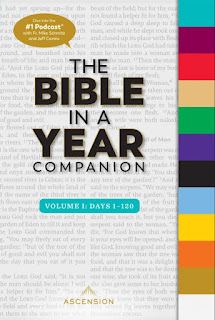
The Bible in a Year Companion Volume I Days 1-120 - Fr. Mike Schmitz and Jeff Cavins - Ascension Press

The Bible in a Year Companion 
Volume I Days 1-120
ISBN 9781950784998
eISBN 9781954881013
ASIN B09R661LR8


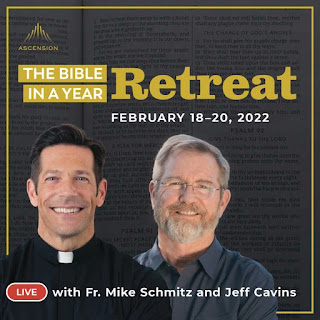
I completed the Bible in a Year in 2021. Then early in 2022 I attended the The Bible in a Year Retreat, and absolutely loved it. When I found out about the three volumes of companions for the Bible in a year I picked this volume up right away and keep my eye out as this one was nearing completion for the second volume to be available. These volumes make the Bible in a Year an even better experience. 

The description of this volume states:

“The Bible in a Year Companion guide takes Catholics through the award-winning podcast The Bible in a Year (with Fr. Mike Schmitz)™ including daily summaries, transcripts of Fr. Mike’s daily prayers, and extra content for each episode.

It’s the perfect way to remember what you’re hearing, as well as learn even more about each part of Scripture!

The Companion presents daily content for each episode of the podcast, including:

The proprietary Bible in a Year Reading Plan Summary of the key points and highlights of Fr. Mike’s commentary on the daily readings.

"Take It to Prayer", where Catholics will be able to pray the daily prayer alongside Fr. Mike and the rest of the BIY community.

Unique content surrounding each day’s readings, from images and Q&As to prayer prompts and ways to live out the Scriptures in real life.

In addition to the daily content, each time period will have a Time Period Introduction and Review. Written by Jeff Cavins, these will help Catholics to know what to look for in the days ahead, and to recall what has happened in the days completed.”

And father Mike states at the end of the introduction:

“I believe that this Bible in a Year Companion is a great tool to take you deeper. It is one thing to be exposed to the Story, but it is another to remember it. This Companion will help those who are so quick to forget—which is all of us! … In this world, where we are so tempted toward distraction and distress, we now have a resource to understand how the story of salvation unfolds and how we can fit into that story today.”

Each time period begins with an introduction by Jeff Cavins. This is where Jeff explains the colour of that period, what it means and why. He gives a brief overview of key events, people, and changes from period to period. And each period ends with a recap and summary from Jeff. Each day has a two page spread. The first page Had the Day number and title, And a section called Reflect on the Word. The Second page has the Passages read at the top and two more sections; Take It To Prayer and Dive Deeper. A sample day is:

Day 24: Tears of Joy
Reflect on the Word

• When Joseph reveals who he is to his brothers, he weeps.
• Just as a mother weeps when she finds her child who was lost, we weep during joyful moments because we know the situation could have gone otherwise.
• Joseph weeps because he knows that he could have gone the rest of his life without seeing his father and brothers again or without meeting Benjamin.
• We weep in joy because we know how fragile we are, and we know that if the Lord isn’t with us, this fragility leads to death and destruction.
• God is with us right now. So there is room in our lives for joy and tears—and joyful tears.
• What joy breaks your heart today, knowing that it could be otherwise?
• What sorrow is breaking your heart today?

Take It to Prayer

Father in heaven, we thank you, and we give you praise. Thank you so much for the gift of this day. Thank you for the gift of your Word. Thank you for the gift of revealing your heart to us, because that is what you do in your Word. You speak to us, and you continue to speak to us—even, Lord, when your Word is challenging—even, Lord, when your Word is confusing and we don’t understand what is going on and we don’t understand what you are trying to say to us. Still, you continue to speak, and we continue to listen. Give us hearts that can understand what we are hearing. Give us hearts to understand what you are saying. In Jesus’ name we pray. Amen.

Dive Deeper

What is the relationship between the stories of Benjamin and Joseph?
The stories of Joseph and Benjamin play a central role in the movement of the Israelites to Egypt, which will end up being a four-hundred-year sojourn in slavery. Joseph and Benjamin are born to Jacob’s favourite wife, Rachel, and are Jacob’s eleventh and twelfth sons. Of the two brothers, Joseph enjoys pride of place with Jacob, as seen by his father’s gift to him of the coat of many colours (or, “a long robe with sleeves”). This obvious preference leads to jealousy among his brothers, eventually leading them to sell the seventeen-year-old Joseph into Egyptian slavery. Jacob believes that Joseph has been killed by wild animals, leaving Benjamin as Rachel’s only surviving child.

Immediately before Joseph is sold into slavery by his brothers, he has two dreams—one with sheaves of wheat (see Genesis 37:5-8), the other with eleven stars (see Genesis 37:9-11), all of which are bowing down to him. These dreams foretell his brothers’ journey to Egypt during the famine seeking food and how the “eleven stars” (his brothers) will bow down to him. 
–Jeff Cavins”

This is an excellent resource. Most days I have listened to the pod cast in the morning. And then on my first coffee break at work, I read through the two pages for that day. I love praying the pray that Father Mike prayed that day, and I love the going deeper sections. I believe this is a must have resource to support your Bible in a Year journey. This is my second time through the pod cast and I see it being an annual journey going forward. If you are listening to the BIAY pick this up as a supplement to that adventure. 

Note: This book is part of a series of reviews: 2022 Catholic Reading Plan

The Bible in a Year Resources:
...

Books By Father Mike Schmitz:
Made for Love: Same-Sex Attraction and the Catholic Church


Contributed to:
Pray, Decide, and Don't Worry: Five Steps to Discerning God's Will
Don't Be Afraid to Say Yes to God! Pope Francis Speaks to Young People

Audio Talks by Father Mike Schmitz:
Living Life by Design, Not by Default
Love - Sacrifice - Trust He Showed Us the Way
From Love, By Love, For Love
True Worship
The Four Last Things
Jesus Is …
Changed Forever - The Sacrament of Baptism
We Must Go Out - The Sacrament of Confirmation

Books by Jeff Cavins:


Thursday, 2 June 2022

My Other Self - Clarence J. Enzler - Conversations with Christ on Living Your Faith

My Other Self: 
Conversations with Christ on Living Your Faith
ISBN 9780870612480
eISBN 9780870612633
ASIN B01N9C7YA3


I picked this book up for a couple of reasons. First a few people I trust and respect had mentioned that they greatly enjoyed it. And second, because Enzler’s everyone’s way of the cross is one of my favourite versions and been a mainstay since the late 80’s when it was still called everyman’s way of the cross. This year during lent I was promoting several different Stations and found out that Enzler had a few other volumes available. The preface of this volume states:

“Since the style of this book is somewhat unusual, a few remarks concerning its structure may be helpful. I have, to a great extent, adapted the mode of presentation followed by the author of the Imitation of Christ. Thus, the reader will find Christ speaking to him in intimate conversations, seeking to make him fully aware of what it means to be a Christian, “another Christ,” Christ's “other self.” 

My aim has been to unfold, as fully as I can, the meaning of union with our Lord and all that it involves both for the individual and for society. I have sought to show that the present moment is Christ's moment, the time for each individual to identify himself with the Lord and to act as Christ. If this book realizes this goal, even to the slightest degree, it will have fulfilled my purpose.”

But the book begins with a preface written by Enzler’s children, called Biographical Introduction. It states:

“We write this reflection about our dad from the perspective of being born into a close-knit Catholic family under the guidance of unparalleled parents, Kathleen Crowley Enzler and Clarence J. Enzler. They were married in Washington, DC, in 1937. Mom was a native Washingtonian; Dad, who grew up in Dubuque, Iowa, attended Columbia College and received his doctorate in sociology from Catholic University in the mid-1930s.

Our dad grew up with a speech impediment, a debilitating stutter that kept him from public speaking for many years. He eventually became an excellent speaker and International Toast Master contestant. Seemingly, his impediment spurred him on to develop excellent writing skills. He spent thirty-two years as an Information Specialist/Speechwriter for the Secretary of Agriculture. He was ordained a deacon for the Archdiocese of Washington in 1972 and served at St. Mary, Mother of God Catholic Church in the heart of Washington until his untimely death in 1976.
How does a man work overtime for the government; write four books, numerous articles, and a devotional Stations of the Cross; be involved as a leader in his parish (particularly as a member of the St. Vincent de Paul Society, where he visited and took care of the elderly and poor); yet make time to attend Mass every day and spend quality time with each of his thirteen children during each stage of our lives? His legacy is strong and powerful as a deacon here in Washington, as a dedicated civil servant and as a man of kindness and love for all. His real legacy was his devotion to our mom during their thirty-nine-year marriage and his absolute, unconditional love for each of his children.

Dad lived the words of My Other Self and he lived them well. He was a model Christian, an outstanding Catholic, a defender of the faith, a gifted and skilled writer, a fabulous husband and an unparalleled father. But most of all, he was a man of God. The word you are about to read speak of his faith, his union with the Lord and his love for Jesus. Enjoy the spiritual reflections and come to know how one man endeavored to be Christ's other self.”

The chapters in the volume are:

Foreword by Benedict Groeschel, C.F.R.
Biographical Introduction
Preface
The Priestly Prayer of Jesus Christ

Part I: THE CALL
1. The Goal of Life
2. Abandonment
3. Be What I Desire
4. Christ in Us

Part II: THE MEANS
5. Detachment
6. Virtue
7. Prayer
8. Avoidance of Sin
9. The Mass and the Eucharist

Part III: THE END
10. The Final Goal
Notes

I read each of the 10 in a sitting or two and took a few days to reflect on it before moving on. I highlighted a few passages my first time through, they were:

“Believe that I am goodness itself. Believe that I want your happiness far more than you yourself want it. Believe that I can and will give you happiness.”

“Try to realize that I see all your thoughts and emotions, all your troubles and desires. I know you far more intimately than you know yourself. I know you not only as you are, but as you have been, and as you will be; and I know all of this NOW. There is no past or future with me; there is only the eternal now.”

“Abandon your will to mine, and all that happens must speed you along the path to happiness, to holiness, to sainthood. Under my loving care, nothing can harm you. Whatever happens to you by my will is so good that the angels of heaven themselves could not conceive of anything better.”

“This moment is given to me by my Lord that I may show my love for him by uniting my will with his. I could have nothing better than this specific opportunity to serve my Creator in this particular way. This trial, this interruption, this reprimand are permitted by my Lord to strengthen me and to unite me more closely to him. This movie, this game, this program are to relax my mind, to give me joy. All these are sacraments of the present moment, gifts of God's providence. If I use them well they will increase God's life in me.”

“Do not waste these sacraments of the present moment. Order your life to my will as a good musician conforms and orders his playing to the will of the conductor. Submit to my tempo, my beat, my direction. Keep your eyes on me, as the musician keeps his eye on the leader. How else can you know my will? Turn to me often in thought, prayer, and recollection.”

“Do not spend your time in dreaming what you would do if you were someone else or in another state of life. Accept your present situation in all its circumstances. Acceptance, however, does not mean passivity. If you are sick, accept it as my will for the moment; but ordinarily it is not my will that you should do nothing to get well. Do not complain, but take reasonable measures to cure your illness. In the same way, if your present situation is unsatisfactory, accept it willingly, without complaint, for now; but strive to improve it in reasonable, common-sense ways. This is being what I desire. It is doing my will as I would have it done.”

This book was of immense value. There were times it was strange reading it and hearing Jesus speak to us directly. But that is also part of what makes this book so powerful. Because of that style and format the pieces will challenge, encourage and inspire readers. It is an excellent resource for your spiritual toolbox. 

Note: This book is part of a series of reviews: 2022 Catholic Reading Plan!

Books by Clarence J. Enzler:
Let Us Be What We Are
In the Presence of God
Some Social Aspects Of The Depression

Wednesday, 1 June 2022

John Vianney - J.B. Midgley - CTS Great Saints

John Vianney
CTS Great Saints
J.B. Midgley
Catholic Truth Society
ISBN 9781860824784
CTS Booklet B698


A few years ago, I encountered the works of J.B. Midgley and was very impressed with his writing. I worked at tracking all his books down. And it took me a few years. I now have all the volumes and after this one have 4 left to read and review. I still have a few to read but it has been well worth tracking down all 28 books by J.B. Midgley. Twenty-six of those books were for the Catholic Truth Society.  And 6 of those were from the CTS Great Saints Series. I have also read many in the CTS Biographies and also Saints of the Isles Series. And have loved most of them. I first read a book by Midgley almost exactly 4 years ago. This volume is a great read, by an excellent author in a wonderful series! 

The description on the back of the book is:

“For over 40 years John Vianney was the parish priest of Ars, near Lyons, France. From modest farming stock and poor at his studies, he overcame many obstacles to become a priest, and to care for his neglected flock. His holiness, preaching and sanctity drew endless numbers of pilgrims. His fame in his own lifetime matched that of a modern day Mother Teresa or Padre Pio. This highly informative booklet reveals the real person behind the famous Cure d’ Ars, and his boundless love for Christ.”

The chapters in this booklet are:

Patron of Parish Priests
Formative Years
Priesthood
Parish Priest of Ars
Dedicated preacher
Pilgrims come to Ars
Good and Faithful Servant
Writings: from his ‘Catechism on the Priesthood’
Writings: from his Sermons

This is one of 10 biographies that Midgley wrote for the Great Saints Series, just over a third of his books were in this series. He does a great job with hagiography. This volume is split in almost three equal sections, the first part is history and set up, the second is his life in ministry and the third is excerpts from his surviving writings and sermons. While reading this booklet I highlighted many passages, they are:

“John Vianney is the patron saint of Parish Priests and the only one to be canonized.  In her human manifestation the Church is passing through an era when, again priests undertake their parish mission single-handed, and when reduced attendance and shortage of vocations threaten parishes with closure or amalgamation.  John Vianney’s story illustrates the essential excellence of the priesthood upon which Christians depend, and it seems an appropriate time to avail ourselves of his eager intercession with confidence.”

“The Vianney family was a splendid example of the farming stock that had provided the backbone of the country.  For generations, they had held their farm that lay on either side of the river Rances at Dardilly, a pleasant, well-wooded village in the Rhone province about eight miles from Lyons, a major city of central France.”

“Pierre was an exemplary Catholic and his wife Marie a model of religious conviction and piety, with a love of prayer that she transmitted to her children.”

“The Revolutionaries had adopted an anticlerical programme that led to the closure of churches unless they were served by priests who swore allegiance to a State Church.”

“The Reign of Terror in Paris touched even Dardilly where intrepid Catholics like the Vianneys went to remote farms visited by loyal priests who risked their lives to celebrate Mass for the faithful and administer the Sacraments.”

“He first received the Blessed Sacrament at a secret Mass celebrated in a house in Ecully behind windows that were shuttered so that no candlelight could be detected from out side.”

“Stripped of wealth and power, the Church in France now concentrated on her fundamental mission to preach the Gospel and serve the people in fidelity to Apostolic teaching.”

“The Sulpicians regarded themselves as educators as well as guardians of souls, and followed a schedule of prayer, spiritual conference and study.  Their Society became identified with the revival of parish life, the reform of seminary education, the nourishment of the spiritual life of the clergy, and inspired saints like John Eudes and John Baptist de La Salle.”

“After ordination and the joyful celebration of his first Mass, John was appointed curate to Father Bellay who had helped him so much on his journey to the priesthood.”

“Almost immediately, he demonstrated remarkable qualities in the confessional where he gave earnest and encouraging advice to those who came to the Sacrament of Penance and Reconciliation in increasing numbers.”

“His unwavering faith in God’s providence gave him a certainty this his flock would return to traditional practice of the Faith if he himself did penance on their behalf.”

“He maintained that if suffering were accepted properly and willingly, it would be rewarded even in this life.”

“In addition to his own penitential self-denial and preaching, he gave every attention to the importance and dignity of the Liturgy and appropriate ritual.”

“Personal austerity inclined him to speak about death, judgement and hell, and he was so dedicated to saving souls that details of moral teaching were presented without compromise so that the least learned in his congregation would understand.”  

“As far as John was concerned, the important thing to remember is that the truth of Catholic theology remains constant.”

“He spent long hours in the cold sacristy preparing his sermons with meticulous care, pausing only to go and pray before the Blessed Sacrament.  Composition did not come easily to him and required an enormous effort.  What he wrote he learned by heart and, late on Saturday nights he rehearsed his delivery aloud in the graveyard, sometimes to the alarm of passers-by.”

“As the years passed, the severity of tone moved to a gentler reminder of the dogma of Divine Mercy, so that all should be aware of the personal and unconditional love that God has for them.”

A few quotes from his writings:

“The father and mother of a family serve God by living with their children and nurturing them in a Christian way, and a servant does not have a problem in serving both God and his master. Serving God as a way of life does not conflict with our responsibilities; on the contrary, it means that they are much better fulfilled””

““Not to be tempted is the greatest of all evils because then there is reason to believe that the Devil is already regarding us as his property. He concentrates on tempting those souls who are in a state of grace, and those who wish to abandon sin. The rest already belong to him and he has no need to tempt them.””

I had previously read Saint John Vianney by Elizabeth Marie Dedomenic and Ben Hatke from the Encounter the Saints Series Book 11 from Pauline Books and Media. It is geared for a younger audience but has many of the same examples as this volume. This book was an excellent read. It was hard to put down once I started. The Cure of Ars is a fascinating man. He had great faith and devotion. And also worked hard. The examples of his working as engineer, designer and builder for the school and orphanage specifically highlight his willingness to do what needed to be done. His schedule was amazing. 5 Hours sleep on a pallet and work and pray all day evening and night. And this biography is a great introduction to this Great Saint. Another wonderful work from the masterful pen of J.B. Midgley and from the Catholic Truth Society!

Note: This book is part of a series of reviews: 2022 Catholic Reading Plan! For other reviews of books from the Catholic Truth Society click here.


Books by J.B. Midgley:

Advent & Christmastide with the Saints
Antonio Rosmini
Benedict - Patron of Europe
Bernard of Clairvaux – CTS Great Saints
Charles Borromeo  - CTS Great Saints
Companion to St. Joseph
Companion to the Feasts of Mary
Companion to Saint Peter
Companion to Saint Paul
Companion to the Angels
Companion to the Feasts of Our Lord
Companion to the Passion of Our Lord
Dominic - CTS Great Saints
George: Patron of England - CTS Great Saints
Dewi Sant: St David Patron of Wales
Francis de Sales – CTS Great Saints
John Baptist de La Salle – CTS Great Saints
John Vianney – CTS Great Saints
Lent with the Saints
Nurturing the Young
Robert Bellarmine
Saint John the Baptist 
Stations of the Cross and Resurrection with the Saints
The Eucharist with the Saints
The Four Evangelists
Thomas Becket – CTS Saints of the Isles
Vincent de Paul – CTS Great Saints
Witchcraft, Sorcery and Magic


Contributed to:
First Fridays and First Saturdays The Devotions Explained 
...

Books in the CTS Great Saints Series:
Antonio Rosmini - J.B. Midgley
Bernard of Clairvaux - J.B. Midgley
Benedict Patron of Europe - J.B. Midgley
Charles Borromeo - J.B. Midgley
Dominic - J.B. Midgley
Elizabeth of the Trinity The Great Carmelite Saint - Jennifer Moorcroft
Francis de Sales - J.B. Midgley
Gemma Galgani Gem of Christ John Paul Kirkham
George: Patron of England - J.B. Midgley
John Baptist de La Salle - J.B. Midgley
John of the Cross - Jennifer Moorcroft
John Vianney - J.B. Midgley
Martin de Porres - Glynn MacNiven-Johnston
Patrick Missionary to the Irish - Thomas O’Loughlin